

Журналістика даних
"They’re already here". Who brought migrants into Ukraine’s information space and how
On May 23, 2026, a rally against the recruitment of foreign workers and labor migration took place on Independence Square in Kyiv. Young men wearing masks held flags associated with a far-right community, while women stood with signs reading "Ukraine for Ukrainians" and "For a White Ukraine". Several dozen people attended this and other rallies in cities across Ukraine. However, social media posts described them as "mass rallies across Ukraine".
By analyzing social media data dating back to 2022, we traced where the narratives about an influx of migrants from India and African countries in Ukraine came from, why they gained popularity, who amplified them in the Ukrainian information space and how, and what they led to. In our view, Ukrainian anonymous Telegram channels, influencers, and officials played a decisive role in bringing the issue to such prominence.
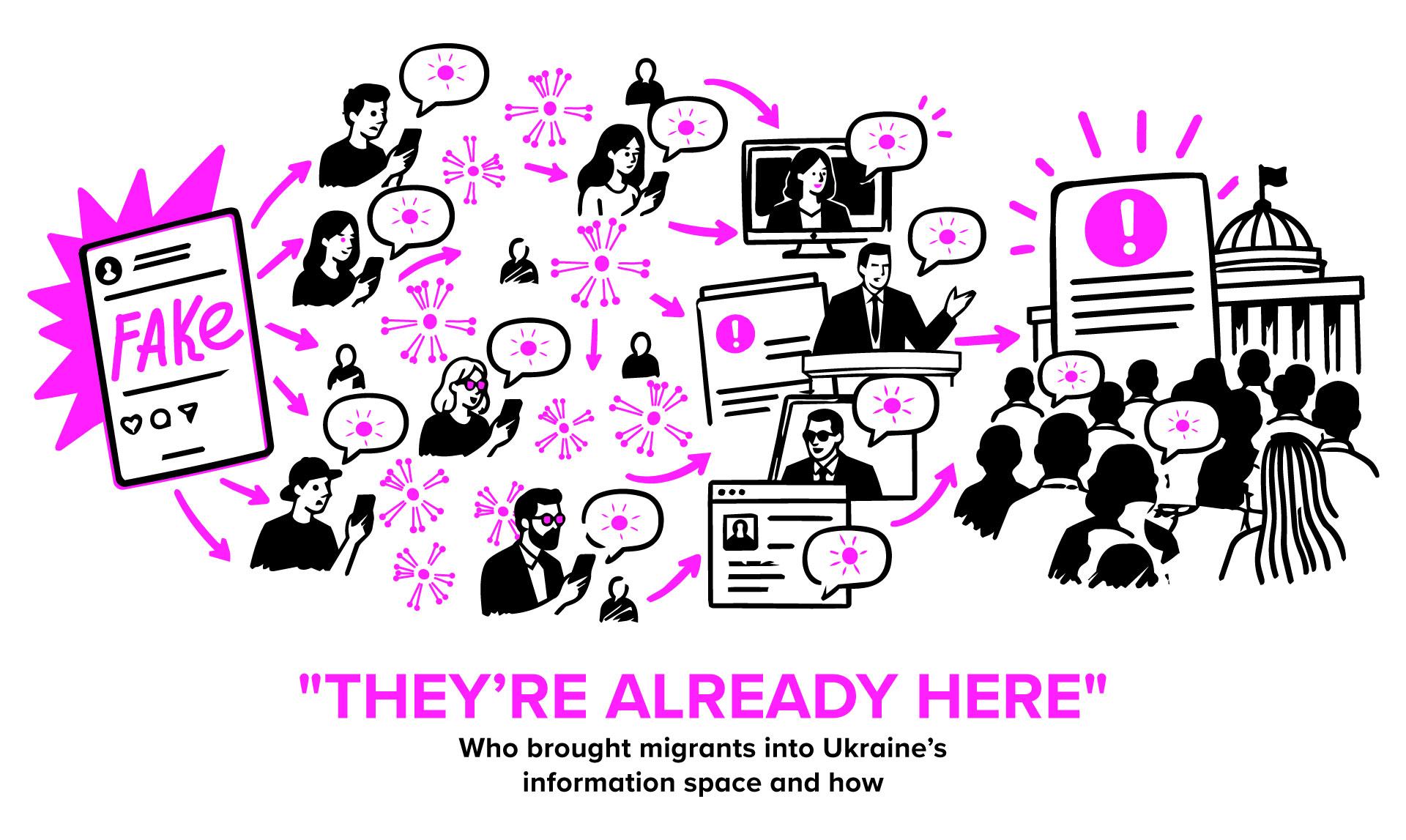
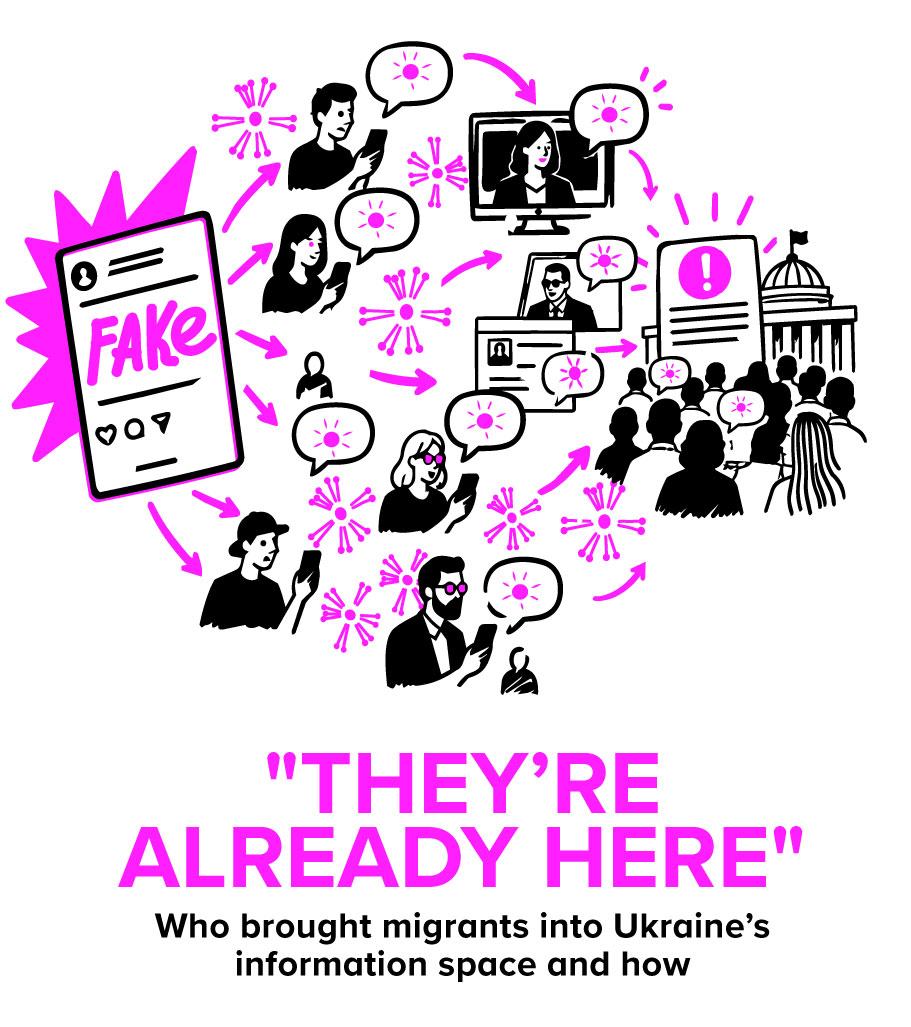
Key waves of narrative dissemination in 2023–2026 demonstrate the following techniques:
- taking experts’ quotes out of context;
- repeatedly and synchronously amplifying the same narratives across dozens of sources;
- involving controversial speakers;
- using AI-generated fakes to create the illusion of migrants being "brought in" on a mass scale where no such influx existed.
The spread of narratives related to labor migrants in Ukraine
The first destructive narratives about labor migrants spread in Facebook groups and pro-Russian Telegram channels. Through pro-Russian amplifiers and Ukrainian anonymous Telegram channels, they moved beyond the information bubble and reached the wider media and social space.
Data: posts on Telegram, Facebook, and YouTube from February 2022 to August 2026
Завантаження даних...

The issue of labor migrants spilled over into public debate as the narratives were repeated over and over and tapped into real problems: the war, a labor shortage, Ukrainians leaving the country, and a genuine expert discussion on the issue. The initiators of the information campaign used all of this to construct a malicious narrative portraying migrants as an existential threat to Ukrainians, thereby displacing the real aggressor — Russia.
The campaign to fuel anti-migrant sentiment achieved a degree of success in Ukraine thanks to Ukrainian amplifiers — from anonymous channels to military personnel and government officials. They brought marginal narratives promoted by pro-Kremlin figures into public debate at the highest levels of government.
Who and where fueled fear of migrants in Ukraine
People and platforms that amplified the narrative of an influx of migrant workers
Data: posts on Telegram, Facebook, and YouTube from February 2022 to August 2026
Завантаження даних...
We downloaded data from 25 Facebook groups and 25 Facebook pages, collected posts from approximately 300 popular Telegram channels in Ukraine, as well as videos and comments published on more than 100 YouTube channels.
Research period: February 24, 2022 — August 15, 2026.
Posts for the study were collected through keyword searches in Ukrainian and Russian. The keywords and phrases used included "migrant", "labor migrants", and "illegal immigrants".
The names of people mentioned in the posts were extracted using Anthropic’s Claude Sonnet 5 model.
The same model was also used to identify and label sources according to whether they were pro-Russian or pro-Ukrainian. The model’s results were additionally checked manually.
Methodological limitations: the study’s conclusions are based on the available data downloaded from our sample. If a news item, narrative, or text potentially relevant to the study was not captured in the sample data, we did not include it in the analysis.
The demographic crisis, the consequences of the war, and the issue of labor migration have been regularly discussed in Ukraine’s information space since the beginning of the full-scale invasion. These discussions included expert debates, interviews with academics and researchers, and attempts to assess the future needs of the Ukrainian economy.
However, the destructive campaign around labor and illegal migration to Ukraine that unfolded against the backdrop of this broader discussion bears characteristic features of Russian information operations.
It unfolded in different "waves": individual information pushes were followed by periods of silence, after which the topic returned with new information triggers, messages, speakers, and platforms.
The first manipulations began in 2023, while in 2024, the destructive narratives that had formed around the issue spilled into the information space on a massive scale.
The propaganda technique is simple: push on people’s pain points, exploit a real public debate, take a bit of truth, and add your own propagandistic ingredients.
The classic mechanics of the information operation behind the development of the migrant issue in Ukraine:
Seeding
The narrative first appears in the information space through an individual channel, account, website, blogger, or other resource. At this stage, it may remain marginal and attract little attention.
Amplification
Other information resources begin repeatedly echoing or paraphrasing the claim. Gradually, it becomes familiar and is no longer perceived as the position of a single source. This creates the impression that "everyone is talking about it".
Replication and Adaptation
The original message is reshaped to fit different news hooks and audiences: it is simplified, given an emotional tone, and supplemented with new arguments, examples, or "expert" assessments. The narrative begins to take on a life of its own in the information space.
Resonance
The claim sparks heated discussion, disputes, and emotional reactions. Importantly, people do not have to support the narrative for it to spread — even critical discussion increases its visibility.
Breaking out of the original environment
The narrative moves from social media or individual websites into the broader media space. Journalists, politicians, experts, and public figures begin discussing it.
Legitimation and public discourse
Through repeated amplification and the involvement of authoritative speakers, the issue begins to be perceived as real and socially significant. At the same time, the very fact that it is being discussed can create the impression that the problem requires an immediate solution. The narrative becomes part of the broader public agenda. It is no longer discussed only by those who initially promoted it, but by a much wider range of participants in the information process.
Impact on the political and policy agenda
At the final stage, the constructed problem may become the subject of politicians’ statements, parliamentary debates, government decisions, or demands directed at the authorities.
Now, let’s recall what happened — and how.
First attempt (Seeding)
We recorded the first attempt to play the "migration card" in the second half of 2023.
It all began in July 2023 with an estimate by Ukraine’s Ministry of Economy that the country would need an additional 4.5 million workers for its future recovery.. The figure was mentioned in the context of one of the discussions about the labor shortage in Ukraine. On social media, however, this information was transformed into an alleged government plan to bring in 4.5 million migrants from Asia and Africa.
One of the first people to manipulate the issue was Oleksandr Okhrimenko, president of the Ukrainian Analytical Center. Before the full-scale war, Okhrimenko was part of the pool of Medvedchuk-affiliated experts. As for the public activities of the "Ukrainian Analytical Center" he heads, little is known beyond the existence of a Facebook page.
After the full-scale invasion, however, Okhrimenko began presenting himself as an expert with pro-Ukrainian views. In particular, he openly supported Volodymyr Zelenskyy’s policies, gave mostly optimistic outlooks for the Ukrainian economy, and catastrophic ones for the Russian economy.
On November 29, 2023, Okhrimenko put a specific figure to the claim, cementing the interpretation of "4.5 million migrants from Asia and Africa". He called for simplifying the process of obtaining citizenship for people from Africa and Asia and said Ukraine should be open to international migration. The claim about "4.5 million migrants from Asia and Africa" would resurface repeatedly in the information space and eventually move beyond the original information bubble.
At least three Facebook groups in our sample actively amplified Okhrimenko’s claims: Hot News from Ukraine | Politics | Economy | Society | Crime (61,800 followers), Conscience and Honor of Ukraine (51,200), and Today’s News (49,200).
Alongside these Facebook content farms, pro-Russian Telegram channels also began pushing the issue of future migrant recruitment. Resident (915,000 followers), Pruf (145,000), Otryad Kovpaka (142,000), Kartel (115,000), MediaKiller (110,000), and Skeptic (25,000) promoted the narrative of an inevitable demographic catastrophe and the need to bring in migrants in the future.
Other pro-Russian influencers also joined the campaign — current "members of the Viktor Medvedchuk club" Oleksandr Shelest and Dmytro Spivak, as well as Oleksii Arestovych.
At this stage, migrants were not yet the main focus of the narratives. The emphasis was on the demographic crisis and the threat of Ukrainians "dying out" if the war continued. The audience was pushed toward the conclusion that, to preserve the population and the country’s future, Ukraine should make compromises and negotiate peace. At the same time, the only "peace" offered by the Russian authorities then and now amounts to Ukraine’s de facto capitulation.
Second attempt (Repeat Seeding)
In 2024, a conspiracy narrative began to take shape claiming that migrants would replace Ukraine’s population.
On May 6, Yuliia Mazur of the NGO Dosta, known for its anti-mobilization calls and protests, brought the issue to the attention of a Facebook group with 129,000 followers. She claimed that while "our boys, farmers, and agricultural workers are defending the country", the government was allegedly planning to bring in migrant workers from other countries: "Some are fighting and dying, while others are supposed to live on this land".
Dosta is a non-governmental organization founded in Zakarpattia that later expanded its activities to other regions of Ukraine. During the full-scale war, the organization’s activists, including on social media, shifted their focus to criticizing the Territorial Center of Recruitment and Social Support, obstructing mobilization efforts, and promoting ideas associated with the so-called "living people" movement. Journalists and investigative reporters therefore classify the organization among movements that operate in the interests of Russian propaganda to destabilize the situation in Ukraine.
Similar claims were soon promoted in sync by propagandists with large audiences:
- blogger Myroslav Oleshko ("Kuleba, Zelenskyy, and those staying away from the front while bullying Ukrainians abroad are only harming the country and will soon have Syrians among their neighbors");
- blogger Denys Yelysevych ("Will migrants take Ukrainians’ jobs?");
- pseudo-expert Serhii Yahodzinskyi ("I don't feel sorry for anyone, because migrants will live here?");
- MP Oleksandr Dubinskyi ("Ukraine needs to bring in 300,000 migrants every year. Obviously, from the poorest countries: Africa, Pakistan, India, Bangladesh, and others. Most of them are Muslims. Naturally, they will concentrate in major cities. Thus, Kharkiv or Odesa, for example, will become 'Black' within a year. Kyiv — within about three years. They certainly came up with a brilliant solution to preserving the nation").
Remarkably, Dubinskyi continues to spread fake news and Russian propaganda while in detention. He has been accused of treason, corruption, and working for Russian intelligence.
On June 1, pro-Russian Telegram channels began actively pushing an interview with Donald Trump Jr., in which he said: "It seems to me that foreign investors want to seize Ukraine’s agricultural land after the war, with migrants working there, because Ukrainians have been wiped off the face of the earth".
Recurring disinformation amplifiers
These include pro-Russian bloggers and politicians, as well as controversial Ukrainian influencers who frequently repeat claims that echo Russian propaganda. They regularly amplify and spread manipulative messages, fake news, and narratives aimed at undermining trust in Ukrainian society and state institutions.
Amplification and adaptation
On June 30, seven major Telegram channels simultaneously reported within a single day that migrants were replacing Ukrainians in many areas of employment: Resident, Sheikh Tamir, Observer, Strana, Taras Sydorets, Zapalnychka, and Slavyansk-Kramatorsk.
At the same time, Facebook posts began circulating about future "enclaves" of people from Asia and Africa: "It won’t take long, given the high birth rates among migrants who will not integrate into Ukrainian culture, society, or the linguistic environment, for us to end up with entire autonomous enclaves of Somalis, Libyans, Afghans, and Syrians!"
The narrative launched by pro-Russian channels and figures was picked up and further developed by Ukrainian far-right groups.
Historian and political scientist Pavlo Hai-Nyzhnyk linked the migration issue to theories about George Soros’s influence and the deliberate "replacement" of Ukrainians. This was prompted by Draft Law № 11405, "On Amendments to Certain Legislative Acts of Ukraine Concerning the Improvement of the Procedure for Employing Foreigners in Ukraine".
The far-right activist Dmytro Korchynskyi, a controversial figure, also joined the campaign.
At the same time, a more measured discussion of the demographic crisis and the prospects of attracting migrants continued in Ukraine.
For example, in October 2024, Volodymyr Paniotto, director general of the Kyiv International Institute of Sociology, suggested that migration from less developed countries, such as Afghanistan and African countries, could be allowed to address the demographic crisis.
The news spread on Telegram. Ukrainian anonymous channels published only the key points, while pro-Russian sources used the information to amplify their narratives.
Paniotto also said that it would be more beneficial for Ukraine to focus on bringing back citizens who had left the country rather than spending resources on integrating migrants from other countries and cultures. However, propaganda outlets omitted this part or expanded on it with their own interpretation.
It reached officials
In January 2025, news spread on social media citing the head of the Zakarpattia Regional Military Administration: a furniture manufacturer in the region was planning to recruit 160 workers from Bangladesh.
The post was followed by numerous comments on social media promoting "population replacement" claims: "The reason is an attempt by these mankurts to settle and leave tens of thousands of migrants of non-European origin in Ukraine".
Until the fall of 2024, such claims were promoted mainly on Facebook pages and in groups with questionable reputations. In particular, they were spread by a group of commenters on the anonymous "Mykola Vidlyha" page (more on it here). But by early 2025, recognizable public figures had already joined the discussion about the furniture manufacturer in Zakarpattia — both openly pro-Russian figures and controversial ones. They included former journalist Dmytro Hnap, propagandists Myroslav Oleshko and Anatolii Sharii, former MP Ihor Mosiychuk, and sitting MPs Oleksandr Dubinskyi and Artem Dmytruk.
A regular circle of influencers and platforms, along with a set of recurring claims, is forming around the anti-migrant campaign. Like ripples spreading across the water after a stone is thrown, the narrative picks up new storylines and begins to reproduce almost automatically.
In the winter of 2025, the issue of labor migrants entered a cycle of recirculation — repeatedly returning to the information space and being amplified whenever a new trigger emerged.
Bloggers & experts (often controversial figures with pro-Ukrainian views) — spread the narrative among their audiences, developing it further and dressing it up with sensational headlines and conspiracy theories.
Reaching new audiences
At the end of August 2025, one such trigger was the news about simplified border-crossing rules for Ukrainian men aged 18-22. Several employers said this had deepened the labor shortage. Officials and experts began discussing the problem, including the possibility of encouraging outward migration and attracting foreign workers.
Pro-Russian Telegram and Facebook resources immediately amplified the discussion to raise once again the issue of "replacing Ukrainians" with workers from India and Bangladesh.
For Telegram channels, the topic of undocumented migrant workers is particularly attractive because it requires no complicated explanations but provokes a strong reaction: outrage, anxiety, fear, or argument — and, consequently, views, comments, and reposts.
Channels with different audiences began posting en masse about the "replacement of the population" by migrants, the future arrival of hundreds of thousands of Asians and Africans, the extinction of Ukrainians, and even the formation of a "new identity".
On November 3, at least 45 Telegram channels shared an almost identical post citing economist Oleh Pendzyn, claiming that migrant workers from Bangladesh were already being brought into Ukraine. The expert pointed to the labor shortage and the fact that businesses had decided to address it by recruiting migrants. On Telegram channels, however, this was presented as evidence of a mass influx of undocumented migrants and used to stoke alarm.
Then an important new element entered the story — a Ukrainian military officer with his own audience.
On October 4, Maksym Zhorin, a lieutenant colonel and deputy commander of the 3rd Army Corps, wrote on his social media: "There should be no labor migrants from countries that are culturally and mentally so completely distant from us, who will come here to earn money while Ukrainians are fighting".
He had expressed anti-migration views before. This time, his statement came when the topic had already been heated up.
In this way, he became a situational ally of a narrative previously amplified mainly by anonymous or openly pro-Russian platforms.
Zhorin is a well-known combat officer with his own audience and a high level of trust. His words carry weight, and popular Telegram channels immediately used the opportunity to launch a new wave, turning migration into a prominent and contentious current issue, despite the fact that the number of migrants in Ukraine had not increased during this period. You can read about the actual number of migrants in Ukraine in our previous study here.
Military personnel
Statements by military personnel took the narrative portraying migrants as a national threat into a "new orbit", as the level of trust in their words is significantly higher than in posts by anonymous Telegram channels or statements by political bloggers.
Finally, during this period, the narrative moved beyond the internet. Anti-migrant leaflets began appearing in cities in the western part of Ukraine, visually and in content similar to those previously distributed in Russia. Petitions were also registered calling to "deny migrants jobs, social benefits, and housing", even though the government had not even discussed any plans to provide migrants with social benefits or housing.
Went viral thanks to AI
In 2026, this story gained a new lease of life — and new tools.
Previously, the narrative about migrants was spread mainly through distorted quotes, emotional posts, and manipulative headlines. Now, artificially generated content has been added to the mix.
Fake videos and images began creating the illusion that events described in posts were actually happening right before people’s eyes. Migrants, like virtual "Pokémon", began "appearing" en masse on Ukrainian streets, at train stations, on public transport, and outside businesses — everywhere they were not actually present.
This is best illustrated by the videos that went viral on TikTok. We wrote more about this in this study.
Channel: kent61310
Views: 1 300 000
Likes: 83 600
Shares: 72 100
Comments: 626
Channel: slavaport
Views: 12 600
Likes: 106
Shares: 64
Comments: 2
Channel: slavaport
Views: 88 700
Likes: 1222
Shares: 828
Comments: 23
Channel: kent61310
Views: 1 000 000
Likes: 18 700
Shares: 16 800
Comments: 835
What made this wave different was that popular Ukrainian Telegram channels also picked up AI-generated videos and images to drive traffic, often without indicating where the content came from.
Previously, there had been a lot of posts claiming that migrants were being "brought into Ukraine". At this stage, the videos and images were meant to create the impression that "they’re already here".
For example, five popular socio-political Telegram channels, including "Battalion Monaco | Ukraine | News", which has more than 700,000 followers, almost simultaneously spread a fake claiming that an alleged migrant from India was calling on his compatriots to come to Ukraine for work. The video claimed that Ukrainian men were at war and that, as a result, the country needed workers to fill various vacancies.
In a single day, 18 channels used fake images to report an alleged mass influx of migrants and claim that they supposedly receive a starting salary of $800. Another five channels spread fakes claiming that migrants were washing their clothes in Ukrainian bodies of water. In comparison, 17 Telegram channels circulated fearmongering claims that the arrival of migrants would lead to a rise in exotic diseases.
Eventually, the fakes even made their way into some regional media. For example, Pavlohrad Television and Radio Company seriously reported in one of its news segments that Indians were washing their clothes in a Ukrainian river.
In this case, we saw how a reality fabricated by propagandists displaced the real picture of the world.
The role of experts and manipulators
The campaign’s real star was Vasyl Voskoboinyk, head of the NGO Migration Policy Office. The organization’s website describes it as an association of experts in migration policy, demography, law, economics, and communications.
The Migration Policy Office may be perceived as the name of a government institution, even though it is an NGO. This gives Voskoboinyk’s comments additional weight: some members of the audience may perceive them not simply as an expert opinion, but as an expression of official government policy. Anonymous Telegram channels and other platforms take advantage of this by selectively quoting Voskoboinyk’s statements and incorporating them into the already established narrative about the "mass influx of migrants".
Manipulating expert statements and comments is a common propaganda technique that helps give greater weight to the claims being spread.
Such manipulation often drew on real statements by academics and researchers, distorted or taken out of context.
For example, openly pro-Russian Telegram channels, popular Ukrainian socio-political Telegram channels, and Facebook content farms all circulated a statement by infectious disease specialist Olha Holubovska: "Kyiv residents are threatened by exotic viruses brought by migrants and tourists from tropical countries". But this turned out to be a manipulation. In fact, Holubovska said she did not believe Ukraine was on the verge of an epidemic disaster because of migrants.
From populists to the President (public discourse)
The debate around the fabricated influx of migrants into Ukraine, fueled and amplified on social media, eventually gained such momentum that senior government officials had to respond, thereby raising the level of the discussion. Politicians entered the fray.
On April 14, Kyrylo Budanov, head of the Office of the President of Ukraine, said that Ukraine was preparing to revise the list of "migration-risk" countries, which determines the rules for the entry and legalization of foreigners. This could partially facilitate the recruitment of foreign workers amid a labor shortage. The statement became "fuel" for a new round of the information fire.
Politicians using populist rhetoric, including Dmytro Razumkov and Oleksii Honcharenko, joined the discussion. Anna Skorokhod (read more about her and the new wave of politicians who promote "the Russian world" in our study here) and Danylo Hetmantsev began talking about an influx of migrants into parliament.
Mayors, for their part, announced, just in case, that they would not allow an influx of migrants into their cities (Ihor Terekhov, Ruslan Martsinkiv, Andrii Sadovyi).
Officials and MPs
The involvement of mayors and MPs gave the issue political weight and legitimacy, significantly strengthening the campaign: claims previously spread mainly by anonymous channels and bloggers were now being voiced by public officials and perceived as a real social and political problem. MPs used claims about migrants in populist speeches and statements.
The media campaign peaked on May 11. That day, we identified more than 140 posts in Telegram channels of various kinds.
In May, rallies against labor migration were held in cities across Ukraine. Questionable individuals organized some. For example, according to investigations by journalists and OSINT analysts, the rallies were organized by bloggers — French Russophile Nicolas Ambert, Yuliia Chubarieva, Mykhailo Monastyrskyi, and Kateryna Taran — who created the "Future of the Ukrainian People" platform. You can learn more about the movement and its leaders here.
The issue eventually became prominent enough that then-Prime Minister Yuliia Svyrydenko and President Volodymyr Zelenskyy had to comment on it.
So, what was the outcome?
The campaign reached millions of people on social media, sparked a public debate involving experts and the country’s top officials, and led to a number of small rallies.
In other words, those who planned and carried out the information operation did achieve a certain degree of success. But we do not know its ultimate goal.
The most convincing signs that an information campaign has succeeded are usually changes in public behavior and attitudes, or the adoption of specific political decisions that align with the campaign’s objectives.
In our view, this has not happened — at least not yet. The issue of an influx of foreign migrant workers unexpectedly died down in August 2026. However, the narrative portraying migrants as an existential threat to Ukrainians will likely return to Ukraine’s information space and be used to heighten social tensions.
Підпишіться, щоб отримувати найкращі статті на e-mail (раз на два тижні)

Підписатися