

Статті
A war of drones. How the battle for Ukraine’s skies evolved in 2026
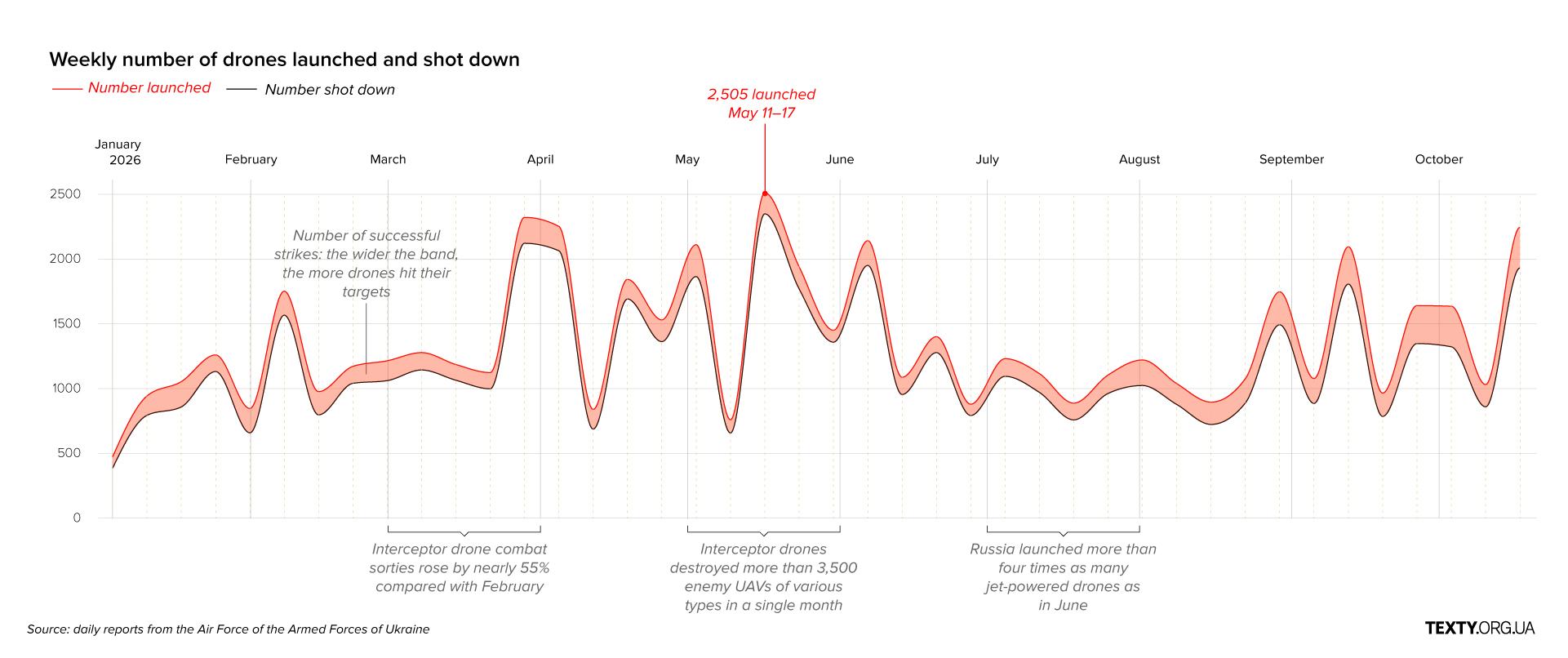
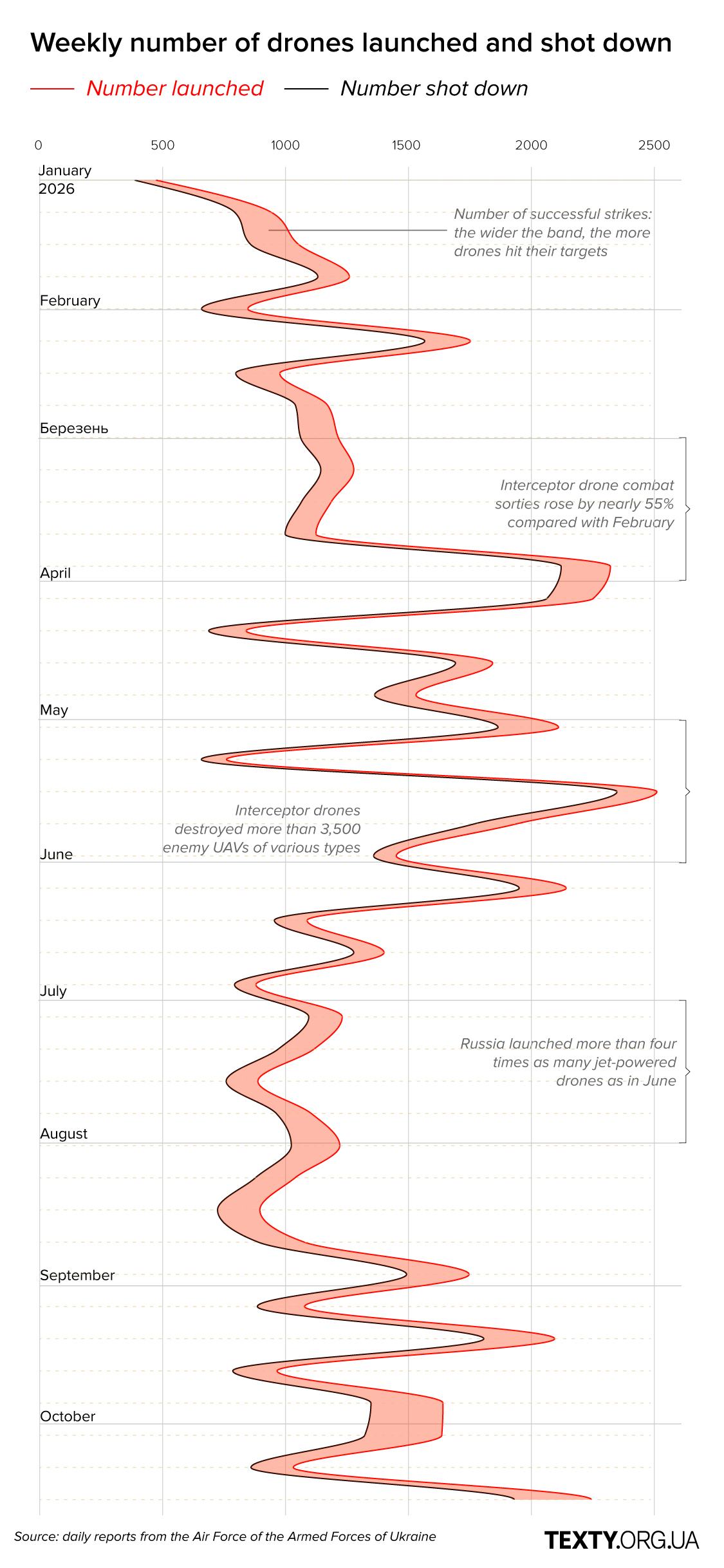
2026 has been a dramatic year, as Russia has sought to impose an all-out air war on Ukraine using drones, while Ukraine has worked to counter this threat. Texty.org.ua tracked how the gap between the number of drones launched and the number intercepted changed over the course of the year.
Russia scales up production
The year began with reports of Russia ramping up drone production. In Alabuga, Tatarstan, new buildings for drone assembly were going up at a relentless pace, with their total area increasing by 340 hectares over the year. Meanwhile, components and raw materials were arriving from China. Early in the year, a Chinese state-owned company supplied Russia with 46 tonnes of raw materials used to produce carbon fiber for drone structures.
Ukraine’s response
Meanwhile, Ukraine was rapidly scaling up a capability that would fundamentally change the nature of aerial warfare. In response to Russia’s expansion, we were increasing the number of interceptor drones. These drones had already been tested and proven in combat last year, but in 2026 the system began to work at scale.
According to Ukrainian sources, the number of interceptor drone combat sorties rose by nearly 55% in March compared with February. By May, Ukrainian interceptors had destroyed more than 3,500 enemy UAVs of various types.
The infographic shows the Russian and Ukrainian military forces going head-to-head in May. On some days, the number of Russian drones launched was staggering. Between May 11 and 17, Russia launched 2,500 drones. But Ukrainian interceptors were also shooting them down at a high rate.
The following months make it clear which side gained the upper hand: Russian activity declined noticeably.
A rapidly evolving war
But Russia was already preparing a response. This time, it was jet-powered drones. In June, Russia launched around 350 of these UAVs. By July, that number had risen to 1,500 — more than four times as many.
The infographic shows how, starting in June, the red line representing the gap between drones launched and those shot down began to widen. This means Ukraine was managing to intercept a smaller share of Russian drones. Unfortunately, Ukraine’s military and political leadership failed to anticipate this development, leaving Russia one step ahead in the technological race (read more about this in our article here). Now, Ukrainian manufacturers and the military need to refine the newly developed interceptors designed to counter jet-powered drones, bring them into mass production, and build the infrastructure needed to deploy them.
Note that interceptor drones are not the only means of shooting down jet-powered drones. Aircraft and other air defense weapons are also used. At the same time, Ukraine must continue countering attacks by conventional drones, which have recently picked up again.
The war is evolving at an extraordinary pace. The example of drones used to strike targets far behind the front lines illustrates this well, but changes are happening just as quickly in other domains and sectors of the war. As soon as Ukraine scales up its defenses against one type of threat, Russia changes its drones’ specifications and tactics. The experience of this spring shows how important it is to anticipate the enemy’s next move, quickly develop countermeasures, and take successful innovations into mass production and combat deployment.
Підпишіться, щоб отримувати найкращі статті на e-mail (раз на два тижні)

Підписатися