

Статті
Map of terror. How Russia changed its tactics in attacks on Kyiv (infographics)
Over the course of more than four years of full-scale war, Russian missiles, drones, and shells have left their mark on every district of Kyiv. Texty.org.ua has updated a database of strikes in the city, adding previously unrecorded cases of damage from strikes and falling debris through June 15, 2026. This refers only to cases reported by official sources or the media. But even this data is enough to see how the aerial terror against the capital has evolved.
Russia keeps attacking the same targets
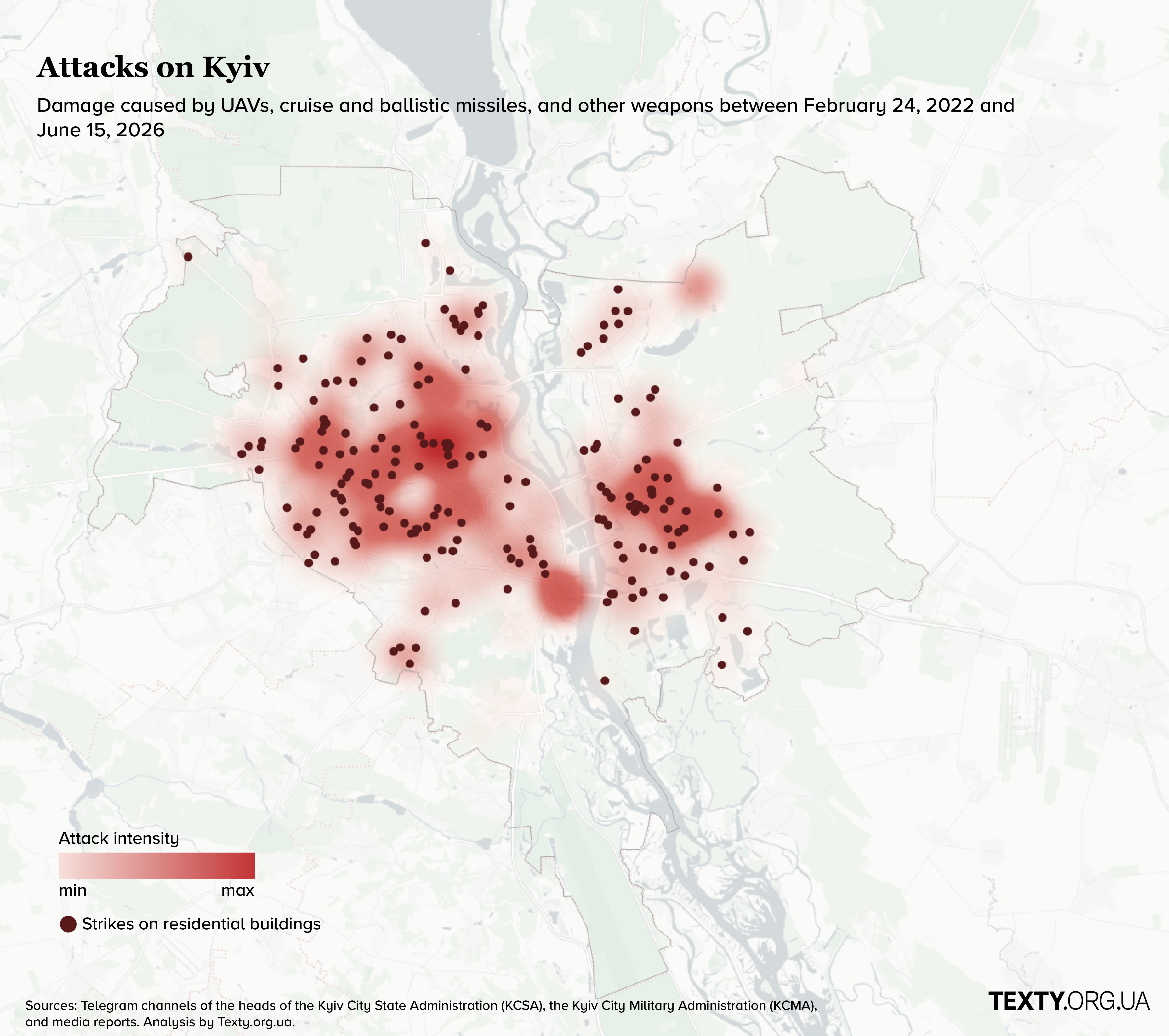
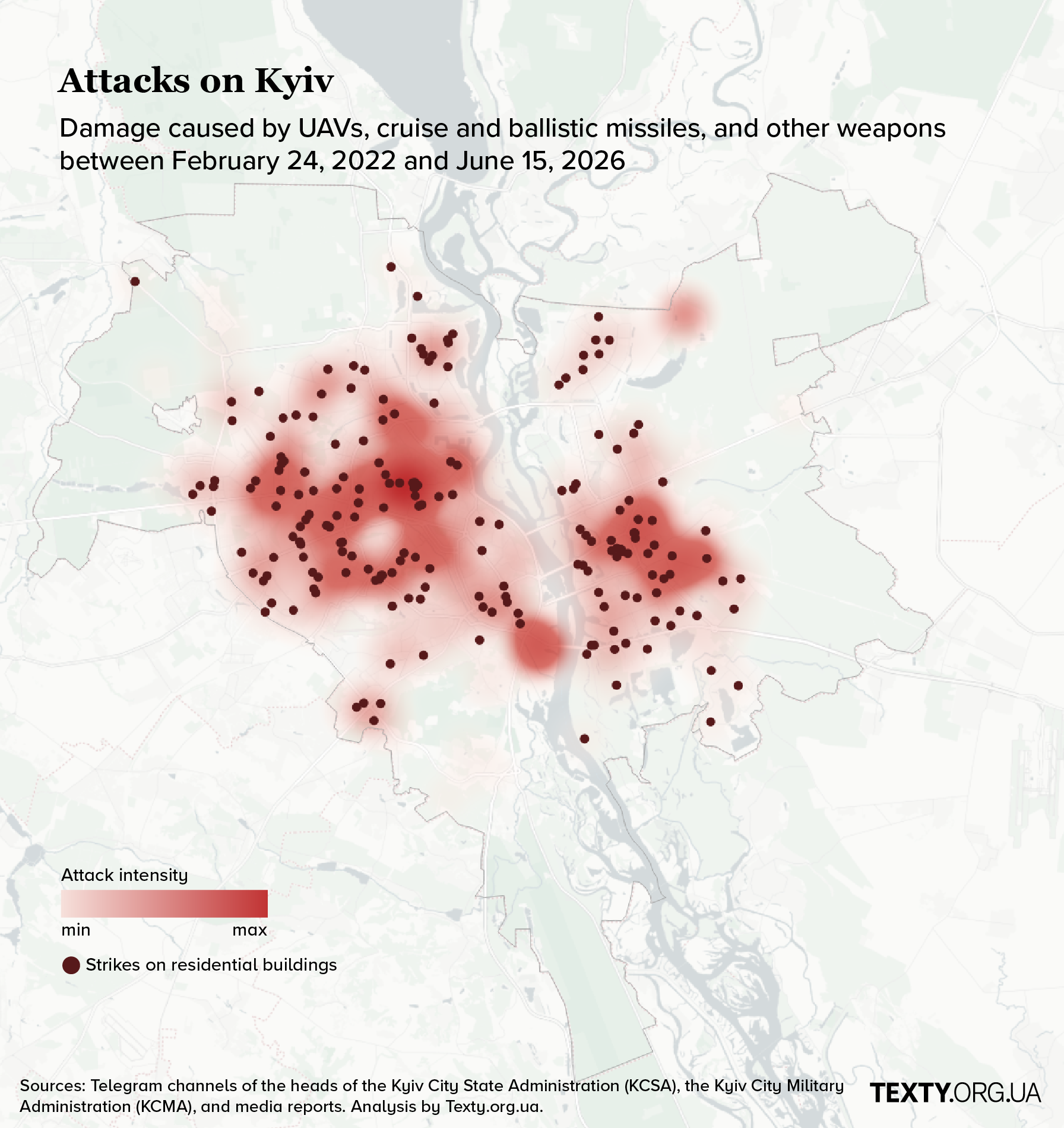
A map of strikes on the capital of Ukraine may appear random at first glance. But when all the recorded strike locations are overlaid, a very different pattern emerges. Russia returns to the same areas of the city again and again.
The highest concentration of strikes has formed on the Right Bank of Kyiv, stretching from the Lukianivka neighborhood (Lukianivska metro station) to the Solomianskyi district. Over four years of war, this area has recorded the highest number of confirmed strike impacts and instances of falling debris. A second major concentration has emerged on the Left Bank of Kyiv around the Darnytsia industrial hub. These two zones stand out most clearly when the map is viewed not by the city’s administrative districts but by the density of attacks.
This pattern is unlikely to be random. The location of major industrial facilities and critical infrastructure largely explains it. The Artem factory, other defense industry enterprises, large manufacturing sites, logistics hubs, and energy facilities remain among the targets that the Russians consider a priority. A separate category consists of energy facilities, which have repeatedly come under attack during campaigns aimed at destroying Ukraine’s energy sector.
At the same time, the pattern of attacks has shifted with the course of the war. In 2022, a large share of the strikes was linked to fighting on the approaches to Kyiv. In the years that followed, a different pattern became increasingly clear: Russian strikes have concentrated around the same persistent hotspots described above. As a result, the Kyiv districts recording the highest number of strikes have also changed over time.
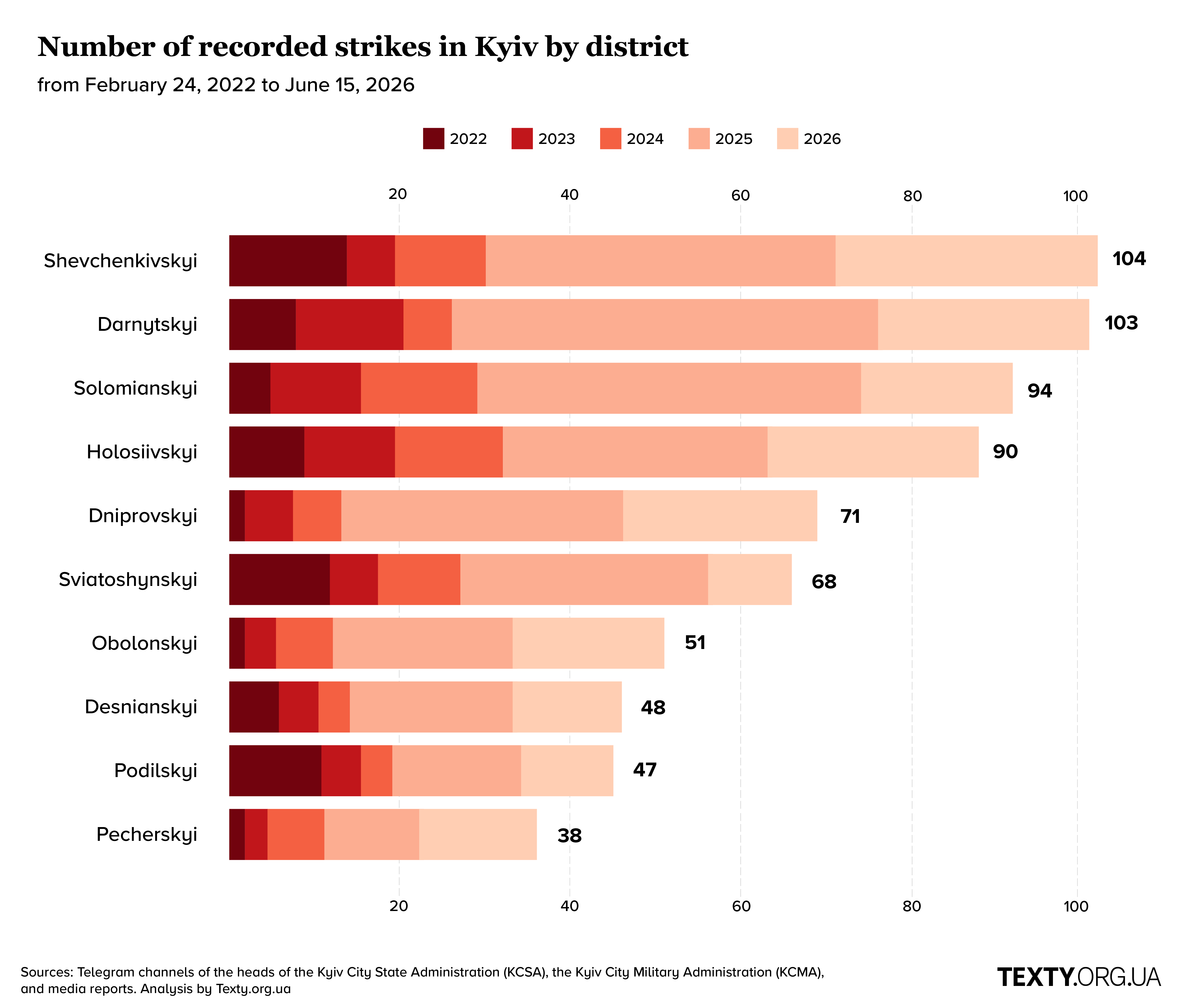
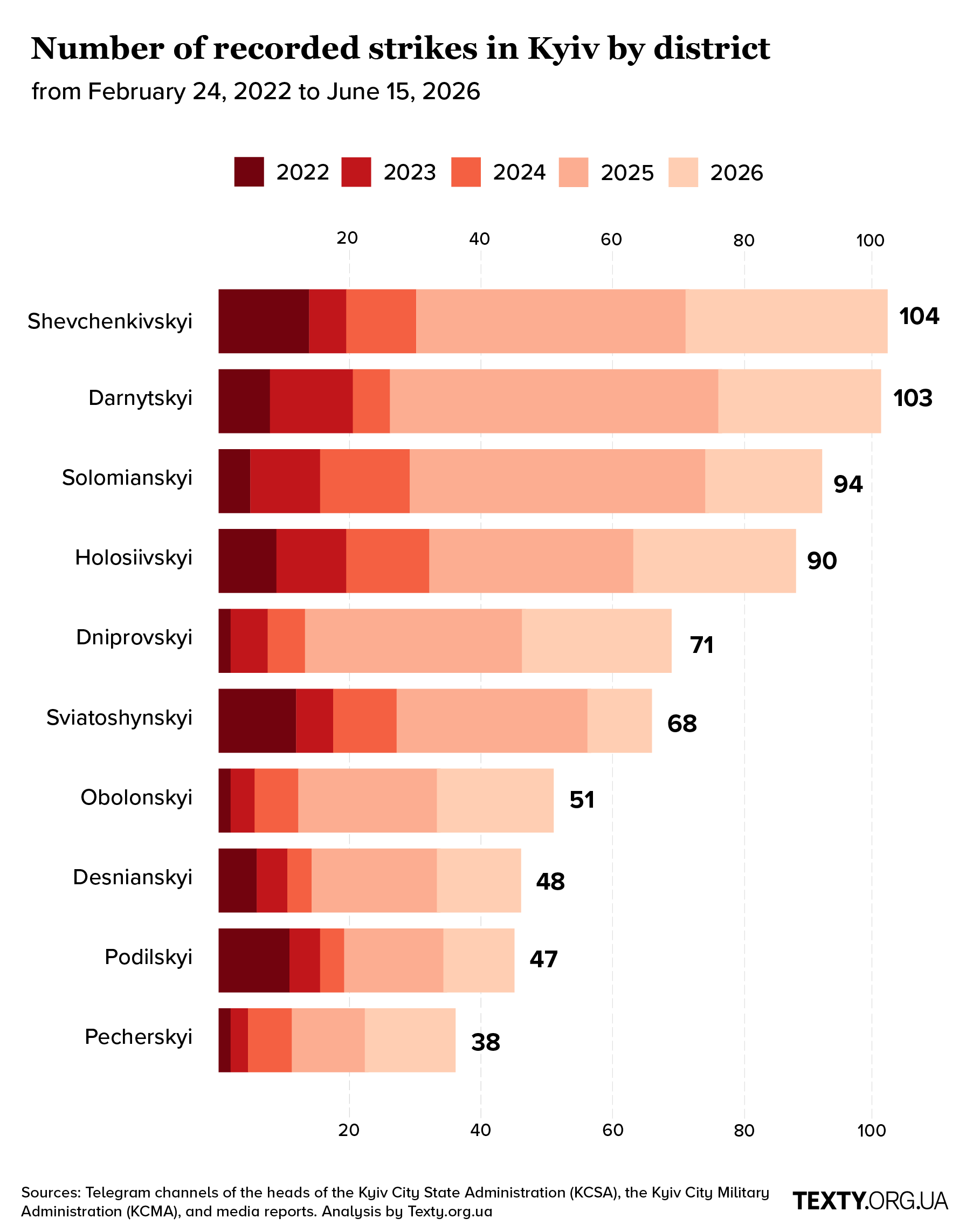
While at the start of the invasion, the Shevchenkivskyi, Sviatoshynskyi, and Podilskyi districts of Kyiv were among the hardest hit, the number of attacks on the Darnytskyi and Solomianskyi districts has risen sharply over the past two years. This is most evident in the Darnytskyi district. In 2022, only 8 strikes were recorded there, but by 2025, that number had risen to 51 — the highest of any district in the capital.
At the same time, the map shows that the area affected by the attacks has expanded significantly over time. Damage is regularly reported throughout nearly all of Kyiv.
How Russia's air campaign has evolved
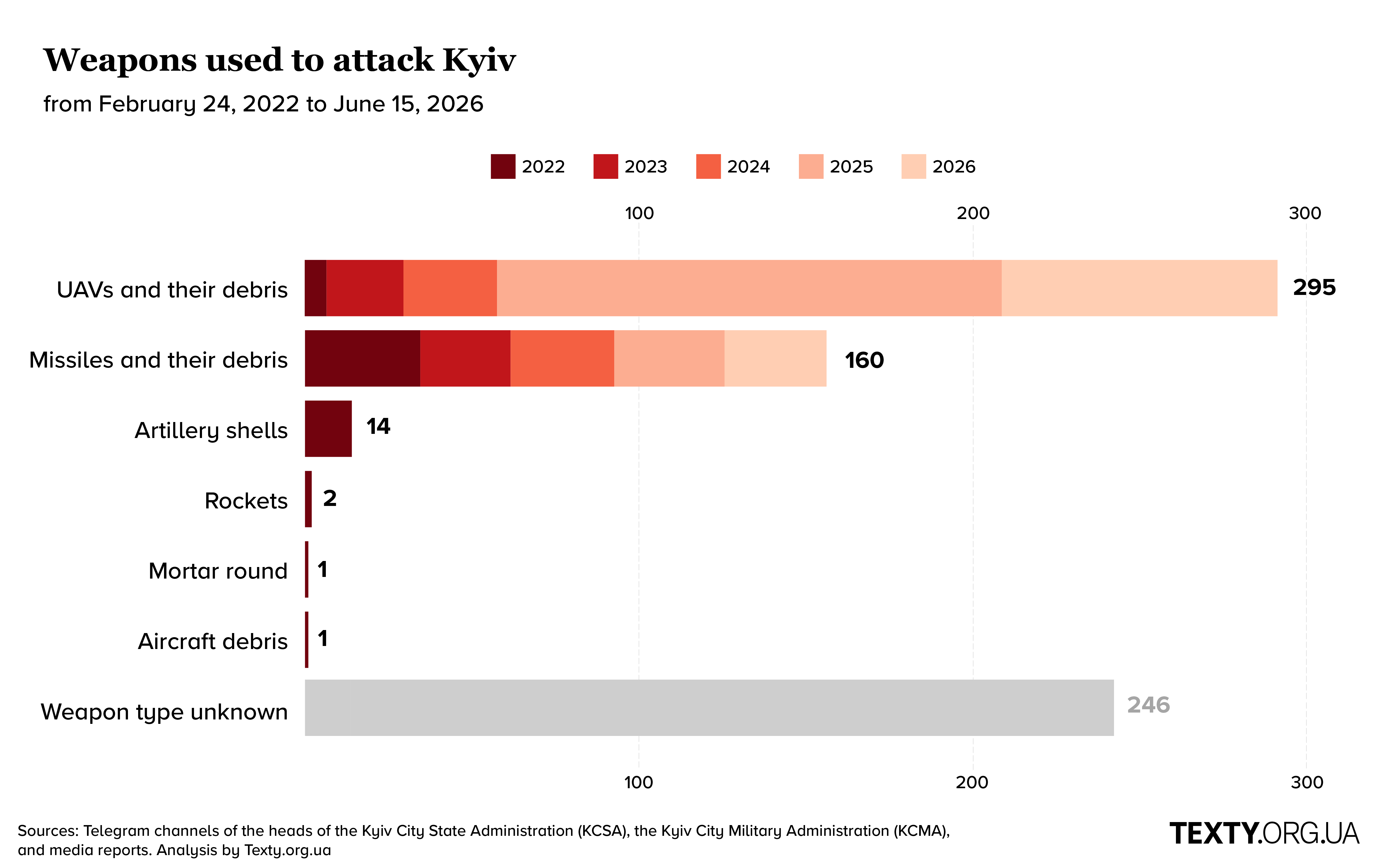
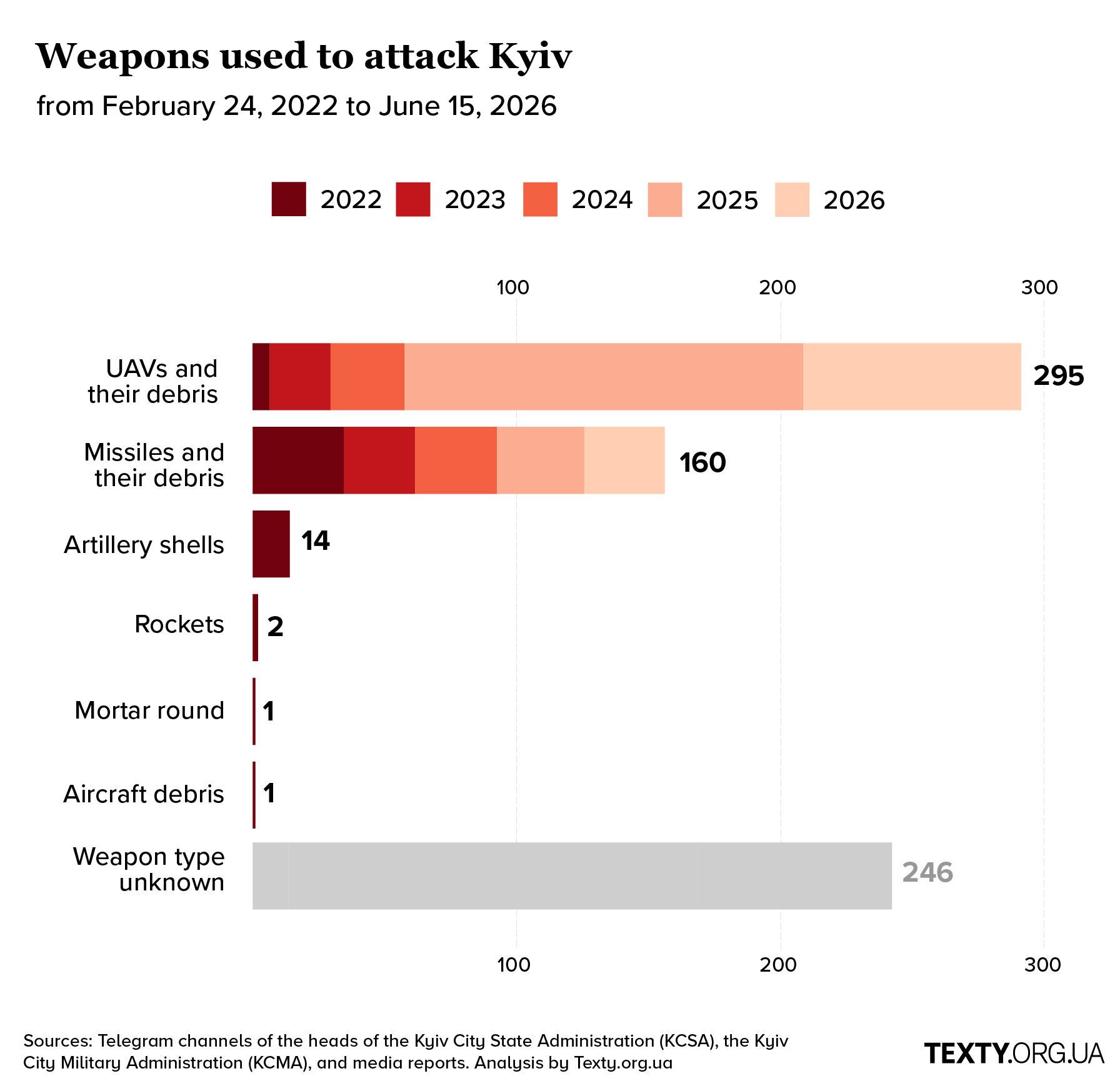
Overall, since the start of the full-scale invasion, Russia has changed its tactics for striking the capital of Ukraine several times.
The references in the infographic to shells and mortar rounds pertain to the first days of the war, when the enemy approached Kyiv.
In 2023, the main threat became massive missile attacks, during which dozens of cruise and ballistic missiles could be launched at the city in a single night.
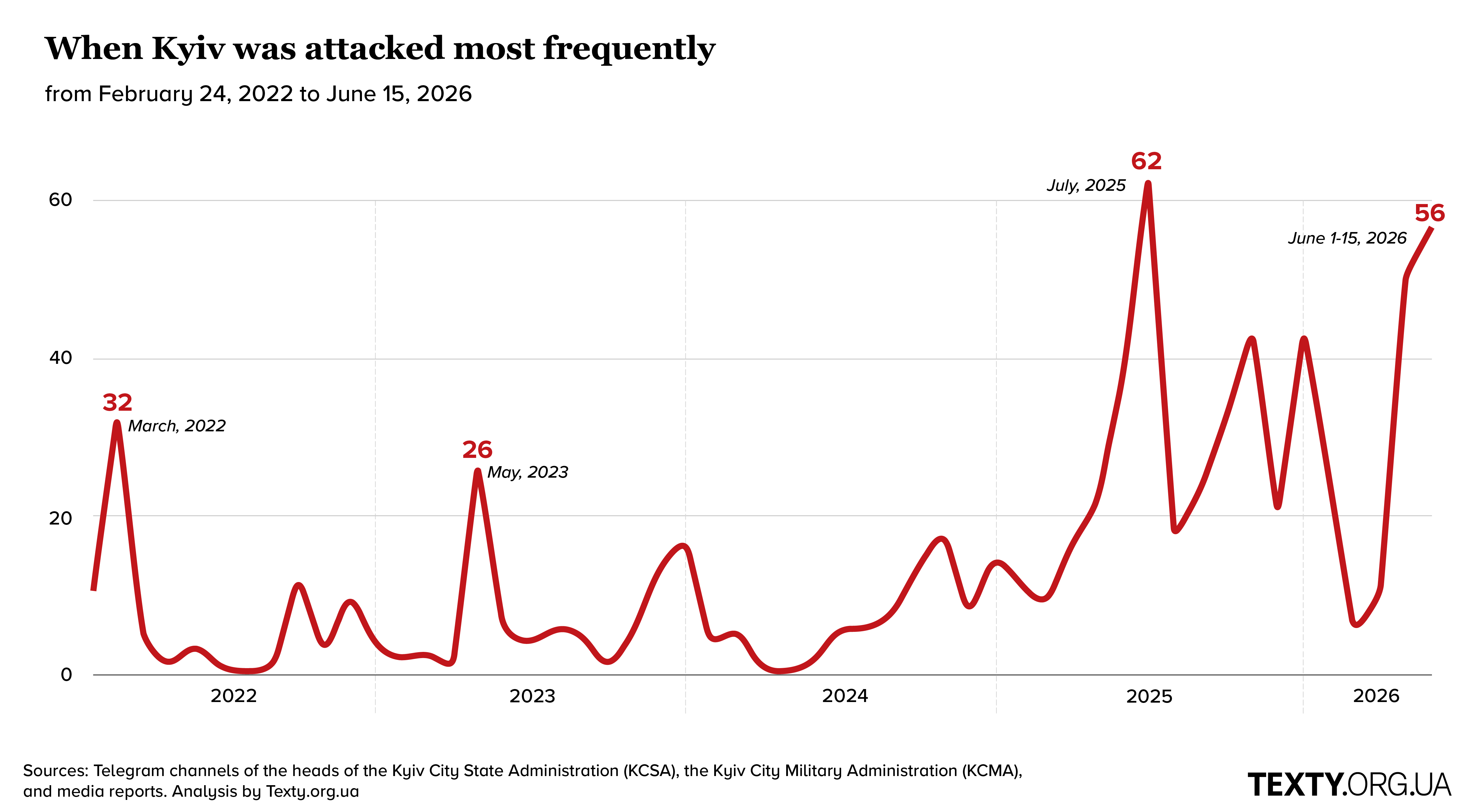
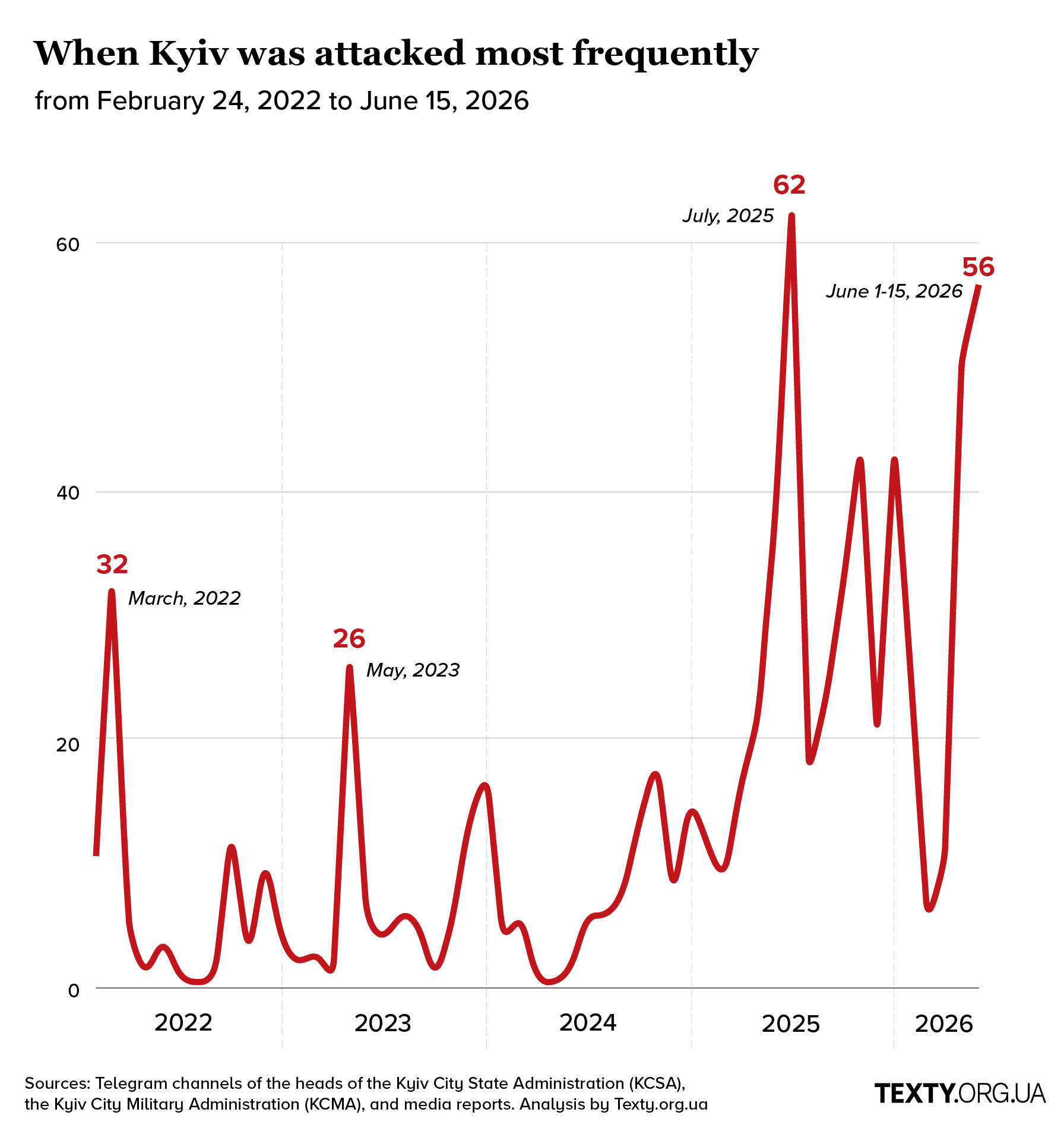
In 2025, the "campaign" entered a new phase. It was then that the number of attack drones increased sharply, and they became the primary means of striking targets. While in previous years the number of missile and drone strikes was comparable, in 2025 the number of recorded hits by drones exceeded those by missiles several times over. July 2025 marked a turning point — after that, massive drone attacks were no longer the exception but became an almost constant occurrence.
The year 2026 has revealed another shift. While in 2025 Russia relied primarily on waves of drones to attack Kyiv, the first half of 2026 saw a sharp increase in the use of ballistic missiles. In just six months, Kyiv recorded almost as many missile strikes as it did during the entirety of 2025.
In 2025, the "campaign" entered a new phase. It was then that the number of attack drones increased sharply, and they became the primary means of striking targets. While in previous years the number of missile and drone strikes was comparable, in 2025 the number of recorded hits by drones exceeded those by missiles several times over. July 2025 marked a turning point — after that, massive drone attacks were no longer the exception but became an almost constant occurrence.
The year 2026 has revealed another shift. While in 2025 Russia relied primarily on waves of drones to attack Kyiv, the first half of 2026 saw a sharp increase in the use of ballistic missiles. In just six months, Kyiv recorded almost as many missile strikes as it did during the entirety of 2025.
Escalation of terror
Although the map shows a concentration of strikes in industrial districts, an analysis of the types of targets affected by Russian attacks reveals that residential buildings are by far the most targeted.
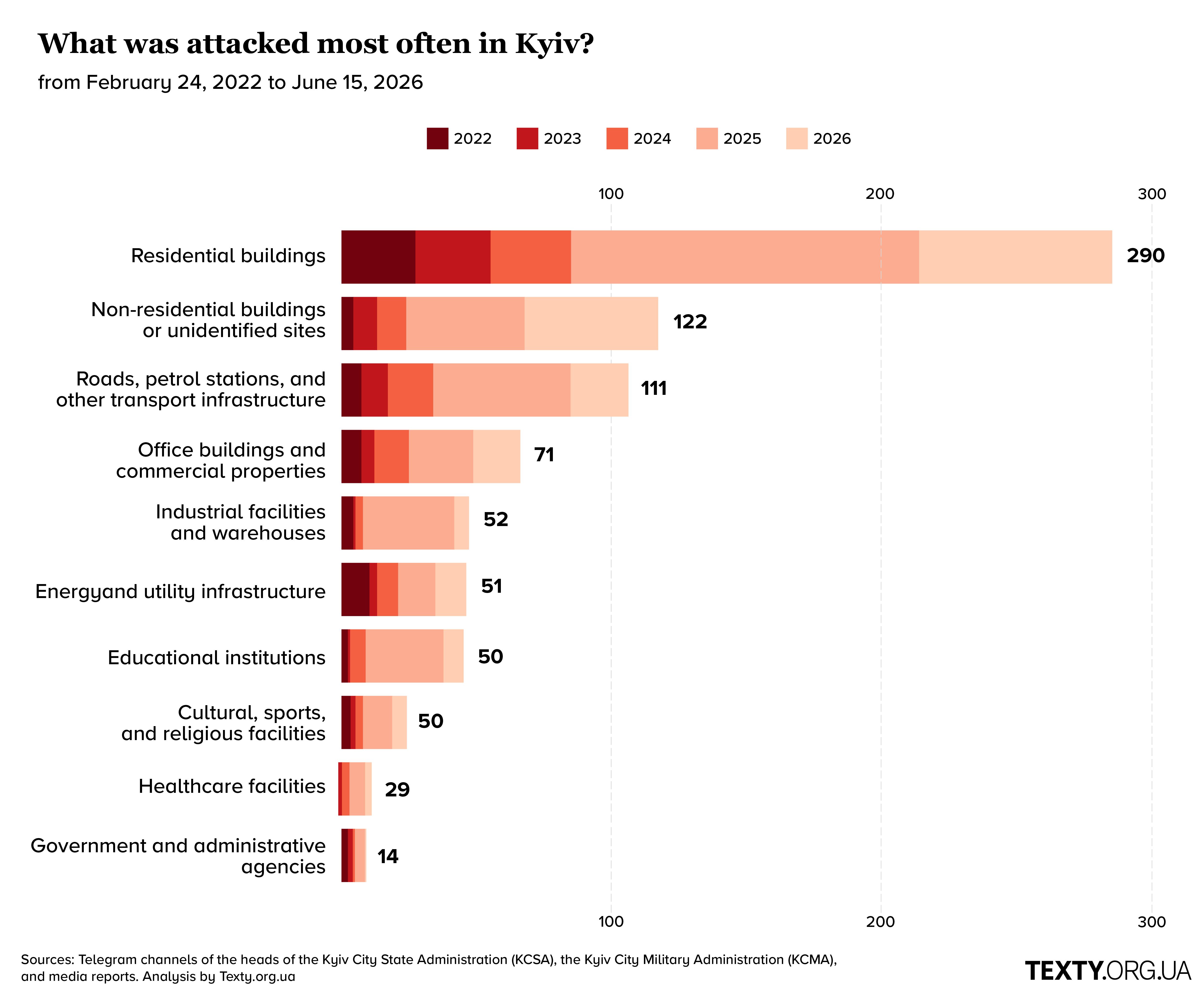
Over the four years of the war, 290 residential buildings were damaged — at least twice as many as in any other category of sites. By comparison, non-residential buildings and sites that could not be precisely identified rank second (122 cases). Next are vehicles, roads, transport infrastructure, and petrol stations (111).
This trend became particularly noticeable in 2025–2026, when the number of large-scale attacks rose sharply.
While residential buildings in Kyiv were hit about 30 times per year between 2022 and 2024, a sharp turnaround occurred in 2025. The number of strikes on residential buildings jumped to 130 — more than in the previous three years combined. And in just the first six months of 2026, Russia added another 72 such strikes. This is no longer a gradual increase, but a change in the scale of terror against the city.
Supposedly, the main targets for the Russians — Kyiv’s industrial zones and factories — cover vast areas. However, enemy missiles and drones strike residential buildings with alarming regularity, resulting in numerous casualties.
If there had been only one or two such strikes, it might have been reasonable to attribute them to error, especially since the accuracy of Russian missiles at the start of the full-scale invasion was quite low. But strikes on civilian buildings continued over time. They’ve actually become even more widespread. After hundreds of strikes on Kyiv, Russia can no longer hide behind talk of "mistakes" or "inaccuracies" of its weapons. If missiles and drones keep striking residential neighborhoods, it means that this is exactly what the Russian command intended. Terror against the peaceful Ukrainian population has become one of the methods of waging this war.
Підпишіться, щоб отримувати найкращі статті на e-mail (раз на два тижні)

Підписатися