

Статті
Russia is intensifying its campaign of strikes on Ukraine’s railway infrastructure. Infographic
Over the past few months, the Russians have launched more than a hundred attacks on railway infrastructure and rolling stock. The scope of these attacks has also expanded. The enemy is increasingly targeting not only frontline logistics but also railway infrastructure across the entire country.
The number of Russian strikes on Ukrzaliznytsia (Ukrainian Railways) facilities has increased significantly in recent times. While 72 reports of attacks on Ukrzaliznytsia were recorded between August and November 2025, there have already been 127 from December 2025 through mid-May 2026. And this is only information from open sources. In reality, there may be even more such strikes.
The enemy is increasing strikes on Ukraine’s railway system on multiple levels at once. If we view the period from December to May as a single campaign, it becomes clear that Russia attacked the network itself (rail infrastructure), the traffic on it (trains, locomotives, and railcars), and the system’s ability to recover (train stations, railway stations, and depots).
Ukrainian railway infrastructure
Russian strikes against the Ukrainian railway continue to target infrastructure above all else. This is clearly evident in the statistics. Attacks on tracks, power lines, signaling systems, and communication networks are the most widespread in nearly all key regions. The enemy is increasingly targeting key transport corridors. In other words, this is no longer simply about disrupting traffic, but about a systematic attempt to hinder movement along the most vital routes between the front lines, the rear, and export logistics.
On the maps, we show only the areas where Ukrzaliznytsia facilities were shelled, as the news does not report more specific impact locations. The data on the maps covers the period from December 1, 2025, to May 15, 2026. The data comes from open sources, so it is not entirely accurate, and some shelling may not have been included.
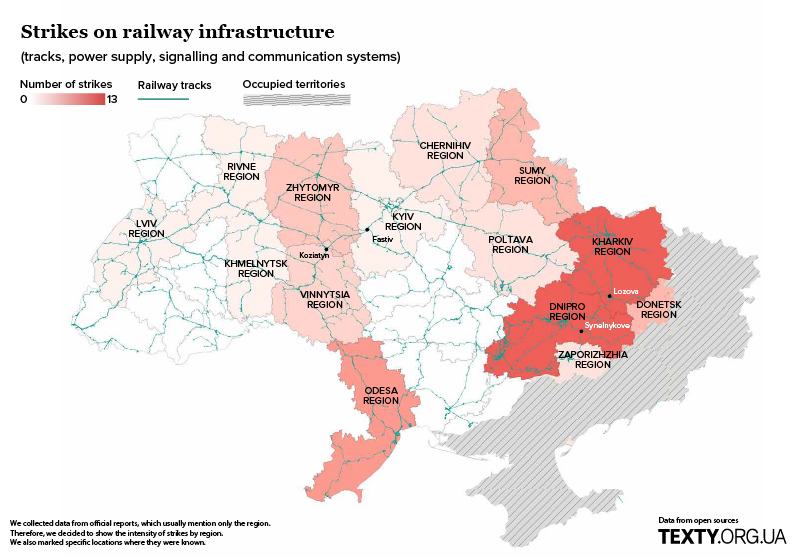
As before, the Dnipropetrovsk and Kharkiv regions are bearing the brunt of the attacks. These regions are currently the main hubs for redirecting military operations toward the south and east. As a result, they are under the heaviest attack.
Namely, Dnipropetrovsk Oblast, which is gradually becoming the primary target of Russian attacks on railway logistics. A significant portion of military, industrial, and reserve routes passes through this region. And attacks on the railway here are an attempt to strike not just a single section of track, but one of the main distribution hubs of the entire Ukrainian railway system.
Another region experiencing the highest number of infrastructure strikes is Odesa region. The enemy is attempting to inflict maximum damage on one of the country’s main transportation corridors and to isolate the southwestern part of the region.
Rolling stock
While between August and November of last year, the Russians mainly targeted tracks, signaling systems, and power lines, since December, they have been striking more frequently at anything that moves: locomotives, railcars, commuter trains, and passenger trains.
From December 2025 to mid-May 2026, according to media reports, the enemy carried out nearly fifty strikes on rolling stock. This is most evident, once again, in the Dnipropetrovsk region. The number of strikes on rolling stock there rose to thirteen, in the Sumy region to seven, and in the Kharkiv region to five. In other words, the target is no longer just the network, but the transportation system itself.
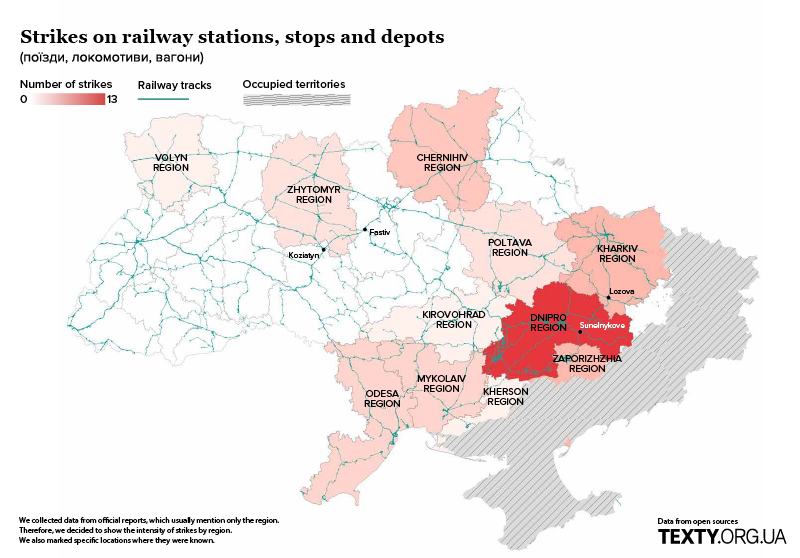
This is a significant shift in tactics because tracks can be repaired fairly quickly, whereas the loss of locomotives or traction is much harder to make up for. This is especially true in wartime, when the fleet is already operating at full capacity. In effect, the Russians have begun targeting the system’s most critical components. And while strikes on infrastructure cause temporary delays, strikes on rolling stock gradually reduce the railway’s overall capacity. This is no longer just an attempt to disrupt individual shipments, but a gradual erosion of Ukrzaliznytsia’s ability to maintain stable rail traffic across the country.
Railway stations and depots
Attacks on train stations, stops, and depots are not as widespread, but they are far more strategic. While attacks on infrastructure cause temporary disruptions to traffic, strikes against service hubs affect the system’s ability to recover quickly. This is particularly true of depots — facilities where locomotives and railcars are repaired and maintained.
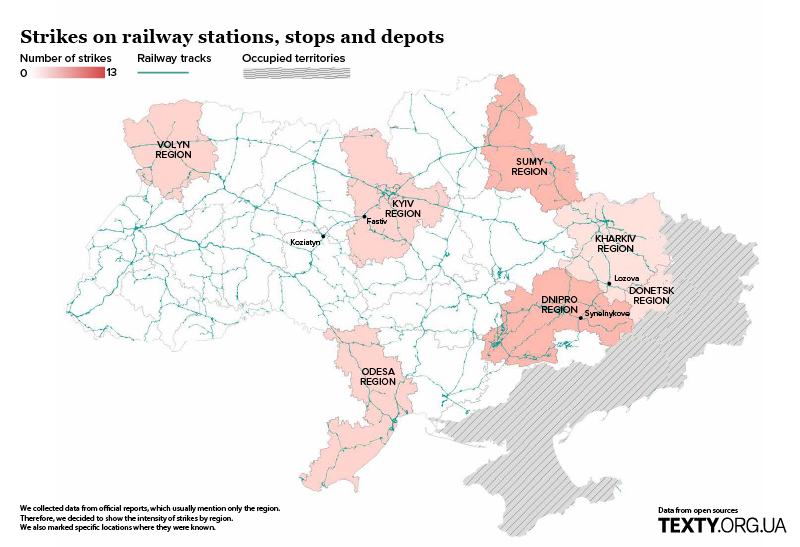
Previously, such attacks were mostly isolated incidents, but in recent months they have become part of a broader strategy. It appears that Russia is gradually shifting from tactics aimed at disrupting traffic to attempts to paralyze the entire railway system.
Expansion of Russian strike geography
As the types of targets changed, the geographical scope of Russian attacks gradually expanded. While attacks on the railway were previously associated primarily with frontline regions, central and even western regions have increasingly come under fire. This is significant because Russia is attempting to exert pressure not only on specific sections near the front but on the entire Ukrzaliznytsia network.
The thing is, Ukrainian logistics during the war is constantly being restructured. If one route is damaged, the flow of cargo, equipment, or passengers must be quickly rerouted. It is not only the corridors near the front lines that become important, but also the central hubs through which the system can bypass problematic areas.
That is precisely why attacks on central regions are of strategic importance, even when they are far from the front lines. The greater the strain on backup routes, the harder it is for the system to maintain stable traffic flow, repair damage, and quickly recover from losses.
Strikes on the western regions — Volyn, Lviv, and Rivne regions — are also telling. They are far less frequent than in the east or the center of the country, but the very fact that such attacks are taking place indicates an expansion of Russia’s campaign deeper into the rear areas. It is an attempt to cut off supplies coming from abroad, as well as Ukrainian exports heading there.
In general, Russia is trying to strike not only at what is currently keeping the system running, but also at what allows the system to adapt and recover after attacks. And this is precisely the key logic behind the current enemy strikes. In turn, the Ukrainian railway continues to transport people and cargo not because it is indestructible, but because it constantly reroutes trains, redeploys locomotives, adjusts logistics, and distributes the load among different hubs.
In fact, this is a kind of "contest" between the brute force of destruction and the flexibility of a system that seeks new ways to keep moving even after each new strike.
Підпишіться, щоб отримувати найкращі статті на e-mail (раз на два тижні)

Підписатися