

Статті
Endless cycle of Shaheds. How jet-powered drones bring Kyiv to a standstill
Jet-powered Shaheds have changed not only the duration of air raid alerts in Kyiv, but also the pattern of the threat itself. Individual drones and small groups spread out over time repeatedly force the city to come to a standstill, sometimes before it has even had time to recover from the previous alert.
Disrupted pattern of air raid alerts
As recently as May–July, air raid alerts in Kyiv still looked more like isolated episodes, with hours of relative calm in between. The threats had not yet merged into a continuous "red thread" that could run through the entire day.
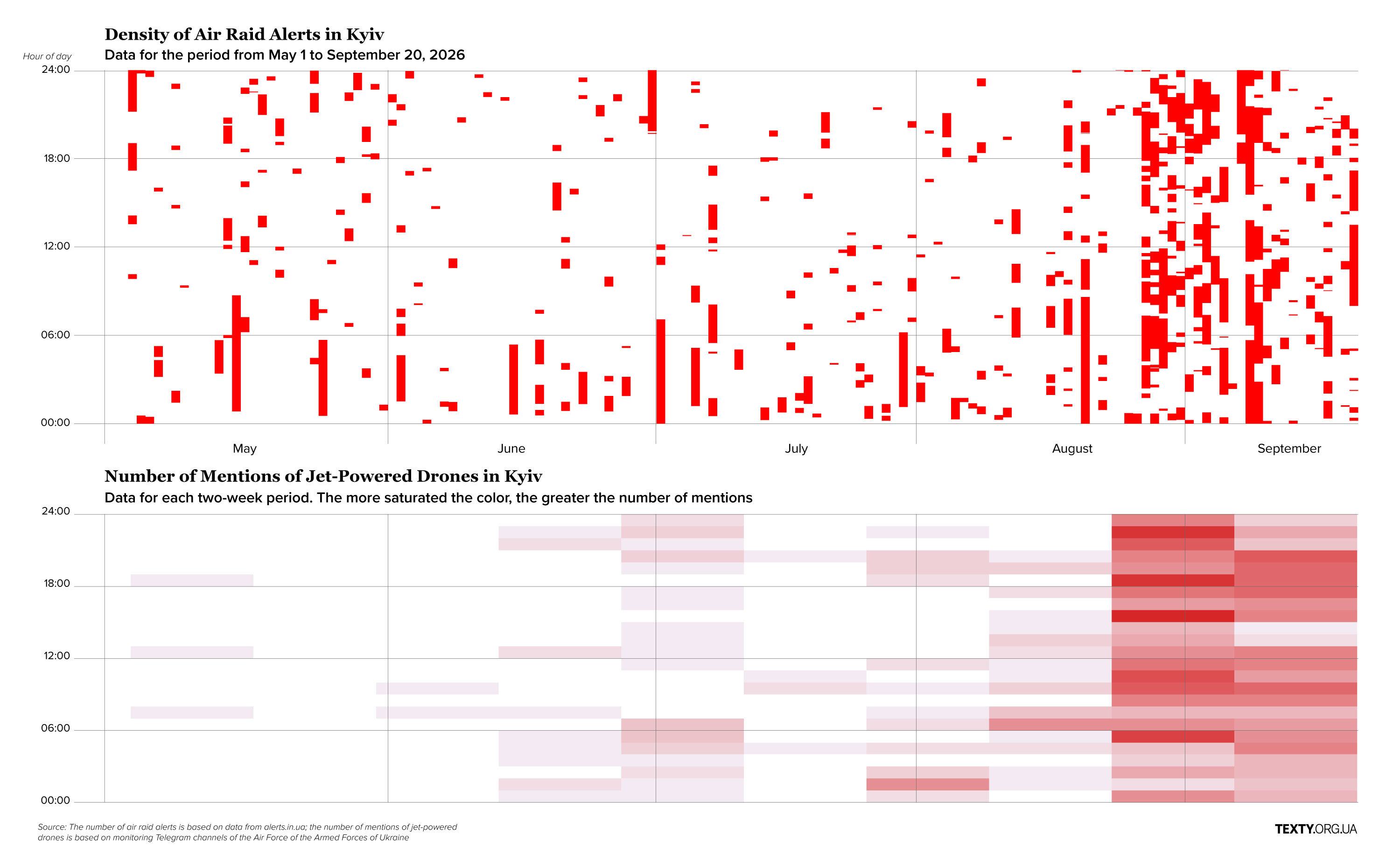
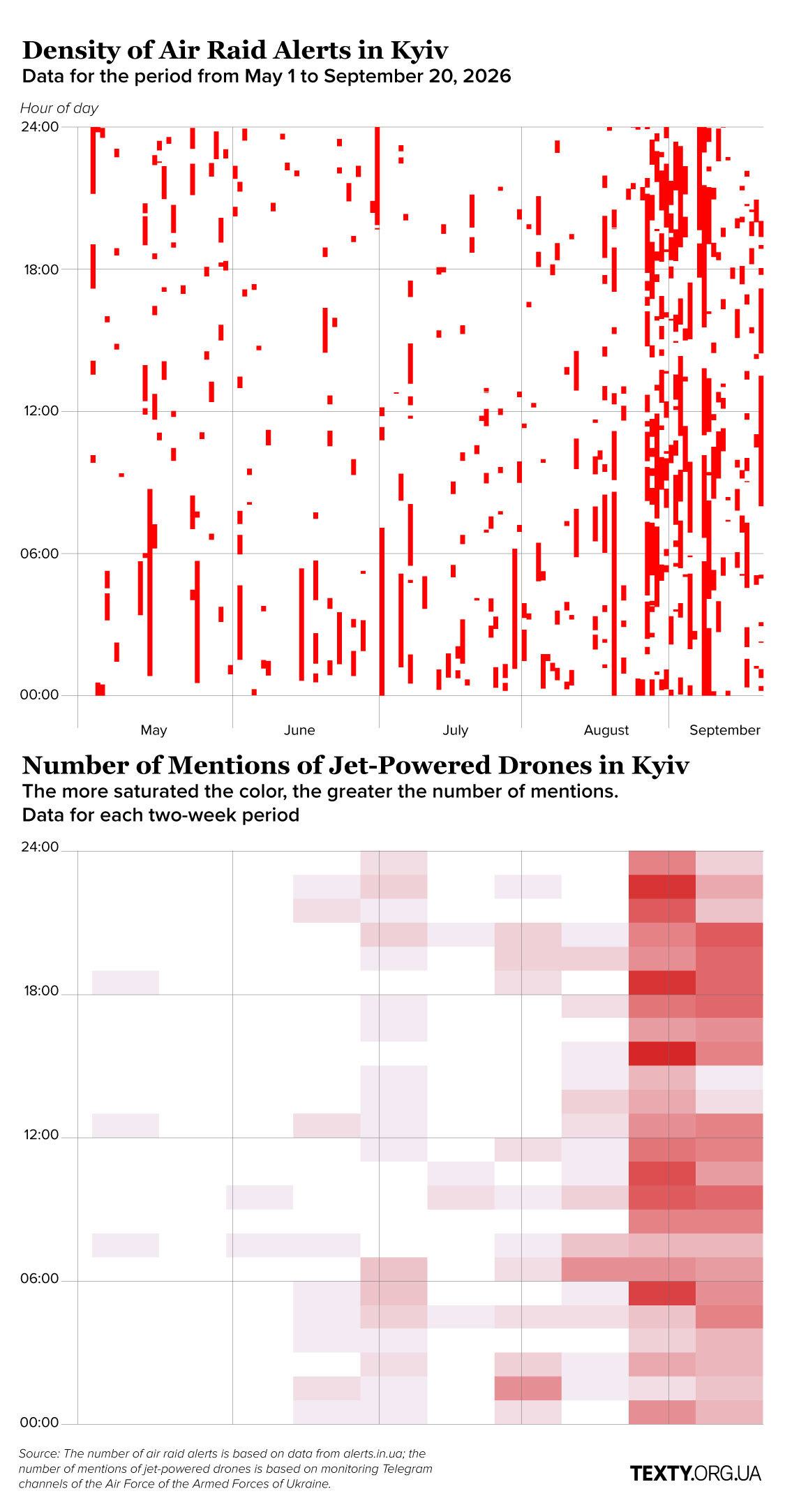
The bottom section of the infographic shows the number of mentions of jet-powered UAVs in reports from various sources
There was no sudden sharp rise in air raid alerts immediately after the first jet-powered drones appeared. At first, Russia used them individually or in small groups. On the surface, it might have seemed that nothing had fundamentally changed. But the process had already begun. The gaps between threats were getting shorter, daytime alerts were becoming more frequent, and the familiar pattern was gradually losing its periods of calm.
This shift in the timing of the alerts coincides with a sharp increase in mentions of jet-powered drones. Isolated mentions had appeared much earlier, but throughout May–July, they were not yet accompanied by a fundamental change in the pattern of air raid alerts. The real turning point came in August, when reports of jet-powered UAVs became regular.
In mid-August, the situation changed sharply. The red segments on the infographic became denser and increasingly appeared throughout the day — at night, in the morning, during the day, and in the evening. Instead of isolated red spikes, long vertical threads emerged, stretching across almost the entire 24-hour period. The city may come out of one alert only to face another soon after.
The idea of using air raid alerts to disrupt the workday for extended periods is not even new for Russia. Ukraine has already experienced endless "training flights" by Kinzhal missile carriers, with one air raid alert following another. Russia also tried to achieve a similar effect with conventional Shaheds, but their mass attacks largely remained confined to nighttime. Jet-powered drones have made it possible to extend the threat far beyond the nighttime hours.
The emergence of the first jet-powered Shaheds
The first jet-powered drones began entering Ukrainian airspace as early as the winter of 2024. One of the earliest clear references dates back to January 8, 2024. "The first Shahed-238 with a jet engine was shot down over Ukraine. The engine is Chinese. It made it to central Ukraine and was flying at more than 500 km/h (310 mph). I didn’t think they would appear here so quickly. Iran only recently unveiled it at an exhibition," Serhii "Flash" Beskrestnov (now a non-staff adviser to the President of Ukraine) wrote on social media.
At the time, this appeared to be more of a test than full-scale combat use. Over the following year, Russia continued refining the design and bringing it into operational use. New engines later appeared, also Chinese-made, with thrust vectoring capabilities. This allowed the drones to change direction more quickly and adjust their course during the final stage of flight. At the same time, Russia continued improving its designs. Eventually, under the names Geran-4 and Geran-5, Russia effectively developed drones whose speed, maneuverability, and method of deployment increasingly resemble those of cruise missiles, but at a much lower cost.
By July 2025, the first relatively large-scale use of jet-powered drones against Kyiv was recorded. According to official information, up to eight jet-powered UAVs were used against the capital.
Tool for prolonging alerts
When a jet-powered drone flies at an altitude of around 4,000 meters (13,100 feet), it is difficult to intercept it with regular air defense systems. But that is only part of the problem. Jet-powered drones are also fast. The difference between the roughly 250 km/h (155 mph) speed of a regular Shahed and the 600 km/h (373 mph) speed of a jet-powered one is enormous. The latter gives mobile teams armed with machine guns little chance of intercepting it. There are not enough anti-aircraft missiles to cover everything, while some systems are less effective at low altitudes. That leaves man-portable air defense systems (MANPADS) and fighter aircraft.
All of this has made jet-powered drones a convenient tool for another Russian objective: inflicting economic losses by keeping people under almost constant air raid alerts. Even a single hour of an alert disrupts the work of businesses, shops, transport services, and public institutions. Kyiv has one of the highest gross regional products in Ukraine. In 2021, it was estimated at nearly UAH 1.3 trillion (nearly $29 billion at today’s exchange rate). For a city of this size, continuous alerts can therefore mean losses of hundreds of millions of hryvnias a day. Russia, of course, has every incentive to exploit this opportunity.
One Shahed after another
With jet-powered Shaheds, Russia has managed, at least for a time, to create something it has probably long dreamed of: a "never-ending cycle of air raid alerts" that can, at least partially, keep the city under air raids around the clock.
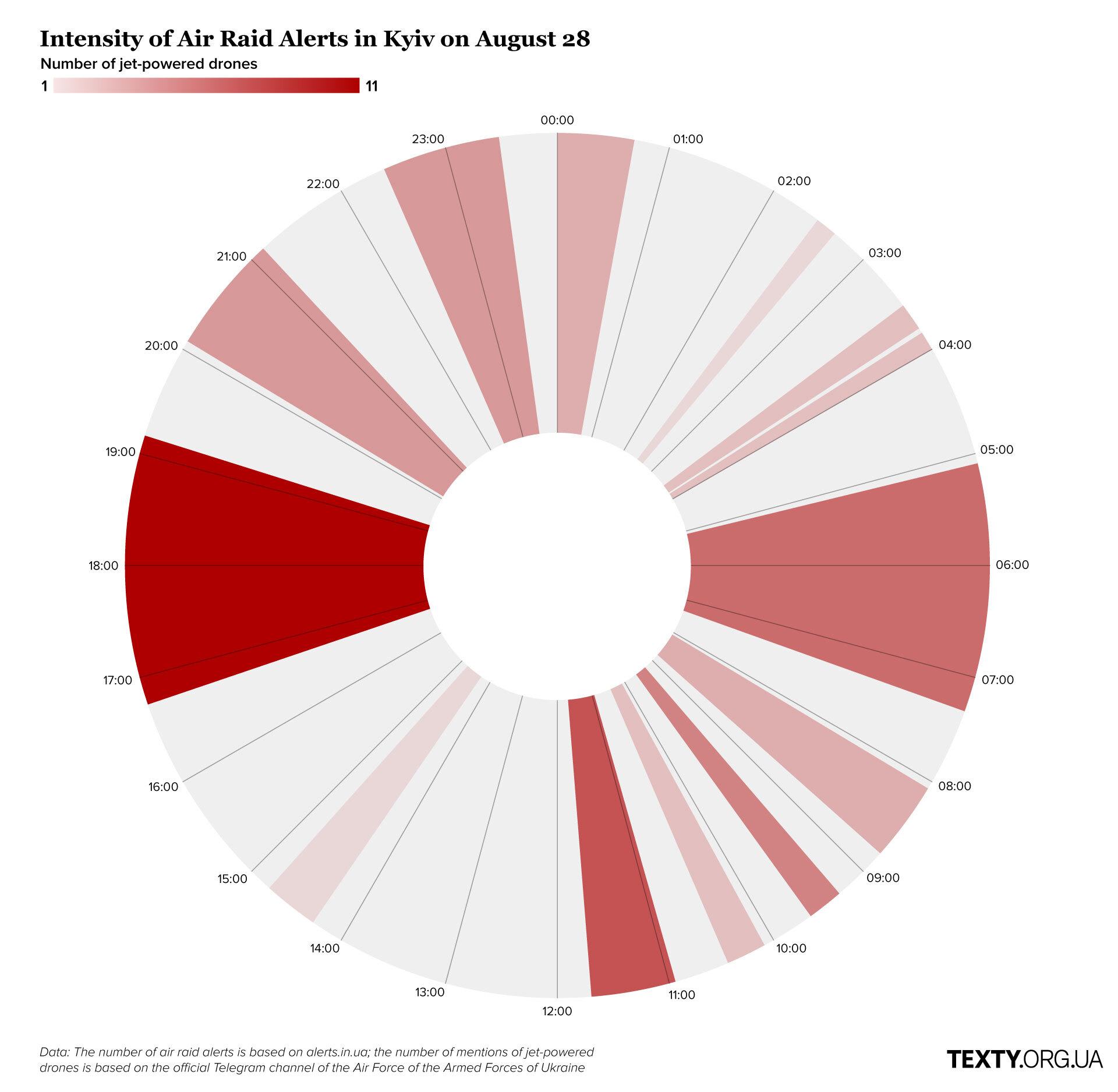
The infographic for August 28 shows how a cycle of continuous air raid alerts can unfold within a single day. The length of each colored segment corresponds to the duration of the alert, while the intensity of the red indicates the number of jet-powered drones
It works very simply: a jet-powered Shahed appears on the horizon over Kyiv, and whatever happens next — whether it hits its target, is shot down, or circles over the city before moving on — an air raid alert is issued in Kyiv. Eventually, the all-clear comes, of course, but before long another drone enters the area, and the alert sounds again. And again, and again…
An infographic shows that this effect does not always require a large number of drones. If the same drones arrived at the same time, the city would likely face one major alert that would eventually end. When they arrive individually or in small groups at intervals, each new drone triggers another cycle of the threat. That is why it is not only the total number of drones that matters, but also how they are spread out over time.
There is always a delay between the all-clear and a full return to normal operations. People need time to return from shelters, while businesses need to restart equipment and resume their work processes. If another alert is issued soon after, an institution or production facility may not have enough time to return to normal operations.
That is why the white gaps on the chart do not necessarily mean that the city is fully operational. Some of that time is spent simply getting back to work after the previous disruption. The next air raid alert may begin before that return to normal operations is complete.
Overall, this tactic ends up affecting every key part of the day — nighttime and sleep, the morning start of the workday and commuting, daytime working hours, the evening rush hour, and late evening.
The period from 5 to 7 p.m. is particularly interesting here. The enemy clearly concentrated a large number of its drones during these hours. The logic is clear: this is when the largest number of people are on the move, heading home from work.
For many people, this means commuting from Kyiv’s right bank to the left bank, putting pressure on the narrowest point in Kyiv’s transport network — the crossings over the Dnipro River. Many people have either seen or experienced firsthand moments of complete traffic chaos, when thousands of residents could not make it home because of air raid alerts. This appears to have been precisely the enemy’s aim — to launch the largest number of drones during these hours.
Erratic flight path
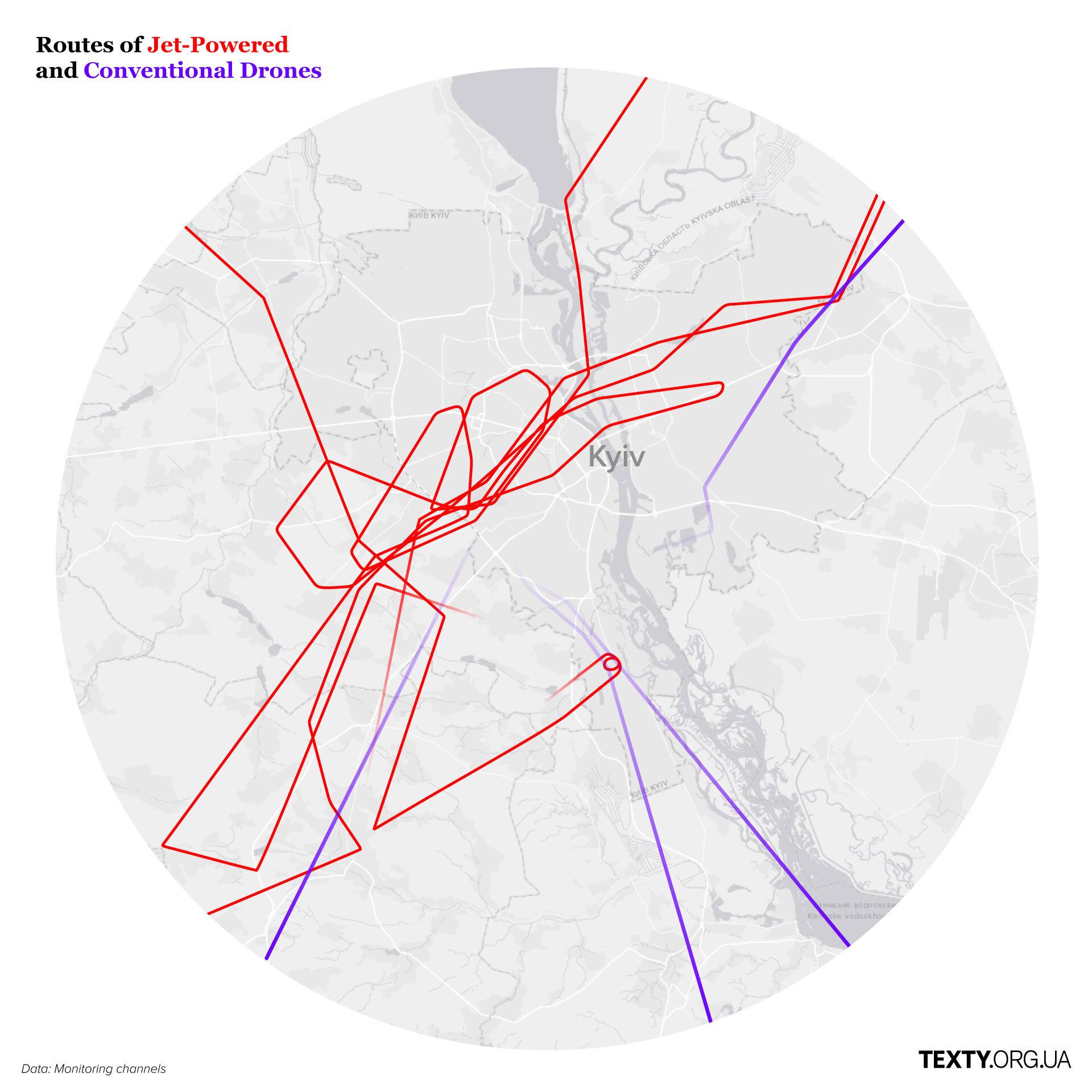
The flight paths of regular and jet-powered drones differ. Regular Shahed routes mostly consist of long straight stretches, with only a few course changes. The trajectories of jet-powered drones are much more erratic — they approach Kyiv from different directions, change course several times, and form a dense cluster over the southwestern part of the city. Even allowing for possible tracking errors, this looks like more than simply an increase in speed. It suggests a change in the flight pattern itself.
The loops and repeated turns themselves can directly affect the duration of an air raid alert. Even a fast drone that does not fly straight across the city but makes an extra loop covers a greater distance and remains in the potential threat zone for longer. As long as a target remains near Kyiv, keeps changing course, or its next direction cannot be reliably predicted, there is no reason to issue the all-clear quickly. If a drone moves away from the city and then turns back, it can prolong the ongoing alert or trigger a new one.
Navigation points may also influence these erratic trajectories, attempts to bypass air defense zones, or reconnaissance. But for the city, the practical consequence is just the same. The longer a drone maneuvers within the threat zone and the less predictable its route, the longer it takes for the system to determine that the danger has passed and, accordingly, issue the all-clear.
To sum up, the negative impact of Russia’s use of jet-powered drones is clear. Russia has gained a relatively cheap tool for striking targets deep in Ukraine, including Kyiv and Kyiv region. But a jet-powered drone is not only a carrier for a warhead. It is also a tool for bringing a city to a standstill. Its speed makes interception more difficult, its erratic flight path delays all-clear, and launches spread out over time can disrupt the workday. The new threat is not just that drones have become faster. A relatively small number of them can now keep a city of millions, such as Kyiv, trapped for hours in a cycle of air raid alerts, all-clears, and new alerts.
"Yellow" does not mean safe
The division of air raid alerts into "yellow" and "red" levels was meant to allow Kyiv to keep functioning without bringing the city to a standstill over every single drone. But many people came to see the yellow level as safe, even though it actually indicates a real drone threat, not an all clear.
The attack on September 23 showed just how conditional the distinction between the two threat levels can be. During a yellow alert, drones struck gas stations, transport infrastructure, a store, and buildings near the Kyiv Central Railway Station. As of Wednesday evening, 43 people had been injured and two killed in the city. A Russian drone does not become any less deadly simply because the threat is marked yellow.
The city has been left with two crappy options. If Kyiv is brought to a standstill every time there is a drone threat, the capital could grind to a halt for much of the day. If it keeps operating, people remain exposed to a real danger, often without a way to quickly reach a safe place.
The problem of modular shelters in the capital remains largely unresolved. With a shortage of accessible shelters and interception capabilities, color-coded threat levels alone cannot solve the problem. They may describe the threat more precisely, but they do not protect people from it. The question of how people are supposed to protect themselves from danger coming from above remains unanswered.
Підпишіться, щоб отримувати найкращі статті на e-mail (раз на два тижні)

Підписатися