

Статті
How Russian propaganda has strained Ukrainian-Polish Relations: The case of the Volhynia tragedy
An investigation by Texty.org.ua into a network of Polish, Ukrainian, and Russian figures who have turned a historical tragedy into a political tool.
An important note:
The Volyn tragedy (Volhynia tragedy) has become one of the most painful chapters in the history of both the Ukrainian and Polish peoples. It claimed the lives of tens of thousands of people, left deep scars on both sides of the border, and continues to shape how Ukrainians and Poles perceive one another. That is precisely why researching it requires the utmost responsibility, a reliance on documentary evidence, and a willingness to engage in honest dialogue free from political speculation.
Texty.org.ua’s response in no way denies the Volyn tragedy or the scale of the civilian population’s suffering. These events require further comprehensive study and historical assessment based on facts, archival documents, and scholarly research. At the same time, our investigation shows that over the past decades, the memory of the Volyn tragedy has often been the subject of political and informational manipulation involving networks of individuals and organizations linked to pro-Russian circles. It is these mechanisms of influence — rather than an attempt to revise the memory of the victims — that are the subject of this study.
In the late 1990s, Ukraine and Poland managed to set aside their historical disputes and prioritize the future. Presidents Leonid Kuchma and Aleksander Kwaśniewski consistently built a model of reconciliation based on mutual recognition of the tragedies suffered by both nations, a rejection of mutual recriminations, and a commitment to dialogue. Joint statements, mutual commemorations of the victims, and the principle of "We forgive and ask for forgiveness" became symbols of this approach.
Polish sociological studies show just how much Poles’ attitudes toward this topic have changed. In 2008, only 20% of Poles were well-informed about the Volyn tragedy, while 41% had never heard of it at all. By 2023, 64% of those surveyed reported being well-informed, and 92% of respondents were generally aware of it.
These changes took place under the influence of political and informational campaigns involving not only historians but also individuals and organizations that would later be repeatedly linked to the dissemination of pro-Russian narratives. It is precisely their role in shaping the contemporary Polish discourse on Volyn that we will examine below.
In this article, Texty.org.ua focuses on the period from the mid-2000s to 2013. At that time, the topic of the Volyn tragedy was increasingly shifting from historical research into the political arena. The culmination came with the 70th anniversary in 2013, when these processes converged particularly clearly.
Precursors
When a Pole speaks of the "genocide of Poles", it is easy to dismiss this as a historical grudge. But when the same words are spoken by someone who identifies as Ukrainian, they take on a completely different weight. It is precisely such witnesses who have, time and again, become one of the most effective tools in the struggle to preserve Poland’s historical memory of Volyn.
One of the first was Viktor Polishchuk, a lawyer who worked in the prosecutor’s office of socialist Poland and later emigrated to Canada. He authored the book "Bitter Truth: The Criminality of the Organization of Ukrainian Nationalists (OUN) and the Ukrainian Insurgent Army (UPA): The Testimony of a Ukrainian". For decades, this work remained one of the most important arguments for those who promoted the thesis of genocide against Poles by Ukrainian nationalists.
Viktor Polishchuk had an extremely difficult life story. He was born in Volyn to a Ukrainian-Polish family. After the Soviet occupation of Western areas of Ukraine, his family was deported to Kazakhstan. Later, the family moved to socialist Poland, where Polishchuk earned a law degree and worked for some time in the prosecutor’s office.
In the early 1980s, he emigrated to Canada. Of course, the Polish People’s Republic was never part of the Soviet Union, but obtaining permission to leave behind the "Iron Curtain" was no easy task. To do so, one had to have compelling reasons. Unfortunately, we will never know what truly convinced the Polish secret services to let him go.
A PROSECUTOR FROM COMMUNIST POLAND SETS UP RESIDENCE IN CANADA AND WRITES MEMOIRS ABOUT THE CRIMES OF THE OUN-UPA
Viktor Polishchuk settles in Canada and tries to get involved in the Ukrainian diaspora movement. He succeeds to some extent. But later, he focuses almost entirely on the Volyn tragedy and eventually publishes the book "Bitter Truth: The Criminality of the Organization of Ukrainian Nationalists (OUN) and the Ukrainian Insurgent Army (UPA): The Testimony of a Ukrainian".
Interestingly, he supposedly published the book at his own expense. A poor emigrant from a destitute socialist country, without a profession in demand under capitalism, somehow manages to find the means not only to live in an expensive country, but also to pursue a historical hobby like this — an extraordinary stroke of luck. Or perhaps one could imagine him surviving on free meals, spending his nights in homeless shelters, and writing these bitter memoirs. A Don Quixote of a writer who, despite everything, remained determined to bring the truth to his readers.
However, the image of a man without material concerns does not sit well with what Viktor Polishchuk himself wrote about himself. As he admitted, material considerations had always been important to him. Here is what he noted in his book: "Even in Canada, I never stopped thinking about bringing Ukrainians and Poles closer together. That is why, and also to earn a few dollars, I wrote a series of articles, first for the Polish newspaper Związkowiec, and later for Echo Tygodnia. Ukrainian newspapers did not pay any fees".
Polishchuk’s work quickly gained popularity in certain Polish circles. That is hardly surprising. When a Pole speaks about crimes committed by Poles, accusations of bias are almost inevitable. But when the same claims are voiced by someone who identifies as Ukrainian, the situation changes completely.
In 2013, this same tactic would be employed by Vadym Kolesnichenko, an ally of Viktor Yanukovych and a member of the Verkhovna Rada of Ukraine of the 7th convocation (2012–2014) from the Party of Regions, who was known for his pro-Russian views. By visiting the Polish Sejm and speaking there, he will effectively play the same role — that of a Ukrainian who corroborates Polish accusations. Testimony "from the other side" almost always carries more persuasive weight than the words of one’s own side.
It’s no surprise that Kolesnichenko would later republish Viktor Polishchuk’s book in Ukraine and organize a public presentation for it.
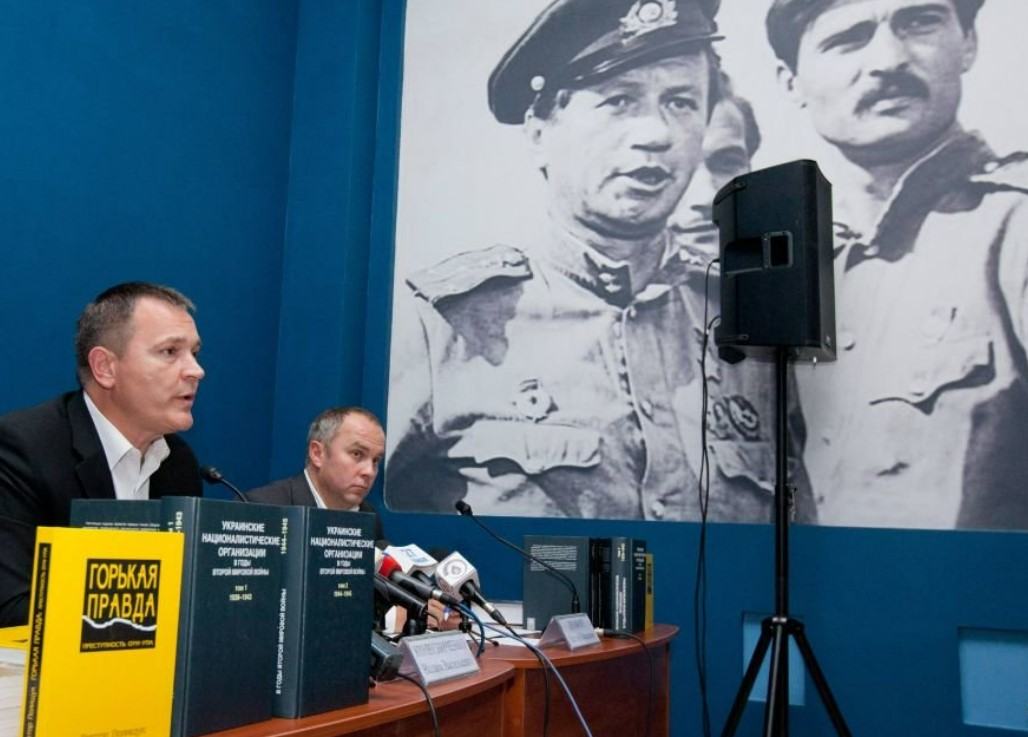
Even as we were putting the finishing touches on this article, we were once again reminded of just what a complex figure Viktor Polishchuk was. Much has been said about his extensive archive. Part of this archive is publicly available on the website of the Polish Association for the Commemoration of Victims of Crimes Committed by Ukrainian Nationalists (Stowarzyszenie Upamiętnienia Ofiar Zbrodni Ukraińskich Nacjonalistów). We will return to the activities of this organization and its collaboration with Vadym Kolesnichenko later.
What matters more at this point is something else. A substantial portion of the materials published on the association’s website consists of photocopies of interrogation records produced by officers of the Soviet state security services in the late 1940s. Many of the documents were handwritten by NKVD personnel and do not contain archival codes or other identifying details that would allow their origin to be unequivocally established.
How these materials ended up in Polishchuk’s personal archive remains an open question. As far as we have been able to determine, he did not explain this in his works or prefaces.
WHETHER POLISHCHUK'S ARCHIVES ARE A KGB FORGERY COULD BE THE SUBJECT OF A SEPARATE STUDY
Reconstructing the history of this archive — who gave Viktor Polishchuk copies of the documents, which archives they came from, under what circumstances they were obtained, and whether they were KGB forgeries — could be the subject of a separate study and might help shed more light on Polishchuk’s own role in this story. (Read this interesting story about how the KGB forged Nazi documents to influence West Germany’s domestic politics).
However, Polishchuk was far from the only early promoter of the "massacre" narrative with a questionable background. There were, of course, others. One of the most famous authors and popularizers of this topic in the 1990s was Edward Prus. He deserves a separate mention. In particular, there is one interesting fact: during World War II, Edward Prus was a member of the Polish resistance movement, and later joined the Soviet NKVD’s "extermination battalions". This did not prevent him (and may even have helped him) from pursuing a career both in socialist Poland and after the collapse of the socialist bloc.
The "extermination battalions" were auxiliary paramilitary units created by the NKVD, recruited from the local population and used to combat the anti-Soviet underground and carry out punitive operations. Upon joining these units, their members became part of the Soviet repressive system. The operations themselves were accompanied by extrajudicial executions, torture, deportations, and other forms of repression, which were characteristic methods of the Soviet state security agencies.
The Association for the Commemoration of Victims of Crimes Committed by Ukrainian Nationalists (Stowarzyszenie Upamiętnienia Ofiar Zbrodni Ukraińskich Nacjonalistów) deserves special attention. It is one of the most prominent Polish organizations specializing in the crimes of the OUN-UPA and the Volyn tragedy. Its representatives have collaborated with the Institute of National Remembrance of Poland on various research and memorial projects, and for many years the association has held conferences, published books, and organized exhibitions dedicated to this topic.
A key figure in this organization, its founder and long-time leader, is Szczepan Siekierka. He has initiated numerous publications on the crimes of the OUN-UPA, as well as the installation of memorial plaques and monuments. He was a soldier in the Home Army (Armia Krajowa). And, of course — as is to be expected — in 1944–1945, he served in the ranks of an NKVD’s "extermination battalions".
Overall, what is striking is the extent of cooperation between various figures in the Polish Kresy movement and these Soviet state security services, as well as how thoroughly this fact has been overlooked in contemporary Poland.
Equally striking is how uncritically a large part of Polish society accepted documents produced by the very same system that massacred Polish officers at Katyn, carried out the mass deportation of Poles, executed 111,000 Poles in the Soviet Union, and waged political terror in Poland and many other parts of the world.
Many of the arguments on which the concept of the Volyn tragedy as genocide is based today rely on interrogation transcripts of Ukrainian underground members, UPA fighters, or villagers, obtained from the basements of the NKVD. How exactly Soviet state security obtained such "testimonies" is well known from the his
tory of Poland itself. But when it comes to Volyn, this fact is often overlooked in critical analysis.
The case of UPA commander Yurii Stelmashchuk (Rudyi) is particularly revealing. His NKVD interrogation — in which he allegedly confirmed that the UPA leadership had ordered the mass extermination of Poles — is today often presented as one of the key pieces of evidence. Even the Polish Wikipedia refers to his "postwar testimony to the NKVD". However, what is actually at issue is the interrogation record of a man held in the custody of the Soviet security services. The very choice of the word "testimony" in connection with the "NKVD" says a great deal about the level of critical scrutiny applied to such a source.
By the time Russia decided to once again turn Volyn into an instrument of its policy toward Poland and Ukraine, it did not need to construct a new historical narrative. The core narratives, archives, authors, and a receptive audience were already in place. All that remained was to breathe new political life into them.
"Massacre" and Russia
The Kremlin chose what was perhaps the most effective tactic for itself — not to intervene directly in the Polish-Ukrainian debate, but to act through Polish actors. This was all the more so because the groundwork for the conflict already existed. Polish historical memory, political disputes, and mutual grievances were, in and of themselves, creating a high level of tension.
All that remained for Russia was to periodically reinforce these processes with its own propaganda, amplifying the most radical narratives, deepening mutual distrust, and turning a painful historical issue into an instrument of contemporary political confrontation.
In 2008, a collection of "documents and studies" titled "Forgotten Genocide: 'The Volyn massacre' of 1943–1944" was published in Russia. The blurb for this edition states: "The book you hold in your hands is the first Russian publication devoted to the 'Volyn massacre' of 1943–1944." This book was published at the expense of an unknown individual, and its editor was a certain Aleksandr Dyukov.
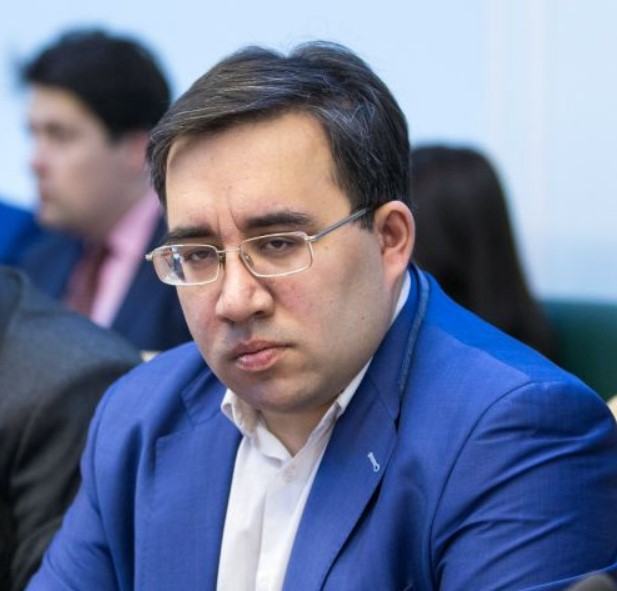
It was the latter who would go on to play a pivotal role in promoting the "massacre" narrative. Aleksandr Dyukov describes himself as an "Orthodox Russian". He has been declared persona non grata in the Baltic states because of his propagandistic works on historical subjects, in which he attempted to accuse the national movements of these countries of collaborating with the Germans during World War II. Here is how he was characterized in 2008 by the Estonian Internal Security Service (Kaitsepolitsei):
"Although Aleksandr Dyukov holds no academic degree in history and has no notable professional achievements as a historian, he enjoys exceptionally easy access to documents kept in the archives of the Russian Federal Security Service (FSB). These archives are firmly closed to ordinary historians, including Russian citizens. There is therefore no doubt that A. Dyukov operates with the full knowledge and approval of the FSB".
"DYUKOV OPERATES WITH THE FULL KNOWLEDGE AND APPROVAL OF THE FSB"
And in 2008, the Historical Memory Foundation was established, with Dyukov remaining its permanent director to this day.
A brief overview of the foundation itself: to be as precise as possible, it can best be viewed as a tool for conducting Russian special operations in countries neighboring Russia in the humanitarian sphere, particularly in the historical context. The foundation seeks, by all means possible, to discredit national liberation movements in the Baltic states and Ukraine.
The Historical Memory Foundation enjoyed the support of Russian government agencies, in particular the Ministry of Foreign Affairs of the Russian Federation. The ministry actively facilitated the foundation’s activities, and its officials regularly took part in the foundation’s events, underscoring the foundation’s integration into Russia’s state historical policy.
The Volyn tragedy was not a standalone project of Aleksandr Dyukov, but part of the broader work of the Historical Memory Foundation. At the same time, the foundation published books on the Ukrainian national liberation movement, the history of the Baltic states, Soviet deportations, the Holocaust, and World War II.
Texty.org.ua has obtained the 2008–2018 activity report of the Historical Memory Foundation. It is genuinely an interesting and important document. From this point on, there will be no speculation or reconstruction — only what the Russians themselves wrote about their goals, methods, and the results of their work in Poland and around the Volyn tragedy.
The report was very much in step with the times, it even featured infographics. Below is part of the foundation’s map of activities showing its events in Poland.
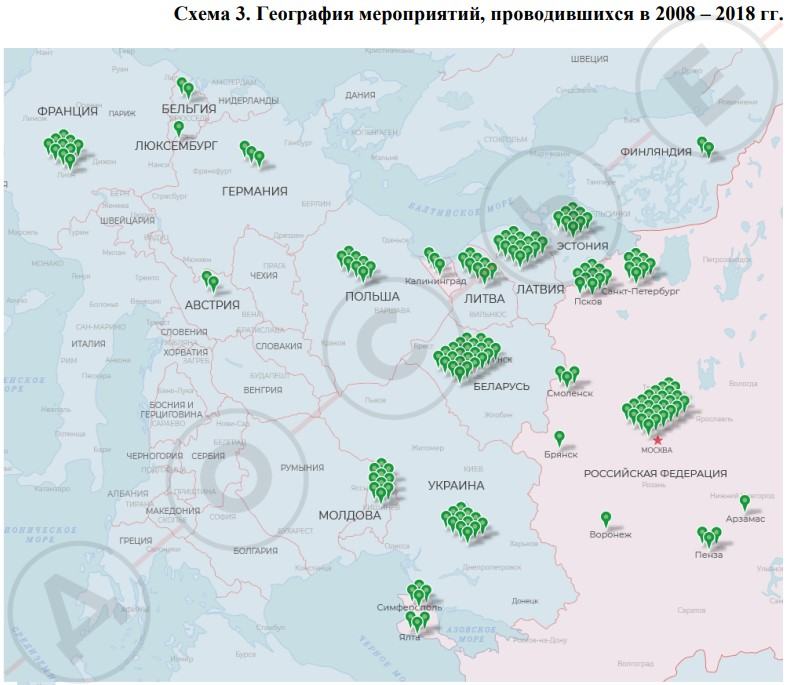
As the map shows, Poland was a regular venue for Russia’s so-called "events" — which were, in reality, humanitarian influence operations. The number of such operations in Ukraine was even greater. It should be remembered, however, that the reporting period includes the presidency of Viktor Yanukovych, when Ukraine had effectively become an open playground for the Russian security services. At the time, the same could supposedly not be said about Poland. Yet the published infographic suggests otherwise.
Unfortunately, the Historical Memory Foundation’s report does not provide a detailed list of the activities it carried out in Poland between 2008 and 2018. It does, however, contain one particularly revealing passage, which is worth quoting here in full:
"Poland is of interest to us as a platform for activities directed against the official historical and propaganda narratives of Lithuania and Ukraine. Publishing materials in Poland about the crimes of Ukrainian nationalists or the repression of the Polish population in the Vilnius region by the Lithuanian authorities is an effective instrument for influencing our opponents in Lithuania and Ukraine.
The presentations we organize on the anti-Polish activities of Ukrainian and Lithuanian nationalists are noted by the Polish authorities and official historians. In this way, we convey arguments to them that can later be adopted and used independently by the Polish side".
It is worth mentioning here the study by Peter Pomerantsev and Edward Lucas, "Winning the Information War Techniques and Counter-strategies to Russian Propaganda". In it, the authors cite the following objective among the so-called active measures of influence against an enemy country — first under the Soviet Union and later under Russia — "to undermine relations with other nations".
The report contains even more admissions. We quote: "We also devote considerable attention to the so-called 'Volyn massacre' — the mass extermination of the Polish population of Volyn by OUN-UPA units. We support the research efforts of Polish historians on this topic. In addition, we are making new documents regarding this crime against humanity available to the academic community".
RUSSIAN FOUNDATION ADMITS IT "SUPPORTS THE RESEARCH ACTIVITIES OF POLISH HISTORIANS"
Once again, in case anyone missed it: a foundation linked to Russian government agencies openly admits that it "supports the research activities of Polish historians" on the events in Volyn. A rather remarkable confession — though, for the moment, it does not name any names. (spoiler: it eventually does.) To understand which Polish historians received Russian support, we need to look at the history of one Polish publication.
Mysl Polska — the common thread
Oddly enough, the Russians once again mentioned all of the events described below in their report. We quote:
"On 30 November 2016, on the eve of the official visit of Ukrainian President Petro Poroshenko to Poland, the website of the Federal Archival Agency of the Russian Federation published a documentary collection prepared by us entitled 'How and Why We Fight the Poles': The Anti-Polish Program of the OUN in Archival Documents. It argued that Ukrainian nationalists had been planning the mass ethnic cleansing of the Polish population of Volyn even before the outbreak of World War II. The publication attracted attention not only in the Ukrainian media, but also in the Polish media (…)".
In other words, we have direct confirmation from the Russian side itself that the release of certain so-called historical documents is a deliberate information and propaganda operation tied to a political event.
And, of course, it’s also interesting to know who, exactly, on the Polish side is backing these smear campaigns. And to this question, the Russians —strange as it may seem— once again provide a complete and comprehensive answer:
"In June 2017, on the occasion of the next anniversary of the Volyn tragedy, the documentary publication was released in Polish by the publishing house Myśl Polska and presented at the Museum of Independence in Warsaw. The publication made an important contribution to substantiating the legal qualification of the Volyn tragedy as genocide and was therefore widely used by Polish historians".
It is probably time to ask what Myśl Polska actually is. And that is where we uncover a great deal of interesting information.
If there is one common thread running through the many Polish organizations and events discussed in this investigation, it is Myśl Polska. Time and again, it appears at key intersections, revealing the network — or rather, networks — working to undermine good-neighborly relations between Poland and Ukraine.
We’re talking about a Polish journal and publishing house of a "national-democratic orientation" that, even after Russia’s aggression against Ukraine and the occupation of Crimea, is publishing a book by the Russian fascist Aleksandr Dugin. It is headed by Jan Engelgard, who also collaborates with the Museum of Independence in Warsaw. This helps explain how FSB-sourced archival materials could be presented at the museum.
Under Jan Engelgard’s editorship, Myśl Polska systematically promoted the works of Aleksandr Dyukov, covered events organized by the Historical Memory Foundation, published interviews and reviews, and provided a platform for authors advancing the most confrontational interpretations of Polish-Ukrainian history. It was through media outlets like Myśl Polska that Russian historical narratives found a pathway into Poland’s own domestic debate.
It is also worth asking who else was part of this publication’s circle. Here, too, the story takes another unexpected turn. As it turns out, the magazine’s editorial board included — and its pages regularly featured — Mateusz Piskorski.
In May 2016, he was detained by officers of the Internal Security Agency of Poland. He was charged with spying for Russian and Chinese civilian intelligence agencies, specifically with carrying out operational assignments to advance Russian interests, for which he was allegedly paid.
The investigation into Piskorski lasted for several years. He was eventually released, and the first media outlet to interview him after his release was a Russian state propaganda channel. In that interview, he thanked the far-right Polish politician Grzegorz Braun and several other well-known Polish far-right figures for their support.
Andrzej Zapatowski also belongs to this same circle — a longtime contributor to Myśl Polska, a regular contributor to the Russian outlet Sputnik Polska, and one of the most consistent advocates for framing the Volyn tragedy as "genocide".
He is now a member of the Polish Sejm representing the Confederation of the Polish Crown, the political party led by Grzegorz Braun, whose representatives have repeatedly promoted anti-Ukrainian and pro-Russian narratives. Since the start of Russia’s full-scale invasion, he has consistently opposed large-scale Polish assistance to Ukraine and criticized state support for Ukrainian refugees.
Myśl Polska has also published the work of historian Bogustaw Paz, who would later argue that Ukraine should come to terms with the loss of the territories occupied by Russia.
These examples clearly show that the network which spent years shaping this historical narrative did not remain on the political fringes. Instead, it ultimately secured direct representation in the Polish parliament.
A "hot-button" issue
Of course, the Historical Memory Foundation and Myśl Polska are far from the only actors involved. Other influential organizations have also worked on this issue.
Take, for example, the rather blandly named Russian Institute for Strategic Studies. For context, the institution was previously known as the Research Institute for Intelligence Problems of the First Chief Directorate of the KGB of the USSR.
It is now headed by Mikhail Fradkov, who previously served as Director of Russia’s Foreign Intelligence Service (SVR). Unlike the Historical Memory Foundation, however, the institute prefers not to publicize the real focus of its activities.
Yet in the 2010s, it suddenly began organizing numerous conferences and roundtables on improving Russian-Polish relations. One of the few monographs devoted to Polish-Ukrainian relations, published on the institute’s website as early as 2010 under the title "Ukrainian Katyn: Ukraine and Poland Face a Reset in Humanitarian Policy", contained the following passage:
"The Polish-Ukrainian alliance was directed against Russia, which was held responsible for the crimes of the past. However, the foundations of this alliance rested on unstable ground. Even without addressing the full range of unresolved and highly contentious issues in Polish-Ukrainian history, it is enough to recall the 'Volyn massacre' alone".
Once again, this illustrates that the Kremlin does not necessarily place its bets on major parties or influential political forces. On the contrary, it often finds reliable partners among relatively small but well-organized political, civic, and media organizations. It is through such networks that Russian narratives can gradually enter the broader public debate, appearing as locally generated views rather than positions imposed from the outside.
Ukrainian connection
If Vadym Kolesnichenko — a former member of parliament from the Party of Regions and, on the side, a Russian propagandist — did not actually exist, those seeking to stir up conflict between Ukraine and Poland would have had to invent him.
In Ukraine, Kolesnichenko had long been integrated not only into the pro-Russian political "camp" but also into a network of Russian government agencies promoting the concept of the "Russian World".
He chaired the All-Ukrainian Coordinating Council of Organizations of Russian Compatriots, led the movement "Russian-Speaking Ukraine", maintained close ties with Russian state foundations and politicians, and received funding from Pravfond (the Foundation for the Support and Protection of the Rights of Compatriots Living Abroad) for his campaign in support of Ukraine’s language law.
According to publicly available documents, Pravfond not only provided funding but also coordinated the accompanying information campaign. In 2013, Russian President Vladimir Putin personally presented Kolesnichenko and fellow Ukrainian deputy Serhii Kivalov with special awards in Moscow for their "promotion of the Russian language" in Ukraine.
Throughout this article, we have discussed the roles played by Polish and Russian historians, politicians, and propagandists. Yet one crucial strategic niche in the campaign surrounding Volyn remained unfilled — the very niche that Viktor Polishchuk had identified and occupied years earlier. It was the role of someone from "this side": a Ukrainian who publicly validated every accusation against Ukrainians, including claims of genocide.
There was probably a reason Vadym Kolesnichenko chose to republish Viktor Polishchuk’s book. He clearly understood the advantages of occupying that position. Perhaps someone even suggested the strategy to him — but he proved to be an exceptionally effective executor. Indeed, Kolesnichenko’s contribution to this campaign far exceeded Polishchuk’s. In this field, he was nothing short of a workaholic.
As early as April 2010, through the organization "Russian-Speaking Ukraine", Kolesnichenko opened an exhibition at the Ukrainian House in Kyiv entitled "The Volyn tragedy: Polish and Jewish Victims of the OUN-UPA".
Crucially, he did not do so alone. The exhibition was organized together with the Association for the Commemoration of Victims of Crimes Committed by Ukrainian Nationalists (Stowarzyszenie Upamiętnienia Ofiar Zbrodni Ukraińskich Nacjonalistów, SUOZUN), which we discussed earlier.
Clashes broke out during the exhibition’s opening. People who had come to protest were met by officers of the Berkut (former special police force) riot police already waiting at the scene. This strongly suggests that the operation had been coordinated at the highest levels of Ukraine’s leadership at the time — or by its handlers in Moscow.
But the reaction of the Polish government at the time is also telling. Olha Hnatiuk, the science and culture attaché of the Embassy of Poland in Ukraine, stated: "You can’t indiscriminately lump everything under the slogan 'Volyn massacre' just for the sake of the word 'massacre'. This is done to provoke strong emotions. And as a representative of the embassy, as a historian with an academic degree, and as a professor at the University of Warsaw, I strongly oppose such abuses".
Looking back today, it is striking how measured and thoughtful the official position of Poland was compared with the rhetoric heard in more recent years.
The exhibition was a joint project of SUOZUN and "Russian-Speaking Ukraine", adapted specifically for the Ukrainian political environment. It was presented in Russian, received extensive media coverage, carried no clearly identified authorship, and toured regions where pro-Russian parties enjoyed significant electoral support.
SUOZUN not only provided materials from its archives but also officially joined the project, which in April 2010 turned into one of the most high-profile political scandals in Ukraine’s humanitarian sector.
Accordingly, this organization deliberately lent its own authority and legitimacy to this project, sharing responsibility for its implementation and consequences. In fact, SUOZUN took full part in the Russian special operation on Ukrainian territory.
It is also worth asking who specifically supervised — and, quite possibly, financed — Kolesnichenko’s activities.
Texty.org.ua contacted Ruslan Bortnyk, a former associate of the separatist politician who continues to be active in Ukraine’s public sphere, asking who had organized and financed the exhibition.
Bortnyk replied that he did not possess such information, "because I was not involved in organizing the exhibition. I attended only the opening in Kyiv as a visitor.” He added: “As far as I remember, the preparation, organization, and financing of the exhibition were entirely the responsibility of Vadym Kolesnichenko, with whom I have had no contact since 2014–2015".
Perhaps those connections become clearer in 2013, when a new phase of the campaign to discredit Polish-Ukrainian relations began — and, with it, a renewed effort to amplify the issue of the "massacre".
Preparations for the "historic" visit
In 2013, Kolesnichenko’s profile in the Volyn debate reached its peak. That year marked a turning point for him: what had until then been largely a domestic Ukrainian campaign began expanding onto the international stage.
As a reminder, in July of that year, a group of Ukrainian deputies — primarily from the Party of Regions and the Communist Party of Ukraine — appealed to members of the Sejm to officially recognize "the Volyn tragedy committed by the OUN-UPA as a genocide of the Polish population". By doing so, the signatories not only adopted the strongest possible legal characterization of the events but also effectively urged a foreign parliament to endorse that interpretation.
Together with fellow Party of Regions deputies, Kolesnichenko also introduced a bill to designate 11 July as the Day of Remembrance for the Victims of the Volyn Tragedy and to establish the honorary title "Ukrainian Righteous Among the Nations".
Kolesnichenko also held a joint press conference in Kyiv with Mirosław Gilarski, a member of the Kraków City Council, and the Polish activist Jacek Wilczur to present the Ukrainian edition of "The Kresy Book of the Righteous 1939–1945".
At first glance, it was just an ordinary book presentation. In reality, however, it reveals which Polish circles Kolesnichenko had chosen as his allies. Both Mirosław Gilarski and Jacek Wilczur were associated with organizations in the Kresy region, which would soon be welcoming the Ukrainian deputy to Poland.
Jacek Wilczur’s role is particularly revealing. Just a few months before the Kyiv press conference, his book "You Can’t Get to Heaven Right Away: Lviv, 1941–1943" was published in Russian by the REGNUM news agency’s publishing house under the editorship of Modest Kolerov, a former official in the Russian presidential administration and one of the architects of Russia’s historical and propaganda policy across the post-Soviet space.
Thus, one of the main Polish guests at the event was an author who had been actively promoted by one of Russia’s key information and propaganda platforms even before the campaign began.
The funding behind the book is no less revealing. According to RISU, the Ukrainian edition was financed by the Dnipro-Sich Charitable Foundation of Viacheslav Bohuslaiev, president of the Motor Sich company and a Party of Regions deputy. In 2022, Ukraine’s Security Service arrested Bohuslaiev on suspicion of high treason, collaboration, and aiding the aggressor state.
After the press conference, Kolesnichenko traveled to Warsaw, where a series of events organized by the Committee for the 70th Anniversary of the Volyn Tragedy and meetings with Polish politicians were already awaiting him.
2013. When the stars aligned
The 70th anniversary of the Volyn tragedy marked the moment when the issue finally moved beyond the realm of historical debate and the families of the victims. By 2013, it had become the focus of a broad political machine involving Kresy organizations, historians, clergy, deputies, civic activists, and the media.
According to the Polish news portal Kresy.pl, immediately after arriving in Warsaw, Kolesnichenko met with an entire cast of notable figures. The following passage is worth quoting in full, as it is particularly revealing:
"Party of Regions deputy Vadym Kolesnichenko arrived in Warsaw at the invitation of the Nationwide Committee for the Commemoration of the 70th Anniversary of the Stephan Bandera Genocide in the Eastern Borderlands of the Second Polish Republic, 1939–1947. At Chopin Airport, he was welcomed by General Mirosław Hermaszewski, chairman of the International Committee for the Commemoration, and Jan Engelgard, the Committee’s spokesman. On his first day, the guest met with members of the Committee, including Colonel Jan Niewinski, MP Franciszek Jerzy Stefaniuk (PSL), Dr. Tadeusz Samborski and Dr. Dariusz Grabowski".
In other words, Kolesnichenko was personally invited to Poland by the Committee. His visit was therefore part of the committee’s official program of public events rather than a private initiative of the Ukrainian deputy.
For the organizers, Kolesnichenko was an exceptionally valuable guest. Here was a Ukrainian member of parliament promoting the same interpretation of the "massacre" as they were, creating the impression that these views were shared in Ukraine itself.
Significantly, waiting to greet him at the airport was Jan Engelgard — the very same figure discussed in the previous section in connection with Myśl Polska and its cooperation with Dyukov’s Russian propaganda foundation. It is an interesting convergence of connections. Evidently, the relationship between Myśl Polska and its Russian partners extended well beyond the promotion of propaganda narratives.
Also present at the meeting was the economist Dariusz Grabowski, a former member of both the Polish Sejm and the European Parliament, and a representative of Poland’s conservative political milieu.
Kolesnichenko also met with one of the leading figures of the Kresy movement — Colonel Jan Niewinski, head of the Kresy Patriotic Movement of Poland.
Niewiński was one of the most respected figures in that community, despite having once served in an NKVD "extermination battalion". Given that Kolesnichenko himself was an outspoken admirer of the NKVD — and had even once held a press conference dressed in an NKVD uniform — the two men likely found no shortage of common topics to discuss.
Not long afterward, Niewiński presented Kolesnichenko with one of the Kresy community’s distinctions — the Cross of Remembrance for the Victims of the OUN-UPA Genocide.
There is, however, another important point.
Reconstructing Kolesnichenko’s visit to Poland reveals a striking pattern. While his participation in public commemorative events was facilitated by organizations, veterans’ groups, and historical associations, it was politicians from the Polish People’s Party (PSL) who opened the doors of the Polish parliament to him.
The PSL connection
One of the leaders of the Polish People’s Party (PSL), former Deputy Prime Minister Jarosław Kalinowski, chaired the Nationwide Civic Committee for the Commemoration of the 70th Anniversary of the Stepan Bandera Genocide in Eastern Lesser Poland. It was this committee that coordinated the anniversary events and invited Vadym Kolesnichenko to Warsaw.
It was also Franciszek Jerzy Stefaniuk, a PSL member, who not only met with Kolesnichenko but also publicly introduced him to members of the Sejm during the parliamentary debate on Volyn, effectively legitimizing him as the voice of "another Ukraine" — one that supported recognizing the actions of the OUN and UPA as genocide.
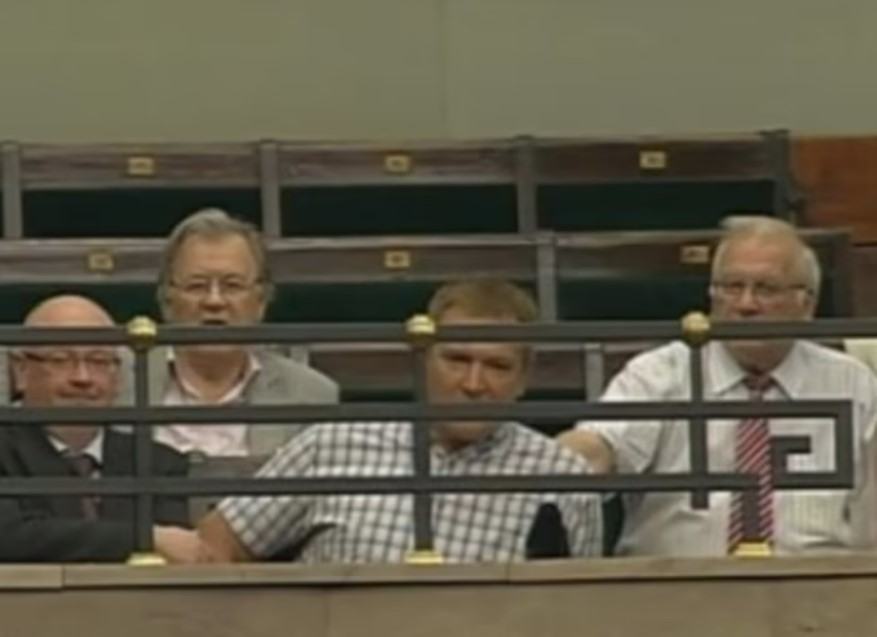
Tadeusz Samborski, whom Kolesnichenko met on his first day in Warsaw, also belonged to the political circle of the Polish People’s Party (PSL). Samborski worked closely with Kresy organizations and regularly took part in commemorative events. He deserves a closer look.
Just a few facts from his biography. According to the Polish independent investigative and fact-checking outlet OKO.press, Tadeusz Samborski earned his doctorate in 1977 from M.V. Lomonosov Moscow State University.
He then returned to Poland and even served as a diplomat in Laos. But in 1983, he went back to Moscow as a newspaper correspondent, where he spent the next ten years. After returning to Poland, he entered politics while consistently emphasizing the issue of the Eastern Borderlands (Kresy) and the alleged "atrocities" of the OUN-UPA.
Yet even during this period, Russia’s "spell" never seemed to lose its hold on him. For years, he organized the Legnica Festival of Polish-Russian Romance, featuring performers from Russia and Belarus. The festival still exists today, although after the start of the full-scale war it was renamed "Autumn Romance".
And most importantly — Samborski is a regular contributor to the now familiar Myśl Polska. The publication thought so highly of his writing that it even released a separate volume collecting his articles.
But Samborski did more than keep the alleged "crimes" of the OUN-UPA in the public eye and offer Vadym Kolesnichenko a warm welcome.
Tadeusz Samborski is one of the few Polish politicians who has consistently promoted the classification of the Volyn tragedy as genocide for more than two decades.
As early as July 2003, the day after the Polish Sejm and the Verkhovna Rada of Ukraine adopted their joint declaration deliberately using the compromise term "Volyn tragedy", Samborski took the floor in the Sejm and described the events in Volyn as "the culmination of the genocide (ludobójstwo) committed against the Polish population of Volyn by OUN-UPA".
Upon his return to the Sejm in 2023, Samborski once again took to the parliamentary floor to promote his views on the Volyn tragedy.
QUITE A CONNOISSEUR OF RUSSIAN ROMANCES
Although the Polish Sejm officially recognized the Volyn tragedy as genocide in 2016, when Samborski was no longer a member of parliament, after returning to the Sejm he became one of the leading political advocates of that course, helping further to entrench it in both legislation and public commemoration. Quite a connoisseur of Russian romances.
Returning to Kolesnichenko’s visit, his itinerary through Warsaw was revealing. Over the course of just a few days, he passed through almost the entire network of Polish circles that would shape the debate over Volyn in the years to come — from Kresy organizations and parliamentary politicians to historians, publicists, and organizers of commemorative events.
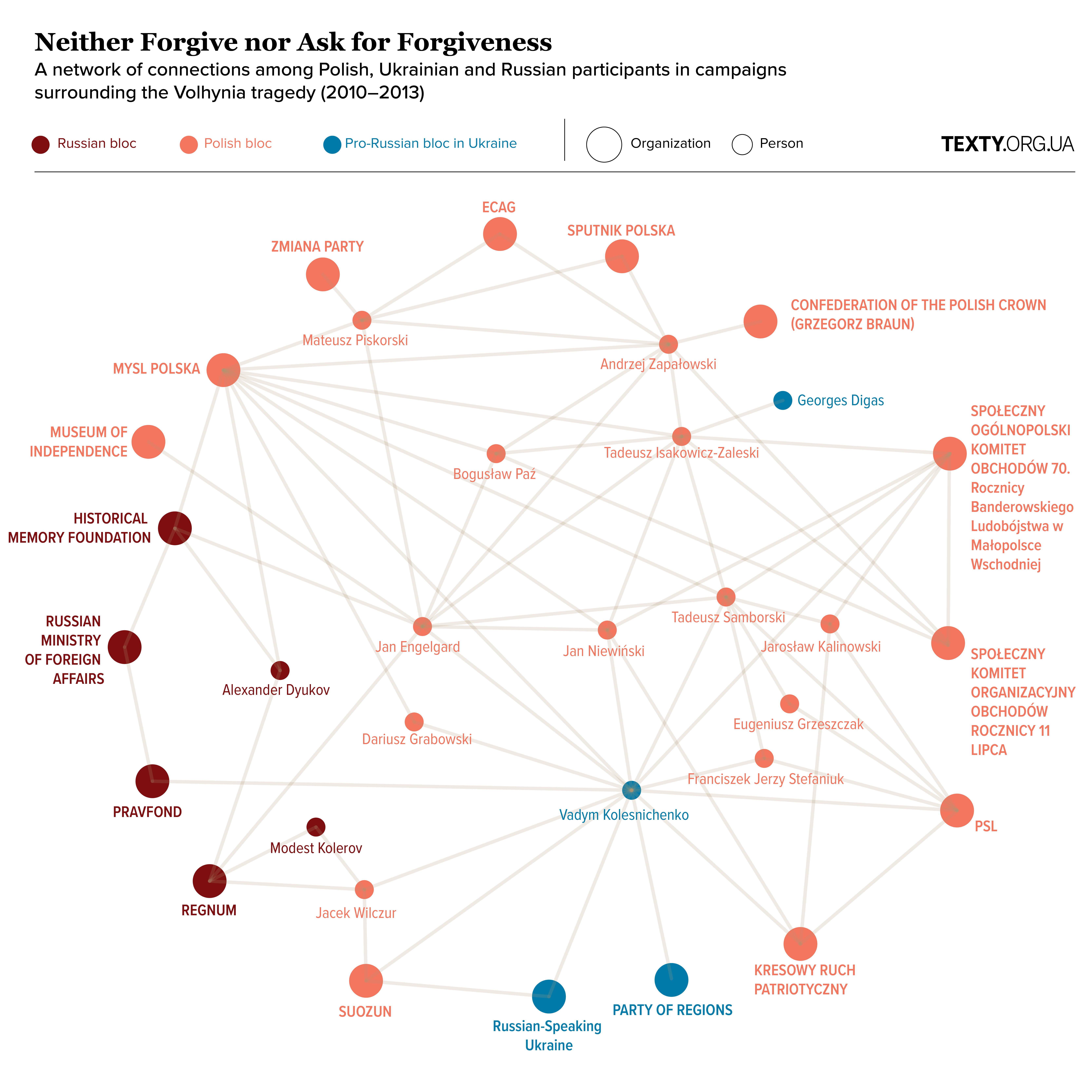
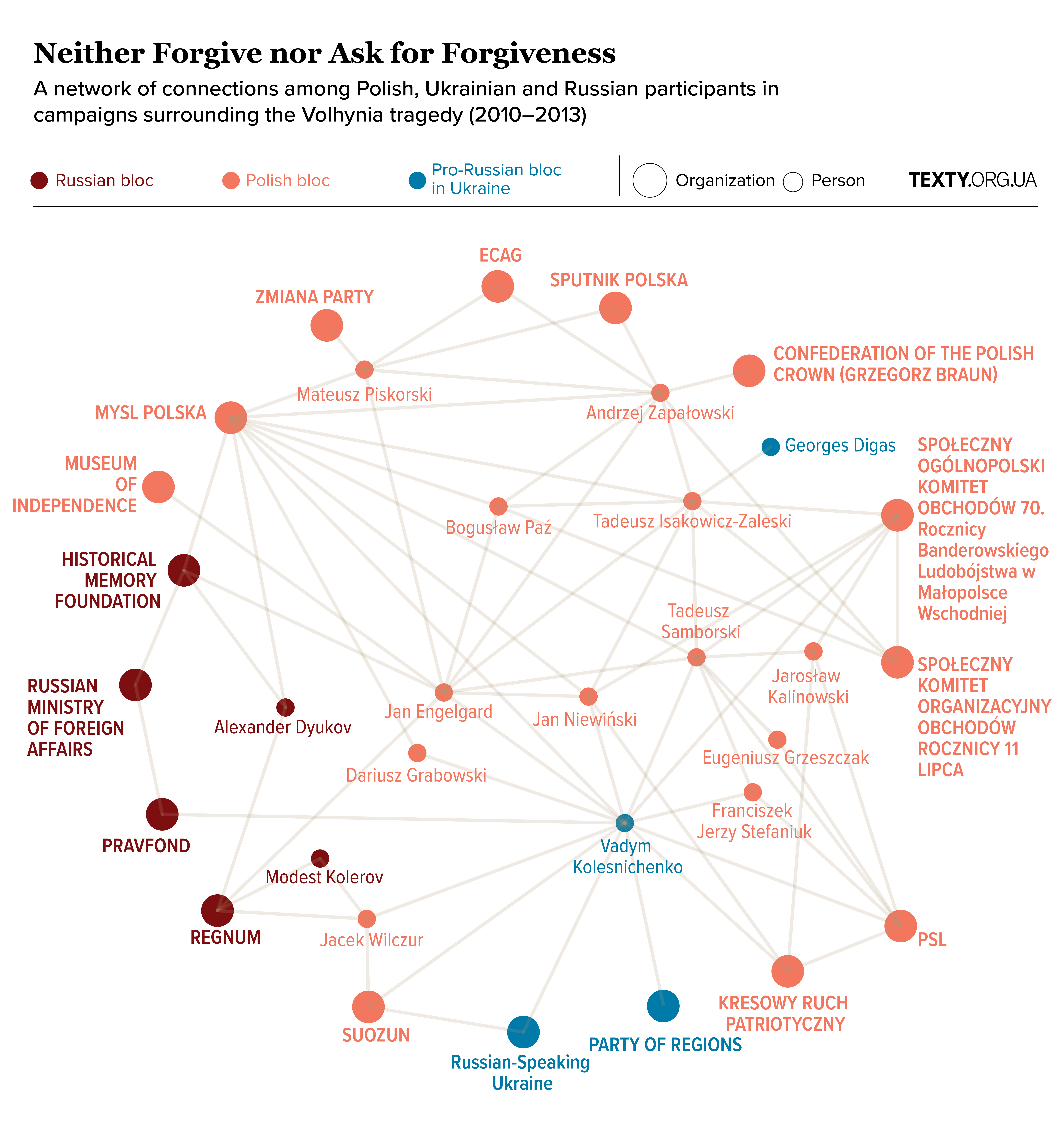
The diagram shows the key participants in the network that has shaped contemporary Polish discourse on the Volyn tragedy over many years. It brings together Polish politicians, journalists, and public figures, pro-Russian entities in Ukraine, and Russian state and parastatal organizations. The title of the infographic plays on the well-known formula of Ukrainian-Polish reconciliation, "We forgive and ask for forgiveness", highlighting a community that has operated according to the opposite logic for many years.
Voice of God
One of the most recognizable faces of the 2013 campaign was Tadeusz Isakowicz-Zaleski (of Armenian descent), a priest of the Armenian Catholic Church, a former anti-communist opposition activist, and a chaplain of Solidarity.
He enjoyed nationwide recognition — something that most of the Kresy activists, who at the time remained largely on the political margins, lacked. To the Polish public, he was neither a party campaigner nor a fringe nationalist, but a priest who the communist security services had persecuted.
It was precisely this biography that made him the campaign’s most valuable moral asset. Isakowicz-Zaleski shifted the demand to recognize Volyn as genocide from the realm of political debate into that of moral obligation. Disagreeing with him could therefore be portrayed not simply as offering a different interpretation of a complex historical event, but as refusing to listen to the victims and to call evil by its name.
Yet Tadeusz Isakowicz-Zaleski was more than a symbolic figure used by others. He actively shaped the agenda himself: criticizing the Polish government and the Church leadership for what he considered an overly conciliatory approach toward Ukraine, demanding the legal recognition of genocide, speaking out against the "cult" of Bandera and the UPA, and, for years, making attitudes toward Volyn a litmus test for Polish politicians.
But if we trace his activities in the years leading up to the landmark 70th anniversary commemorations, an interesting discovery emerges. In April 2010, Isakowicz-Zaleski traveled to Kyiv to participate in a press conference with the telling title "Participants of the Great Patriotic War Against Bandera".
The event was organized under the auspices of the International Ukrainian Union of War Veterans as part of a campaign to revoke Viktor Yushchenko’s decrees awarding Stepan Bandera and Roman Shukhevych the title of Hero of Ukraine.
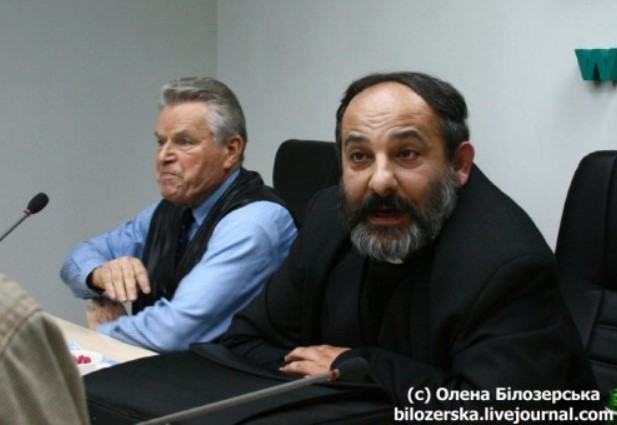
It is also important to consider whom he chose to appear alongside. Among the announced participants at the Kyiv press conference was George Dygas, a former KGB officer and representative of veteran organizations of the Soviet security services.
Another announced participant was Avigdor Eskin, an Israeli far-right publicist born in Moscow who, after 2014, would become a regular contributor to Russian anti-Ukrainian propaganda. The choice of partners is highly revealing.
Tadeusz Isakowicz-Zaleski’s own website functioned not only as a personal blog but also as a platform for other authors. It published texts calling for accommodation with Russia, lamenting the "hatred of Putin", criticizing financial assistance to Ukraine, and warning of an alleged threat posed by Ukrainian migrants. Not all of these views were expressed by the priest himself, but his platform — and his reputation — gave them additional credibility.
Yet in 2013, few people in Poland seemed to pay attention to such connections. A wave of historical hysteria swept the country. Isakowicz-Zaleski embarked on an extensive lecture tour, traveling from city to city across Poland to speak about the alleged "atrocities of the OUN-UPA".
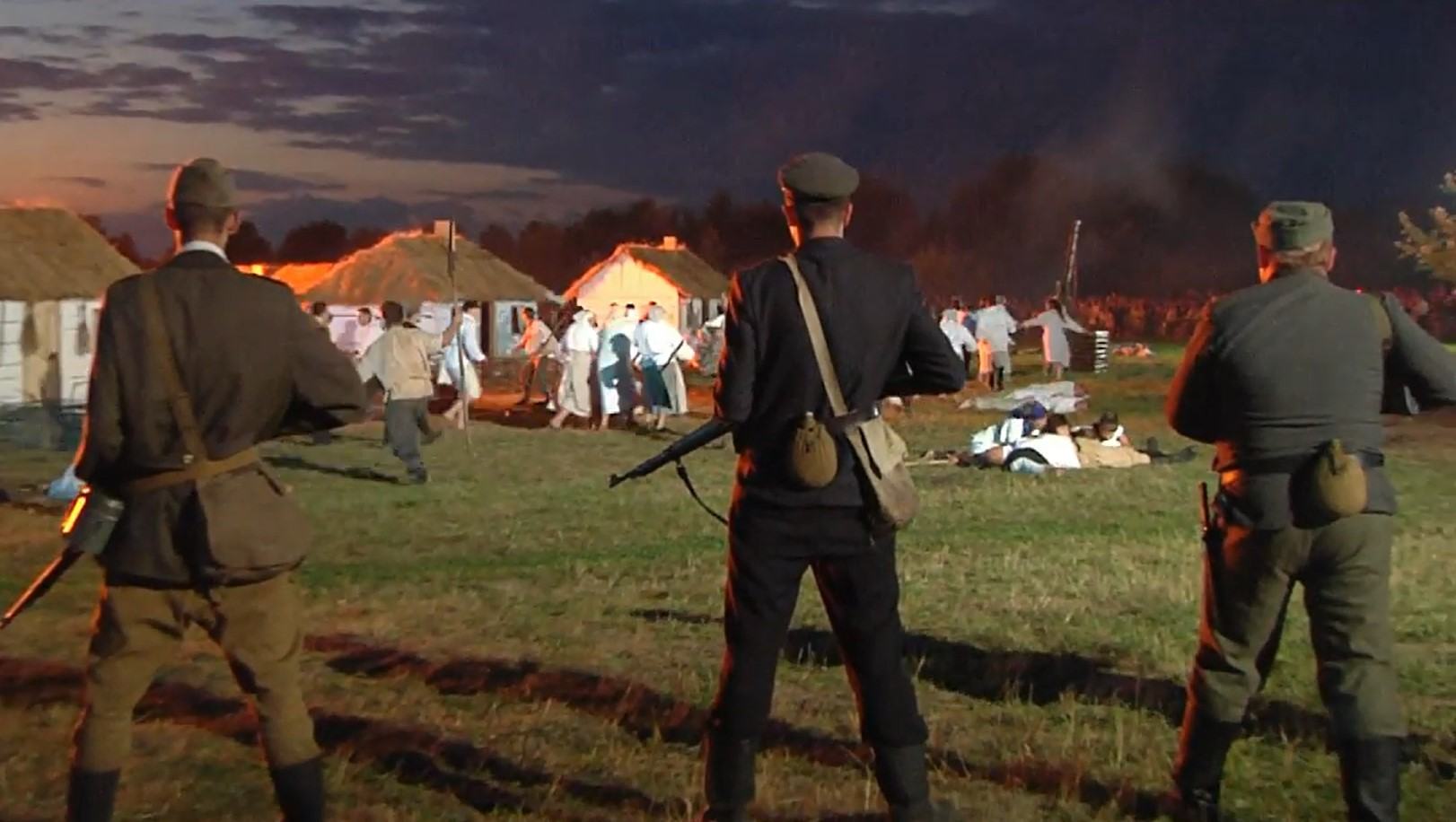
It seemed there was hardly a major town in Poland that this energetic priest did not visit. The Polish press regularly reported on new events and initiatives. Large-scale historical reenactments of the "massacre" were organized across the country, becoming popular public attractions. By that point, there appeared to be no turning back— the process had taken on a momentum of its own, and the situation would only grow worse.
What changed after 2013
After 2013, Volyn ceased to be an issue that resurfaced only around anniversary commemorations. It became firmly embedded in Poland’s political agenda and, within a few years, culminated in the Sejm’s decision to recognize the Volyn tragedy as genocide.
At the same time, a stable circle of politicians, public figures, historians, journalists, and media outlets emerged around the issue, shaping the tone of the debate for years.
The uncritical use of historical sources meant that Soviet state security documents, questionable archival discoveries, and the works of authors repeatedly exposed for manipulation and falsification were often treated as carrying nearly the same weight as academic scholarship.
Another serious problem was the lack of discernment in choosing partners, which opened the door to individuals and organizations that were later found to have ties to Russian propaganda platforms, political projects, or influence networks.
Equally important was the willingness of some Polish politicians to embrace any ally who supported their preferred historical narrative. They even legitimized figures such as Vadym Kolesnichenko, whose role in advancing Russian interests in Ukraine was already well known at the time.
This is precisely why Russian state-linked actors were able to integrate so seamlessly into existing historical and political disputes.
The Kremlin did not need to hijack the Polish debate. It was enough to gradually shape its direction by exploiting existing grievances, trusted voices, media platforms, and political connections.
The line between good-faith historical debate, rigorous scholarship, domestic politics, and foreign information influence gradually became increasingly blurred until it disappeared altogether. Yet it seems that most people in Poland never noticed it.
Підпишіться, щоб отримувати найкращі статті на e-mail (раз на два тижні)

Підписатися