Статті
Why most Kyiv residents don't go to bomb shelters
As soon as another phase of active shelling of Kyiv begins, the problem of shelters immediately arises. Some people complain that shelters are dirty. Others that they are too far away, and still others that they were not allowed back in. We asked our readers to share their experiences of staying in shelters to help us summarize the problem. Some of our respondents are pretty satisfied with their nearest shelters, but there is still much room for improvement.
The Kyiv shelter system has never operated at full capacity. Local officials claim that the capital's shelters can accommodate 2.7 million residents.
There is no accurate information about the number of people using shelters today. The only available data concerns metro station attendance. At the peak of the bombing of the city, several tens of thousands of people gather in the metro at night. The Kyiv Metro reported that on the night of July 21, 2025, about 25,000 people were hiding in its stations. That is, at the peak of the Russian strikes, up to 1% of the city's population was in the metro.
Attendance at other types of shelters is at the level of assumptions. With a great deal of exaggeration, we can only take the estimated figure repeatedly mentioned during the survey — approximately 5% of city residents go to shelters during alarms. We have a situation where, in the event of a deadly threat, Kyiv residents prefer to stay at home rather than go to shelters. Why is this happening?
Suburbs, Suburbs, and again Suburbs
Let's start with something trivial. There are areas in Kyiv where getting to a shelter is a real quest that takes 10 minutes or more. For example, in the suburbs, which is also quite common in the Ukrainian capital, there are no shelters nearby.
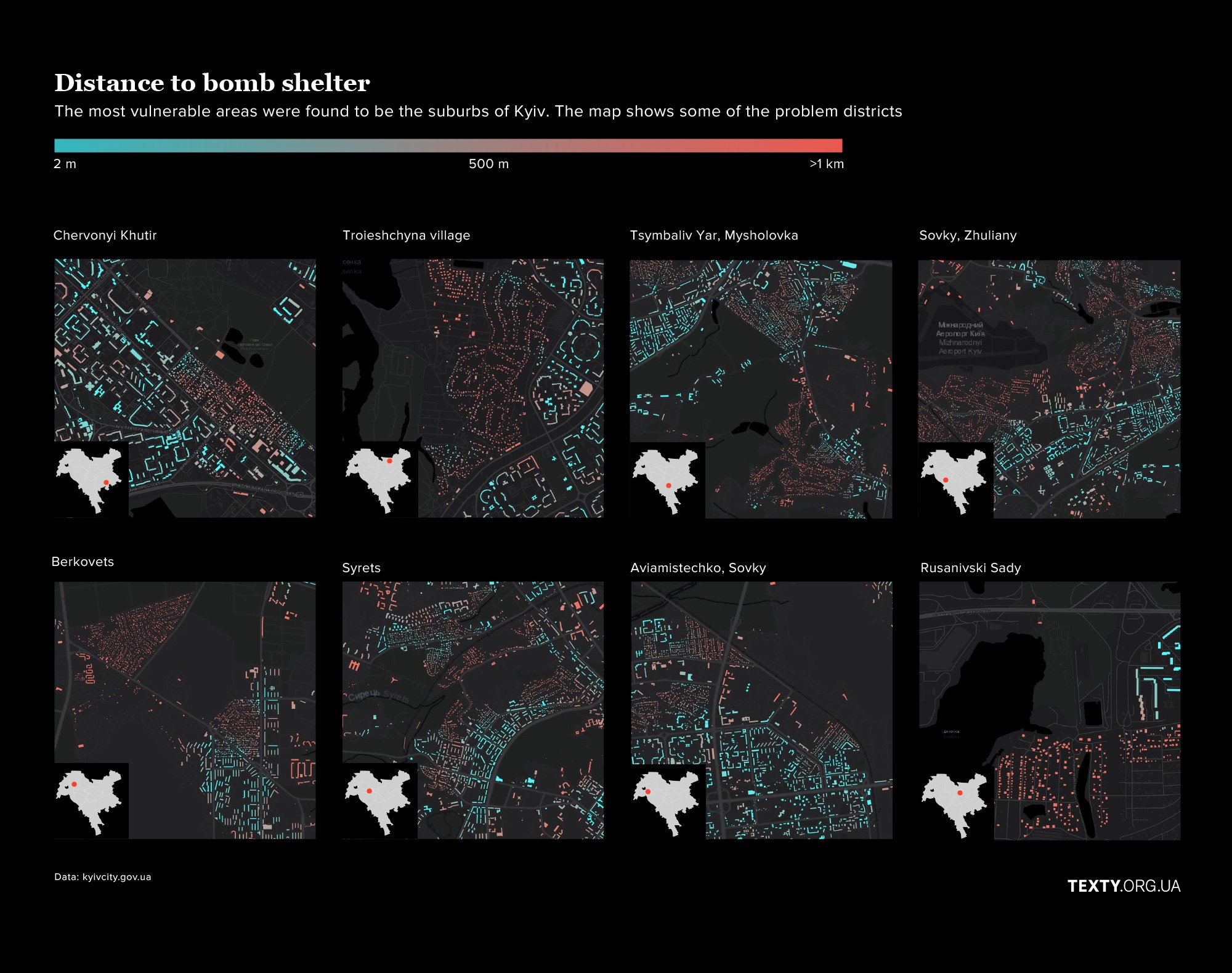
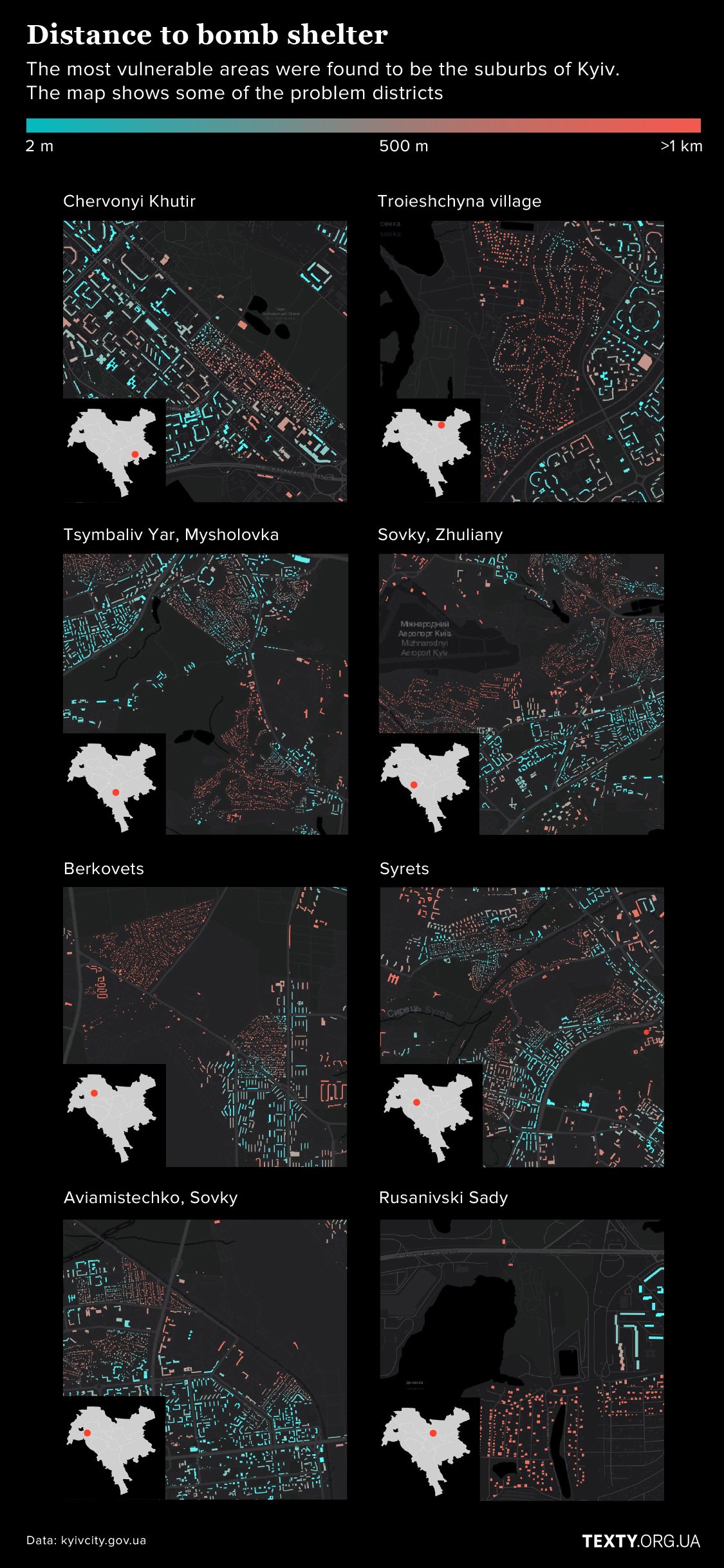
As the map shows, residents of several Kyiv neighborhoods, especially those with a predominance of private housing (suburbs), have difficulty reaching shelters on time.
Oleh, a resident of the Osokorky district of Kyiv. During air raid alerts he drives his family to a parking lot:
"I live in the suburbs, in a private house. There are no shelters nearby. So when the alarm sounds, we drive to the nearby metro station. It has an underground parking lot. It's more comfortable than spending the night in the metro, where there are more people and the lights stay on. The parking lot is still more convenient. You can make yourself comfortable in the car and take something with you: water, a blanket".
There are also problems with shelters in the city center. Dense urban development and old buildings sometimes don’t allow for the construction of shelters in existing structures or near them.
Closer is not always better
Even from the above comment by a Kyiv resident, it becomes clear that there is one nuance with shelters. Very often, people don't go to the nearest shelter, but to where they really want to be during an air raid alert. This brings us to one of the most significant problems with shelters.
Not everything that is named and marked on the map as a shelter is actually one. At least, that is the conclusion we can draw after talking to Kyiv residents.
There are not enough shelters in the downtown of Kyiv
Artem, a resident of Shevchenkivskyi district (downtown), stays at home during air raid alerts:
"The thing is, there aren't really any shelters in the historic center of the city. For example, take the street where I live. There are no schools nearby, no metro stations, no underground passages.
There is a shelter in the basement of our building. But it is more dangerous to go there than not to. There are hot water pipes there, and they are in a semi-emergency condition. Water often leaks there, so we call the emergency service. Now imagine if something else were to fall there.
However, there is shelter in the neighboring State Emergency Service of Ukraine building, but they won't let us in because it's a government building. I know our Homeowners Association asked them to let us in, but they said it was only for the government stuff.
As for the metro, it takes more than 10 minutes to walk to the nearest station, and it's uphill. Of course, I understand that this is a feature of the historic downtown. The basements are all occupied by various technical facilities and are dangerous. There are no parking lots as such. That's why I don't go anywhere in particular".
We are not talking about some conditional categories here. There is persistent mistrust and the most complaints among city residents about the most common type of bomb shelters — in basements and ground floors of residential buildings.
Pipes leak in most basements
Most shelters are located in basements and on ground floors.
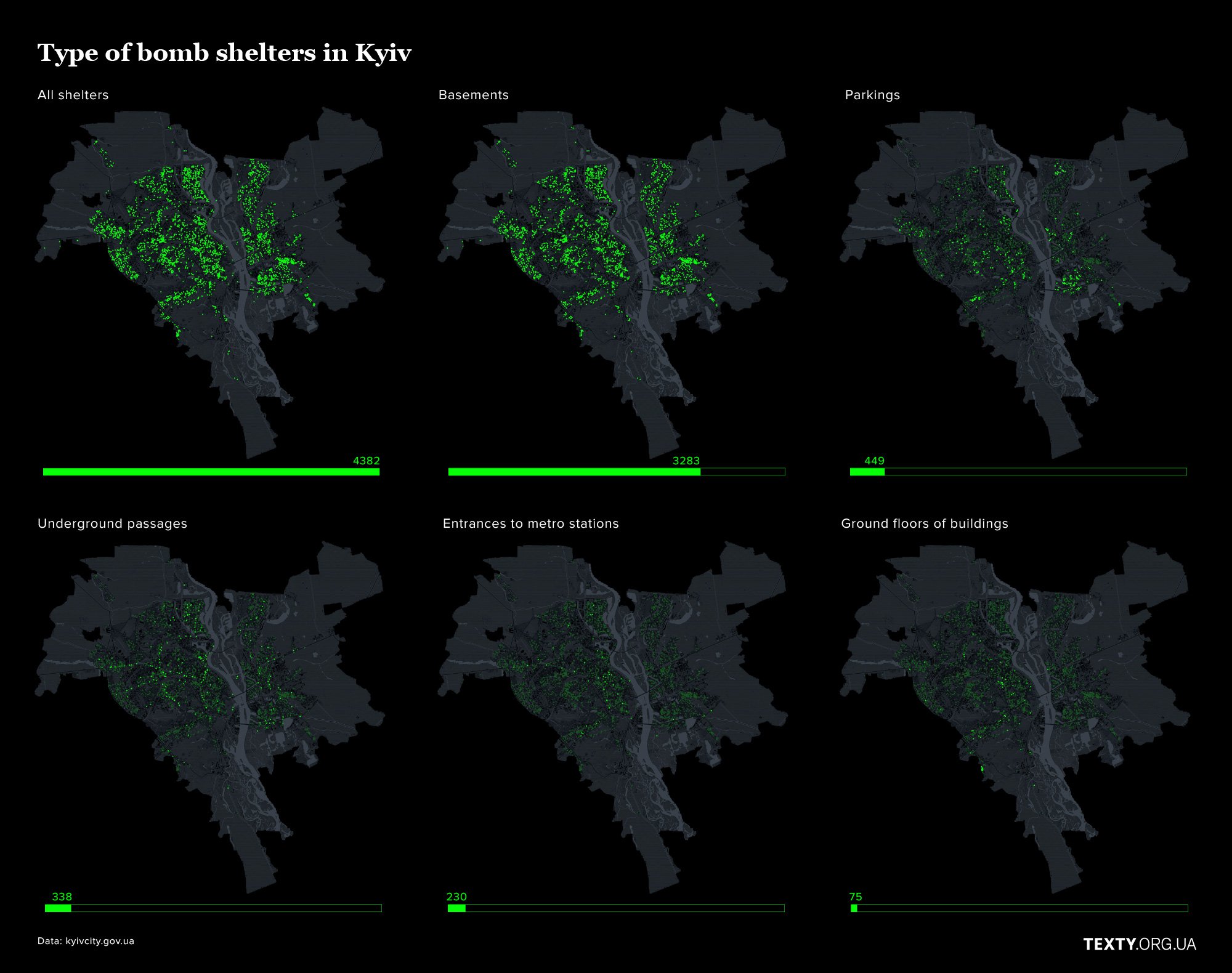
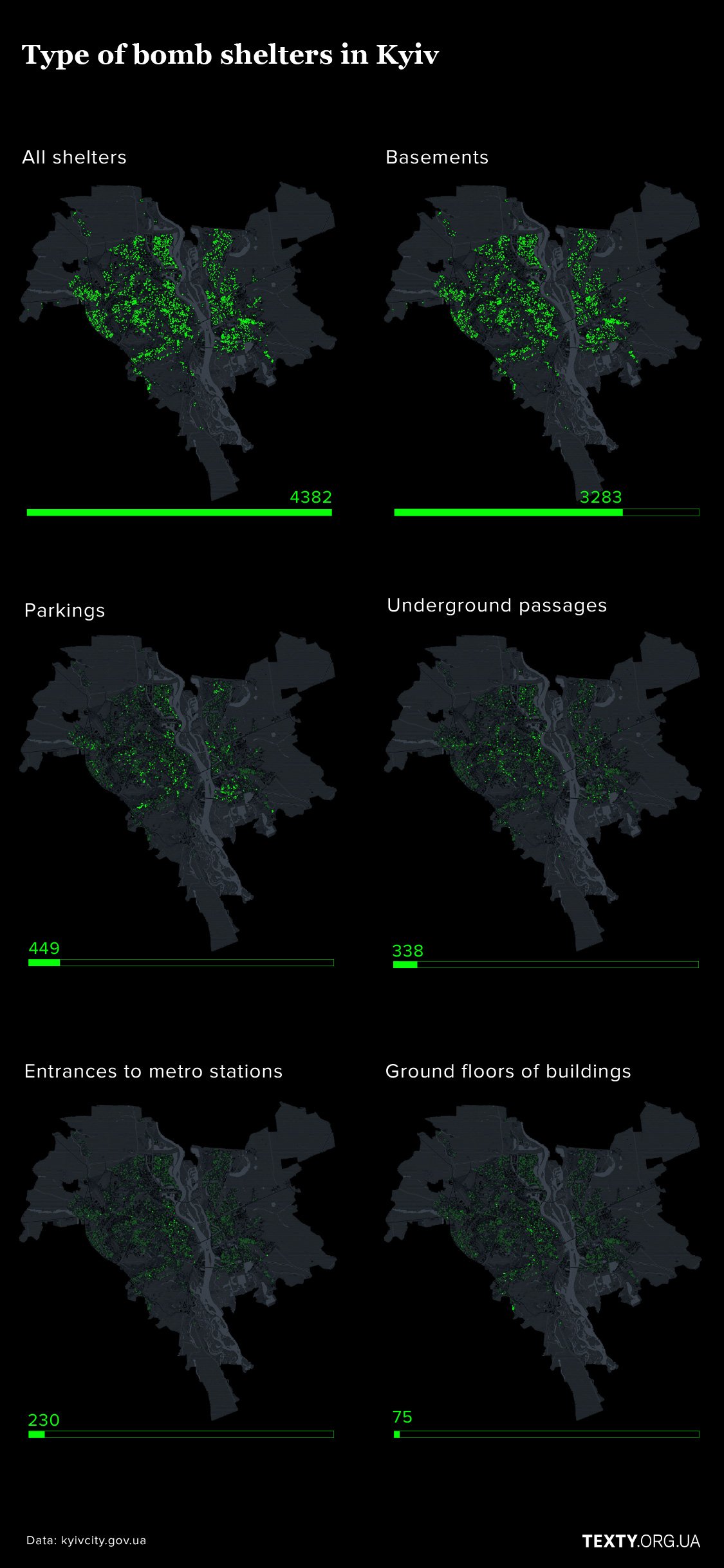
The situation is getting crazy: in a building with a shelter, people would rather hang out on the first floor than go down to the basement.
Serhii, a resident of the Poznyaki district, stays at home during air raid alerts:
"I don't go to the shelter myself. But I see that some of the residents of our building gather on the first floor. They bring folding chairs and blankets. This is even though our building has an official shelter. It's written in big letters: 'Shelter'. Personally I have never gone down there. It smells unpleasant there. I know that from time to time, they repair some pipes there. In short, no one goes there".
Sometimes dirty and unkempt
Residents are also concerned about the condition of the shelters themselves. There are so many complaints about dirty shelters in buildings, as well as a lack of facilities to wait out air raid alerts.
Partly, this involves routine maintenance and supervision. That is, matters that can be resolved at the grassroots level, namely by management companies (housing and communal services) and the Homeowners Association.
A resident of the Solomianskyi district, who wished to remain anonymous, sometimes goes to shelters in hospitals or the metro during air raid alerts:
"Yes, each shelter must have a designated person in charge, either from the community or from the business. There must be a simple and accessible way to communicate with the person in charge. If that person is not responding, everyone should be able to see that. That is a reason to replace them".
Sometimes people are not allowed into the shelters
And so, in the fourth year of the war, one of the oldest problems, which has repeatedly led to human casualties, remains unresolved. Some shelters are still closed during air raid alerts.
A resident of Rusanivka district, who wished to remain anonymous, during air raid alerts, she goes to a shelter in an educational institution or hospital:
"All shelters must be open during an alarm. Once, we were not allowed into the shelter during a night alarm on the instructions of the head of the educational institution.
We had to call the police and prove that it was indeed a shelter. Only then did the police force the guard to open the shelter. They refused to accept our statement".
It is difficult for people with disabilities to enter
To this should be added a problem that should also have been solved long ago — the accessibility of shelters for people with limited mobility. Since the start of the full-scale invasion, this issue has been a constant topic of discussion, but, as our conversations with Kyiv residents have shown, it remains relevant.
People need to stay in the shelters longer
Recently, the nature of the alerts has changed. First of all, they have become longer. The Shahed attack can begin in the evening, and the air raid alert itself can end the next morning with a missile strike. All this time, it is better to stay in a shelter. This means that people need conditions for an extended stay, not just to wait out half an hour. They need water, toilets, and, ultimately, some furniture to stay there until morning.
"There is a serious lack of places to lie down in the shelters. There should be some folding benches, camp beds, mattresses... After all, people often go there to spend the night because the alarm lasts until morning. I don't go because I can't sit on a chair all night," says a resident of the Obolon district, who didn't want to give her name.
In addition, such shelters must have ventilation to prevent suffocation. One of the most frequently mentioned problems is the lack of water and toilets. This is followed by a lack of benches and ventilation, as well as dirt and clutter.
The shelters need some basic repairs, which, of course, require funding.
According to Olha Lekova, a civil engineer and architect, it'll cost about 100-120 thousands euros to fix up the simplest shelter in a house for about 50 people, hook up water and ventilation, and put in some furniture. If the place is really run down, it'll obviously cost more.
More comfort — more people
But surely the money spent is worth it if it means that more people will go to shelters during emergencies. This correlation (the greater the comfort, the more people) does indeed exist, as confirmed by the Kyiv residents we surveyed.
There are shelters in the capital that meet almost all people's expectations.
"Our shelter is clean, with lighting, benches, ventilation, toilets, and a washbasin. The only thing missing is the internet," says a Kyiv resident who lives in Darnytskyi district.
Improving conditions in shelters clearly leads to an increase in the number of people willing to wait out the next alarm there.
Yevhen, a resident of Sviatoshynskyi district, confirms this:
"We go down to the basement of our building. A few years ago, it was renovated and turned from a regular basement in terrible condition into a good shelter. There is water, benches, light, toilets, and ventilation. It was after the renovation that people started actively going there, and attendance really increased. Now, 20 to 30 percent of the building's residents go down to the shelter. The same thing happened in the neighboring building: after it was renovated, 20 to 30 percent of the residents started going to the shelter. Before that, they tried to go to the metro station".
Security issues
In addition to purely domestic problems, there are also issues related to the safety assessment of such shelters. People are frightened by water pipes or other pipes above their heads in basement shelters. Even according to the State Building Standards in Ukraine, this should not be the case. People are also afraid of being trapped under rubble in the event of a direct hit.
Olha Lekova says that at most 10 percent of shelters in Kyiv are fully functional. These are mainly newly built shelters in educational institutions and new buildings. The rest of the shelters are considered the most basic. They will protect against small debris and broken glass. If something powerful hits them, then of course they won't.
Another problem is that the prefabricated buildings typical in the city were not designed as protective structures. Therefore, according to Olha Lekova, they have limited ability to withstand impacts or provide adequate protection. Accordingly, the number of shelters in such buildings is now reduced to a minimum. "It is usually tough, and sometimes simply impossible, to change the design of an already built prefabricated building," says the expert.
Schools and kindergartens
New shelters are indeed being repaired and equipped in Kyiv. This primarily concerns schools. Of course, there is no arguing with this: children come first. According to official information from the Kyiv City State Administration, in 2025, funds will be allocated to complete the construction of 23 new shelters in educational institutions. Shelters in 163 educational institutions will also be repaired.
A lot of schools and kindergartens lacked sufficient spacious shelters at the beginning of the invasion, so children had to study in shifts so that everyone could hide during an alarm. By the way, after the cancellation of online learning, some schools may return to two shifts (read more about this here).
This also raises questions. 23 new shelters are to be built in case of a nuclear strike. This means that considerable funds will be spent, although it might have been better to build cheaper shelters in greater numbers today. In addition, in some places, children are forced to hide not in school shelters, but in subway stations.
Dmytro, father of a graduate of Lyceum № 145, located in the downtown of Kyiv, near the Olimpiyskiy Stadium:
"My son spent all three alerts at the Olimpiyska metro station from the start of the full-scale invasion. This is even though the school complex was supposed to have a solid underground shelter built back in the days of the Soviet Union. But it so happened that the area with the shelter was given over for the construction of a church (Trinity Church, Ukrainian Orthodox Church of Moscow Patriarchate). I don't know how the communication went from there, but our students never got access to this shelter".
Unfortunately, even in new construction projects, there is not always room for shelters.
Olha, a resident of the Obolon district:
"They spent nine months renovating the underpass and technical rooms. It is unclear why it was not possible to provide shelter in these rooms. In addition, a similar passageway has already been renovated in our district, and it does have shelter".
New (old) rules
Since November 2023, new State Building Standards for civil protection structures have been in force in Ukraine.
On the positive side, the new standards oblige developers to include protective structures in new building projects. The new shelters must contain detailed requirements regarding the need for water supply, ventilation, and, in particular, access for people with limited mobility.
However, the new standards with their detailed and specific requirements, have not made the rules for the construction of new shelters more flexible. For example, the latest version of the SBS still contain standards for anti-radiation shelters with all their special conditions.
Oleh Grechukh, architect:
"They are starting to apply Soviet standards when it comes to the construction of anti-radiation shelters, with separate rooms where people should run to after a nuclear strike, take off their clothes for chemical treatment, go to some kind of dosimetry station, and so on.
It was as if they were approving new standards, but instead they pushed through Cold War requirements instead of making something affordable, so that it wouldn't cost a fortune, and, of course, so that people would go there".
During the construction of shelters, the bureaucracy acts as if there is no war, with all procedures being lengthy and involving numerous approvals. The government should make them much faster.
Civil engineer, architect Olha Lekova:
"The process of constructing a new shelter is as follows. First, a commission arrives and determines whether it is possible to build a shelter here and whether it will meet the new requirements. If so, a project is developed, i.e., tender documentation is ordered and issued to select a contractor who will prepare the design and estimate documentation. Once the contractor has been selected, the process of developing the documentation begins. Next, a new tender is announced to find a contractor to implement all of this. Everything takes time. And again, after each stage, there is an examination to confirm that everything is correct, meets the requirements, and has been taken into account.
It usually takes six to eight months to obtain all permits, plus one and a half to two months for the work itself.
In the case of repairing an existing shelter, approval usually takes less time. Still, it requires a technical inspection, compliance with specific requirements (ventilation, lighting, access to water, two evacuation zones, etc.), and sometimes approval from local authorities or the State Emergency Service of Ukraine, depending on the facility".
Modular shelters are «not timely»
Modular shelters are prefabricated protective structures made from ready-made factory-built blocks that can be quickly assembled on site. They protect from debris, blast waves, and other hazards during shelling.
Such shelters are especially needed where there are no basements or permanent protective structures. However, the new standards approved in 2023 don't include a separate regulatory framework for modular shelters. Incidentally, this aspect is constantly mentioned by the Kyiv City Council as the reason why there are almost no such shelters in the capital. However, this regulatory conflict doesn't prevent other cities from installing modular shelters.
Modular shelters are particularly relevant in frontline cities, where not only Shahed drones or rockets can strike, but artillery shelling or FPV drones can also occur.
Given the ongoing shelling of Kyiv, it won't be easy to stay in such shelters throughout the night. Of course, they would not withstand a direct rocket hit. But still, this could be an alternative in a situation where it takes 10 or more minutes to get to the nearest shelter or go down to the basement with pipes above your head. Unfortunately, there are almost no modular shelters in Kyiv today.
Підпишіться, щоб отримувати найкращі статті на e-mail (раз на два тижні)

Підписатися