Статті
Gas, heat and electricity. What awaits Ukrainians this winter
The coming winter will not be easier than the last one, Prime Minister of Ukraine Serhii Koretskyi said. Last year, Russia primarily targeted electricity and heating infrastructure in Kyiv and other major cities, and there is no reason to believe things will be different this time. But there are some important differences this year. We looked at why attacks on combined heat and power plants (CHPPs) and thermal power plants (TPPs) could pose the biggest threat this winter, which regions could come under Russian attack, and how Ukraine’s energy system is holding up. Here’s what we found.
What about gas reserves
By mid-August, Ukraine’s underground gas storage facilities held more than 14 billion cubic meters of gas. One factor behind the rapid pace of storage is lower industrial consumption following Russian strikes and the disruption of export logistics. As a result, gas is being injected quickly, largely from domestic production. For comparison, last year’s storage season ended in November with 13.2 billion cubic meters.
But having that amount of gas in storage does not necessarily mean it will be available to households and businesses. The gas itself is stored in underground formations more than a kilometer below the surface. Destroying it with missiles is nearly impossible, although claims that this could happen occasionally appear in information campaigns. The vulnerable part is the above-ground storage infrastructure: compressor stations, gas treatment facilities, and production sites. These are periodically targeted.
Attacks on gas production have also been ongoing for a long time. In mid-August alone, Russia attacked facilities of Naftogaz, Ukraine’s largest oil and gas company, 13 times in just one week, hitting one of the targets several times. Some facilities have had to suspend operations. There have been 293 such attacks since the beginning of this year, and their intensity is only increasing. Russia also benefits from the fact that Ukraine’s main gas fields are located relatively close to the border, in the Poltava and Kharkiv regions.
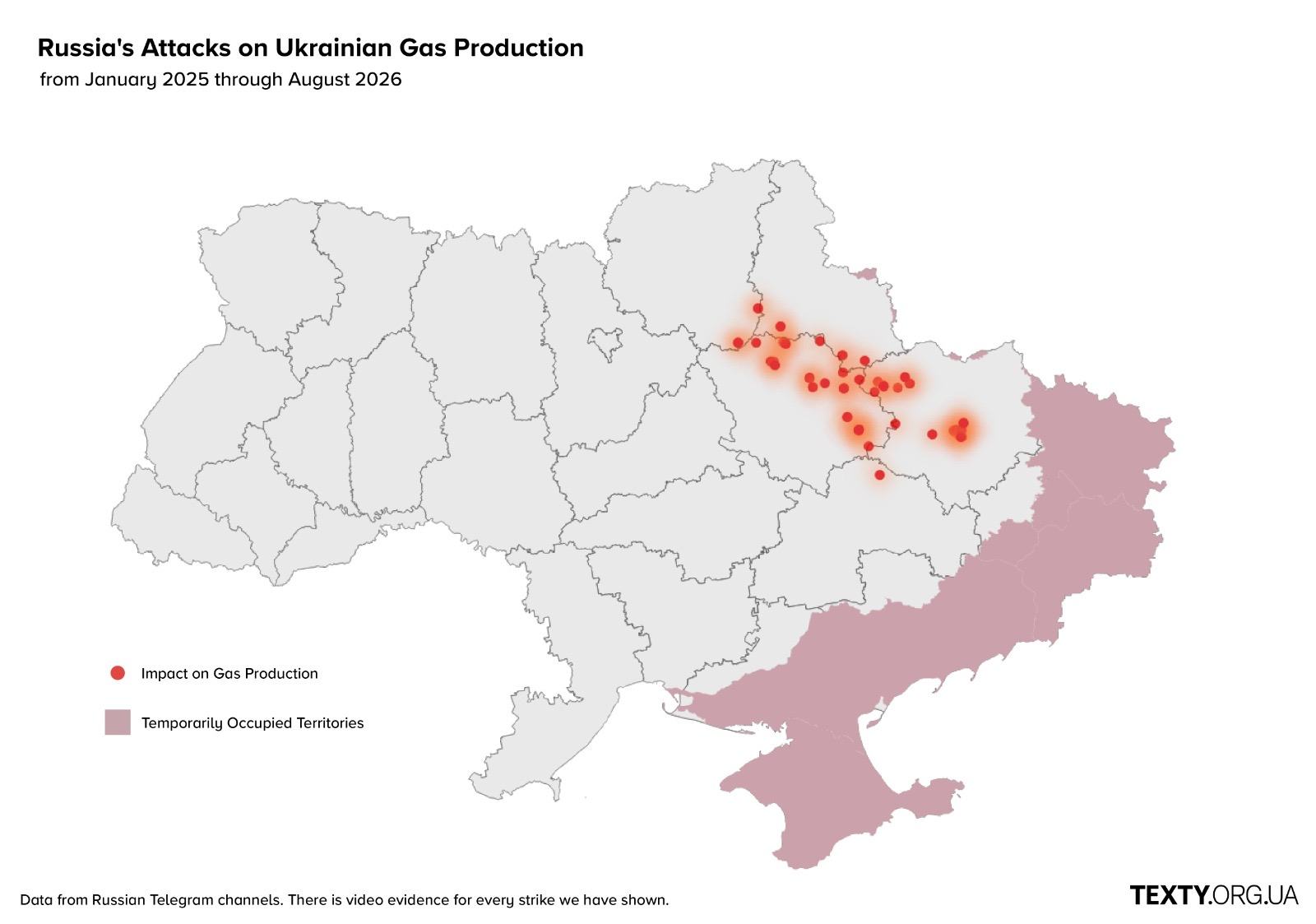
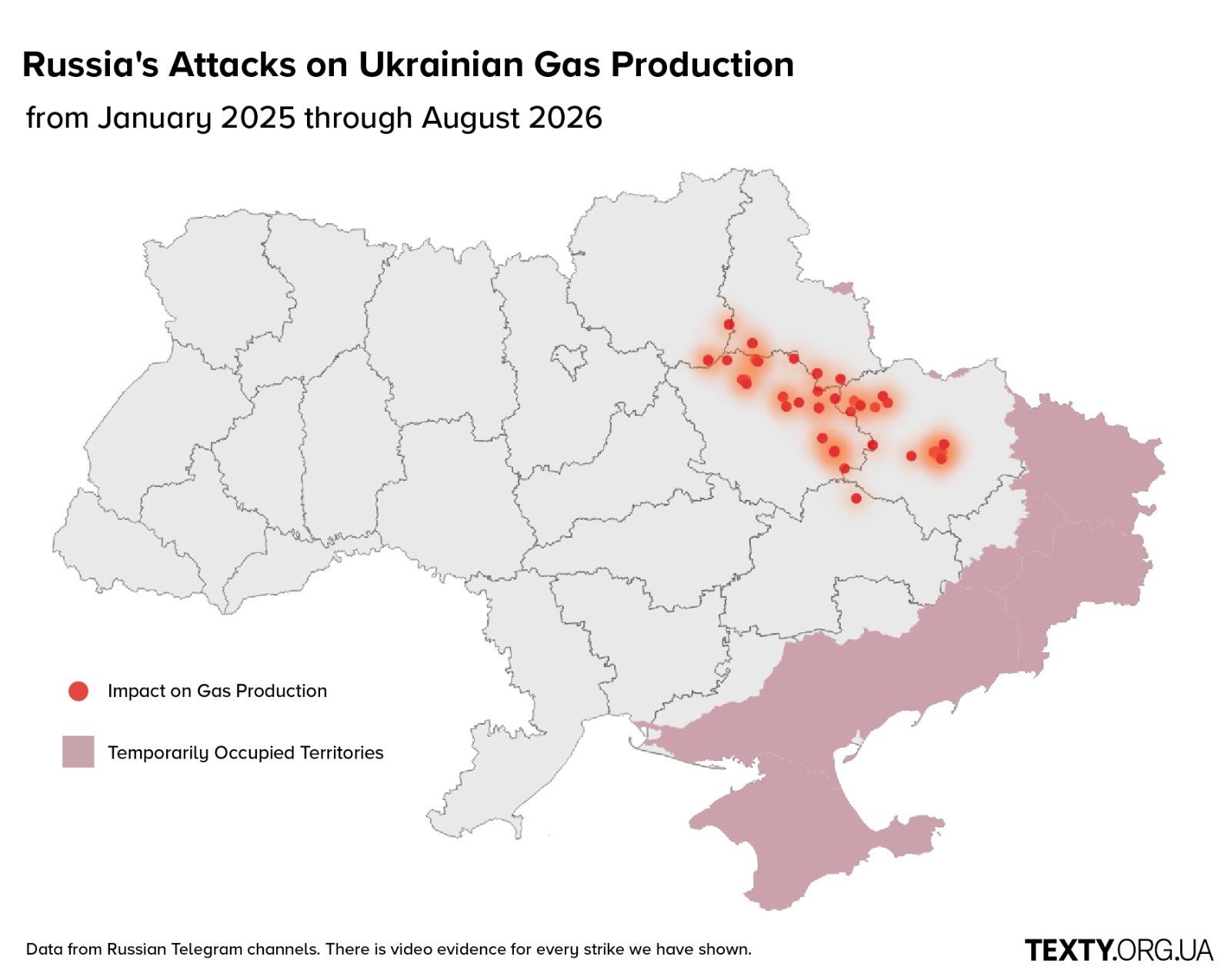
The logic behind Russia’s strategy is clear. If it cannot stop Ukraine’s gas production, it can at least slow it down. That would force Ukraine to buy more gas from abroad and spend money provided by international partners. For the same reason, Ukraine targets Russia’s oil refining industry, seeking to force the aggressor to buy oil products abroad and increase its war costs. Fuel shortages also put pressure on Russian citizens and the Kremlin, which wants to keep the public as detached as possible from the reality of the war.
Ukraine will not be able to avoid importing gas this year either, but the expected volume is 4-6 billion cubic meters a year. Technically, this is more than feasible. The infrastructure needed to import gas from Europe is already in place, with even some excess capacity. The only issue is the cost — hundreds of millions of dollars. To put that in perspective, Ukraine consumes more than 20 billion cubic meters of gas a year. Moscow will seek to steadily increase the share of imported gas in Ukraine’s overall supply.
Why heat matters most
Most of the heat production in Ukraine depends on the availability of gas. For many cities, gas and heat are essentially synonymous. And there is some good news here: completely destroying the gas transmission system is difficult. Serhii Makohon, who headed the state-owned Gas Transmission System Operator of Ukraine from 2019 to 2022, explains:
"The gas transmission network is extensive, with alternative routes and backup components. We have more than a dozen gas storage facilities in different parts of the country. Gas reaches major cities, including Kyiv, from different directions. So attacks are more likely to target the facilities that consume gas, such as CHPPs and TPPs".
There is another important detail. Gas supplies are largely independent of electricity: pressure in the pipelines is maintained by gas turbine units that run on gas itself. Even when cities lose power, gas will usually still be available. At the same time, municipal boiler houses and CHPPs need electricity to run pumps and electrical equipment.
But the good news comes with a catch. Different parts of the energy system are connected by invisible threads — through people’s behavior and the interchangeability of resources.
As things worsen
When temperatures start to fall, people turn on electric heaters even before the heating season begins. Once heating is switched on, the load on the power grid falls. It rises again when temperatures plunge. And when shelling cuts off heating, people turn to gas and electricity to keep warm. The gas system can handle this. The power grid cannot always cope with the additional load.
Former Acting Minister of Energy of Ukraine Olha Buslavets gives the following figures. Every 1°C (1.8°F) drop in temperature increases electricity consumption by 150–250 MW. When heating is in short supply or a CHPP is out of service, the increase can reach 300 MW per degree. A drop from −2°C (28.4°F) to −10°C (14°F) means an additional 1.2–2 GW of demand. That is why losing a CHPP that produces both heat and electricity is a double blow.
At the same time, the backbone of Ukraine’s power generation remains in place. Energy expert Volodymyr Omelchenko of the Ukrainian Centre for Economic and Political Studies named after Oleksandr Razumkov calls it the country’s basic energy "shield": nine nuclear power units with a combined capacity of about 8 GW, plus 2.5 GW of imported electricity, around 1.5 GW of distributed generation, and another 1.5 GW from solar, wind, and hydropower. That adds up to 13.5 GW.
"This is a shield that the enemy has failed to break in four and a half years," the expert says.
Last year, electricity consumption reached 18 GW during evening peaks on cold days. This year, the expert forecasts 16 GW. In his assessment, even if all TPPs and CHPPs are destroyed, we could face 4–6-hour power outages during peak hours. That is a serious problem, but not a catastrophe.
The loss of a large CHPP, however, would be the worst-case scenario for the part of a city that depends on it for heating. Central heating for hundreds of thousands of people cannot be quickly replaced with an alternative. What’s more, heating networks need continuous circulation in winter. Otherwise, the pipes can start to freeze. Electricity can be redirected from another region, but heat cannot. It is produced and consumed locally. That is why heat from CHPPs is the most pressing problem — and the one that needs to be addressed first.
What winter may bring
In the fall, Russia will continue launching missile and drone attacks, as well as ballistic strikes. In my view, Russia will once again step up cruise missile launches, targeting areas from Dnipro to Ukraine’s western border — home to some of the country’s key TPPs. The current relative lull in such attacks should not give us a false sense of security.
And the main issue here is not electricity. As long as the nuclear power plants (NPPs) keep operating, Russia cannot take away the backbone of Ukraine’s power generation. Russia will again target the substations that feed electricity from NPPs into the grid. But Ukraine has already learned how to deal with this. Before a massive attack, nuclear units reduce their output in advance and ramp it back up a few hours later. This helps prevent emergency shutdowns caused by an inability to feed the required amount of power into the grid. If a unit were to shut down automatically in an emergency, bringing it back online would take much longer. Energy workers have also learned how to "reroute" electricity around damaged nodes and keep backup equipment on hand. So long periods when nuclear plants are completely disconnected from the grid are not expected. Heat is a different story — and that is the key issue this winter.
Logically, the solution would be to provide round-the-clock electricity to districts that have lost their heating. The problem is that residential building-level electrical equipment usually cannot handle such a load. Last winter’s experience in Kyiv confirmed this: building equipment burns out, and the number of minor failures becomes a nightmare for repair crews.
So here is the bottom line. We do not know how cold the winter will be or how well our air defense will perform. We do know that Russia will target energy infrastructure and power grids. I would assume the baseline scenario: new waves of massive strikes on major CHPPs and TPPs across the country.
We also know the most important thing: heat is the priority. Districts that depend most heavily on large CHPPs need to be protected with backup capacity or given "unlimited" access to electricity while centralized heating is unavailable. But even with enough electricity, things are not that simple. The problem is the capacity of distribution transformers. The weakest link is no longer Ukrenergo’s (National Power Company) large autotransformers, but the old, windowless gray "hut" in the courtyard. That is a distribution transformer: high-voltage electricity comes in here, and cables run from it to the buildings.
The capacity of this "hut" is enough for lights, refrigerators, and kettles — roughly what it was designed for when the system was built. Transformers were installed, incoming cables laid, and wiring in apartments designed accordingly. Electric heating, in most cases, was never part of the equation, and no one could have imagined the kind of war Ukraine is facing today.
So the question is not whether electricity is available. If even half of the apartments turn on electric heaters, the load will increase several times over. Then either the protection system trips and the entire neighborhood loses power, or something burns out. And that means not hours but days or even weeks to restore power.
I will not give people advice on what to do or where to go. Nor will I tell fairy tales about distributed generation saving everyone. It is necessary, but in reality, Ukraine’s energy system rests on large NPPs and domestic gas production.
We also know Russia will come up with something new in its attacks — it has done so every year. But we are now in the fifth year of the war. Experience should have accumulated at every level. Among energy workers, who have learned to restore equipment in days rather than months. Utility workers, who know the weak points in their networks. Residents and homeowners’ associations, who know what to do when the power or heating is cut off.
Підпишіться, щоб отримувати найкращі статті на e-mail (раз на два тижні)

Підписатися