Статті
Visits by foreign partners are indeed Kyiv’s fine air defense (INFOGRAPHIC)
Ukrainian jokes about the "Keith Kellogg’s operating range", the "Duty roster for Western officials in Kyiv", and "The prince has arrived, girls — everyone’s sleeping naked tonight" are funny precisely because they’re true.
Texty.org.ua, in collaboration with the StratCom of the Armed Forces of Ukraine, analyzed Kyiv’s air alert archives for 2026. The "popular wisdom" saying that Russian strikes decline when visible support rises is largely backed up by the data.
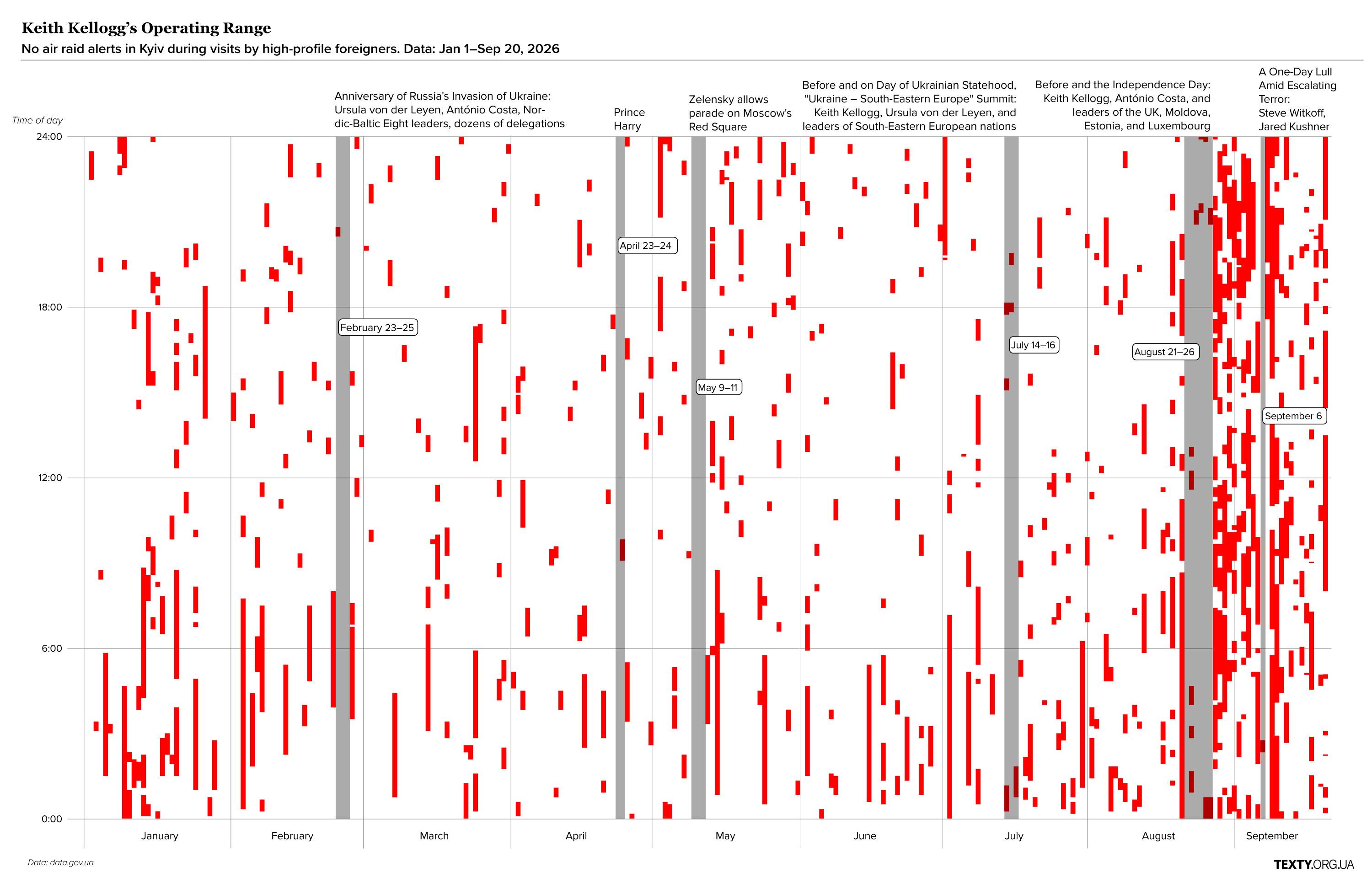
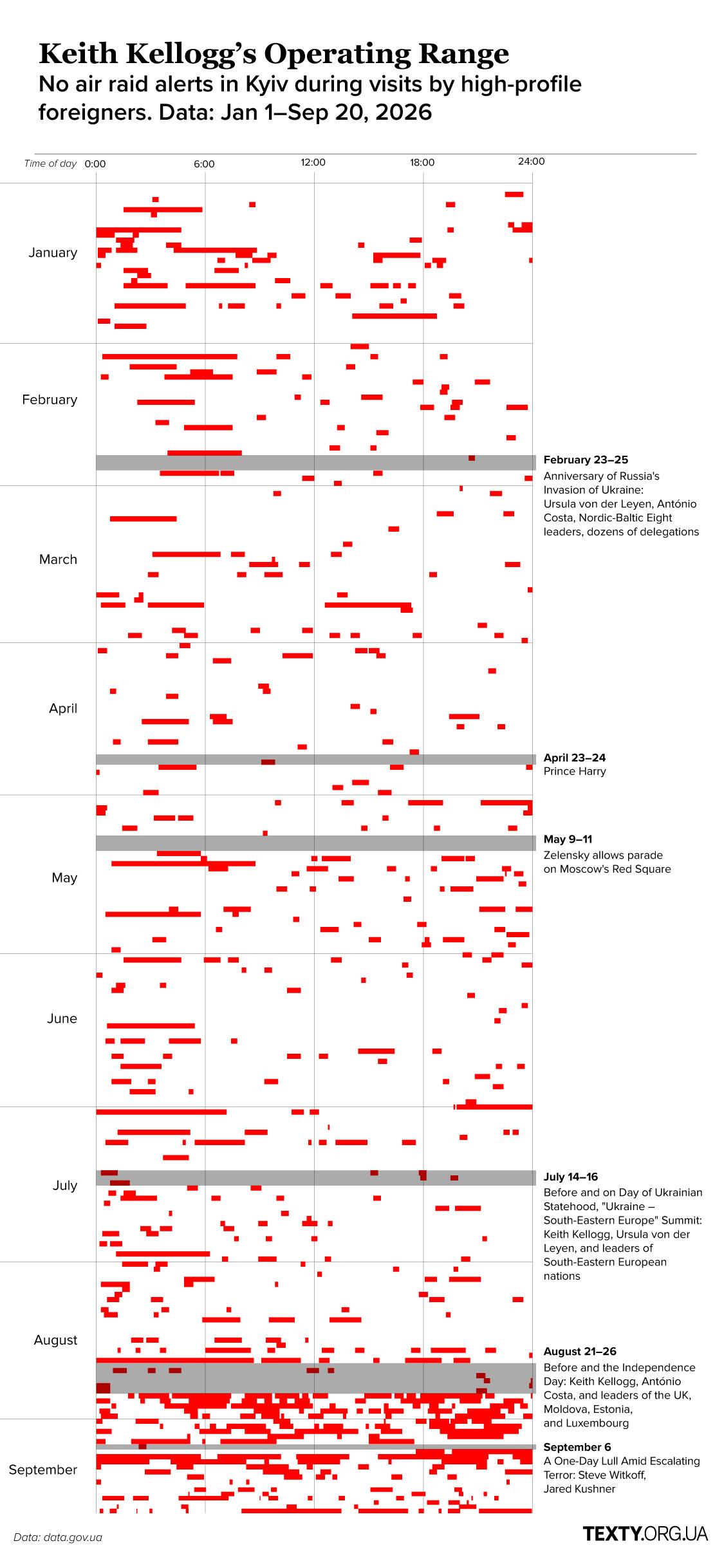
As we may recall, Russia begins easing its winter terror as temperatures rise, having previously tied its strikes on heat and power plants to a record-breaking freezing streak. The coldest day was February 10, after which conditions gradually shifted toward meteorological spring — which in Ukraine coincided with calendar spring this year. Yet even by late February, we see clear days of calm.
The anniversary of the Russian invasion stands out on the chart as a distinct lull in Russian strikes. It was during these days that Kyiv hosted European Commission President Ursula von der Leyen, European Council President António Costa, and the leaders of Croatia, Denmark, Estonia, Finland, Iceland, Latvia, Norway, and Sweden.
Another break from the bombardments — one that stayed in the minds of Kyivans through lighthearted jokes — came with British Prince Harry’s visit to Kyiv and Bucha in late April.
Given the epic scale of the event, we also recall a pause of a different kind — when the President of Ukraine, responding to Russian requests relayed through intermediaries, issued his viral meme decree permitting Russians to hold a parade on Moscow's Red Square. Shortly after holding its parade, Moscow resumed its bombardments.
Around Ukrainian Statehood Day and the Ukraine–Southeast Europe Summit, we see another lull in strikes. During those days, Kyiv hosted European Commission President Ursula von der Leyen alongside leaders of Romania, Moldova, Slovenia, Montenegro, and Serbia. Ukrainians were able to get some sleep, sparking online jokes about the "operative defense range" of US Special Envoy Keith Kellogg.
Finally, leading up to and around the Independence Day of Ukraine, we see a wide several-day band of lull in Russian air strikes. After visiting Odesa, the very same Keith Kellogg arrives in Kyiv with the very same outcome. Also, European Council President António Costa — who also visited on the invasion anniversary — as well as the UK’s new Prime Minister making his inaugural foreign visit, along with leaders of Lithuania, Estonia, Luxembourg, and Moldova once again, among others.
Shortly after the delegations depart, an unprecedented wave of terror begins on the night of August 27, ultimately forcing a delay to the start of the school year, among other outcomes. Yet within this phase lies one brief, telling pause: September 6, the day US negotiators Steve Witkoff and Jared Kushner arrived straight from Moscow. One can only speculate whether the Russian barrage leading up to their visit was, in fact, Putin’s version of a “negotiating tactic”.
For now, however, one takeaway is clear: the stronger the demonstration of support from partners, the weaker Russian terror.
Підпишіться, щоб отримувати найкращі статті на e-mail (раз на два тижні)

Підписатися