

Статті
Ukraine's energy network: Between the fortress of the past and the infrastructure of the future
The energy map of Europe is a dense web of lines and nodes that glow like the night lights of industrial cities. At the same time, the difference between its western and eastern parts is clearly visible. This is not merely a technical difference, but an entire visual history of two civilizational approaches to energy.
Visual difference
In Western and, to some extent, Central Europe, power grids were developed based on business principles: competition, efficiency, and proximity of generation to consumers. Here, 110–220 kV and 380–400 kV lines predominate—the “ceiling” of the European system. Energy flows from decentralized sources—wind, solar, hydro, nuclear, and thermal power plants—along short routes with minimal grid losses. This grid resembles the capillary system of a metropolis—dense, flexible, market-driven, but not overly fortified with reserves.
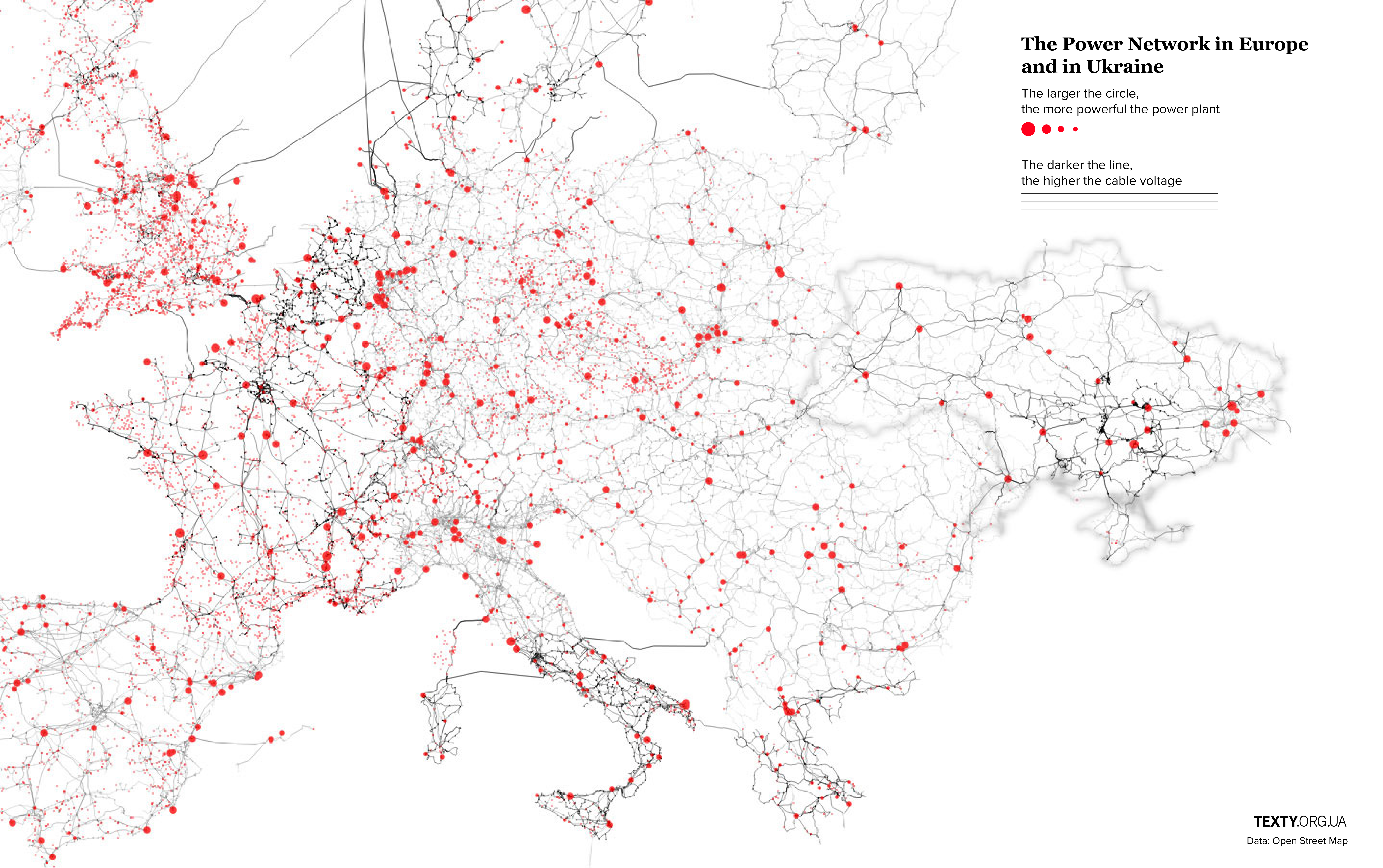
The Ukrainian part of the map looks different. It is dominated by thick 330 kV, 500 kV, and especially 750 kV transmission lines—an ultra-high voltage class that is almost unheard of in Europe. This is a legacy of the Soviet doctrine of the 1960s–1980s, when an “energy fortress” was built to support total war and a super-powerful industrial sector. The giant thermal power plants of the Donbas, the Zaporizhzhia Nuclear Power Plant, and the cascade of hydroelectric power plants on the Dnipro River required transmission lines capable of carrying gigawatts over hundreds and thousands of kilometers, with redundant routes and excess reserves.
It was precisely this legacy of the Ukrainian SSR that, paradoxically, saved the system in 2022–2025: even after losing up to 80% of thermal generation and suffering strikes on key nodes, the grid did not collapse completely or break up into isolated islands. But this fortress has a downside. It is centralized, energy-intensive, with high transmission losses, and critically vulnerable to attacks on key nodes. The very existence of these nodes creates a target for enemy attacks.
After the first large-scale attacks in late 2022, there was much talk in Ukraine about decentralizing power generation. These discussions continue to this day, especially against the backdrop of Russian attacks and the crises of early 2026. But the main point is often overlooked: it is not only power generation that needs decentralization, but first and foremost the grid itself—transmission and distribution.
The Ukrainian grid remains largely undecentralized, poorly digitized, and heavily reliant on manual processes. The voltage classes are Soviet-era: 750 kV as the backbone, 330–500 kV for regional flows, and 110–220 kV for distribution. In Europe, the 750 kV voltage class is rarely used because there is no need to transmit electricity over such long distances: everything is closer, simpler, and more efficient.
Formally, Ukraine is already part of the European energy space: since 2022, we have been synchronized with ENTSO-E (the European Network of Transmission System Operators for Electricity), and as of July 2025, even the nominal voltage in electrical outlets has become 230 V instead of the Soviet-era 220 V. This is a symbolic break with the past. Ironically, however, symbols do not negate reality: following the winter power outages of 2026, many consumers are seeing less than 200 V on the grid.
The contrast remains striking: the European grid is driven by business and economic logic, while the Ukrainian grid is a resilient but outdated bunker. The question is no longer whether to transform this fortress-bunker, but how to do so without creating new, massive targets for the enemy.
Three Steps
And here it’s worth taking a sober look at popular ideas. For example, burying 750 kV substations underground. At first glance, it seems appealing. In reality, however, this risks turning them into even more expensive and even more attractive targets. There is another way—not to bury these giants, but to decentralize the system, while still ensuring a certain level of protection.
Based on our discussions with various experts, energy professionals, and industry specialists, we can identify three steps on which there is near-consensus.
The first necessary step is to radically simplify the voltage hierarchy. Historically, Ukraine has accumulated “superfluous” voltage levels: 110 kV and 150 kV, 220 kV and 330 kV, with 500 kV and 750 kV existing in parallel. This “zoo” of voltage levels turns the simple into the complex. It is expensive, inefficient, and complicates operations.
Strategically, 500 kV and 750 kV should gradually disappear from the map of Ukraine, making way for the European 400 kV standard. This is not a matter of a single year, but it requires a clear and politically binding decision. Otherwise, we will continue to add new voltage levels without phasing out the old ones, and the grid will turn into a tangled web in which our entire energy sector is caught.
The second step is to build an extremely powerful and extensive lower-voltage grid—110–150 kV. This is not how things are done in peaceful Europe. But the Russian Federation isn’t targeting everyone with nearly its entire arsenal of missiles and drones. There are an order of magnitude more substations in this class; they are significantly smaller in size, and some of them can actually be protected or even partially buried underground. This grid already exists—it doesn’t need to be invented, but rather systematically strengthened, assigning it a system-forming role.
The third step is to move beyond mere talk of “smart grids” (smart grids and microgrids) to the actual ability to operate in an isolated mode. The war has already provided us with an unexpected resource—thousands of generators brought in without any unified system. Now the task is to learn how to balance these “islands”: maintain frequency and voltage, and quickly and safely synchronize them back into the main grid. “Quickly and safely” is probably the most important part here.
We need to do
In other words, the problem in Ukraine isn’t so much about what needs to be done, but rather about the consistent implementation of what has already been devised. This is understandable: the three steps mentioned are complex, costly, and long-term. There won’t be a quick political “wow effect” here, but what’s needed is the entire government system’s tenacious ability to “stay focused on a single goal.”
The problem isn't a lack of ideas, but putting what has already been conceived into practice
But this can be done step by step, on the ground, in areas where there is readiness. Critical consumers—water utilities, boiler rooms, communications, and military and medical infrastructure—should become the hubs of such “islands.” As for generation, it should come not only from large, older power plants but also from small and medium-sized hydroelectric plants, biogas, gas and diesel generators, renewable energy sources, and energy storage systems. Even large power plants need to be retrofitted so that each individual unit can sustain one such “island.”
This energy map is not just an illustration. It is both a diagnosis and an action plan that has already been effectively agreed upon within expert circles. For Ukraine stands between two models: preserving a slowly aging Soviet fortress, or transforming it by combining resilience with European efficiency and decentralization. The war has made this choice inevitable. The only question is whether Ukraine can—and will—manage to learn from its harsh lessons in time.
P.S.
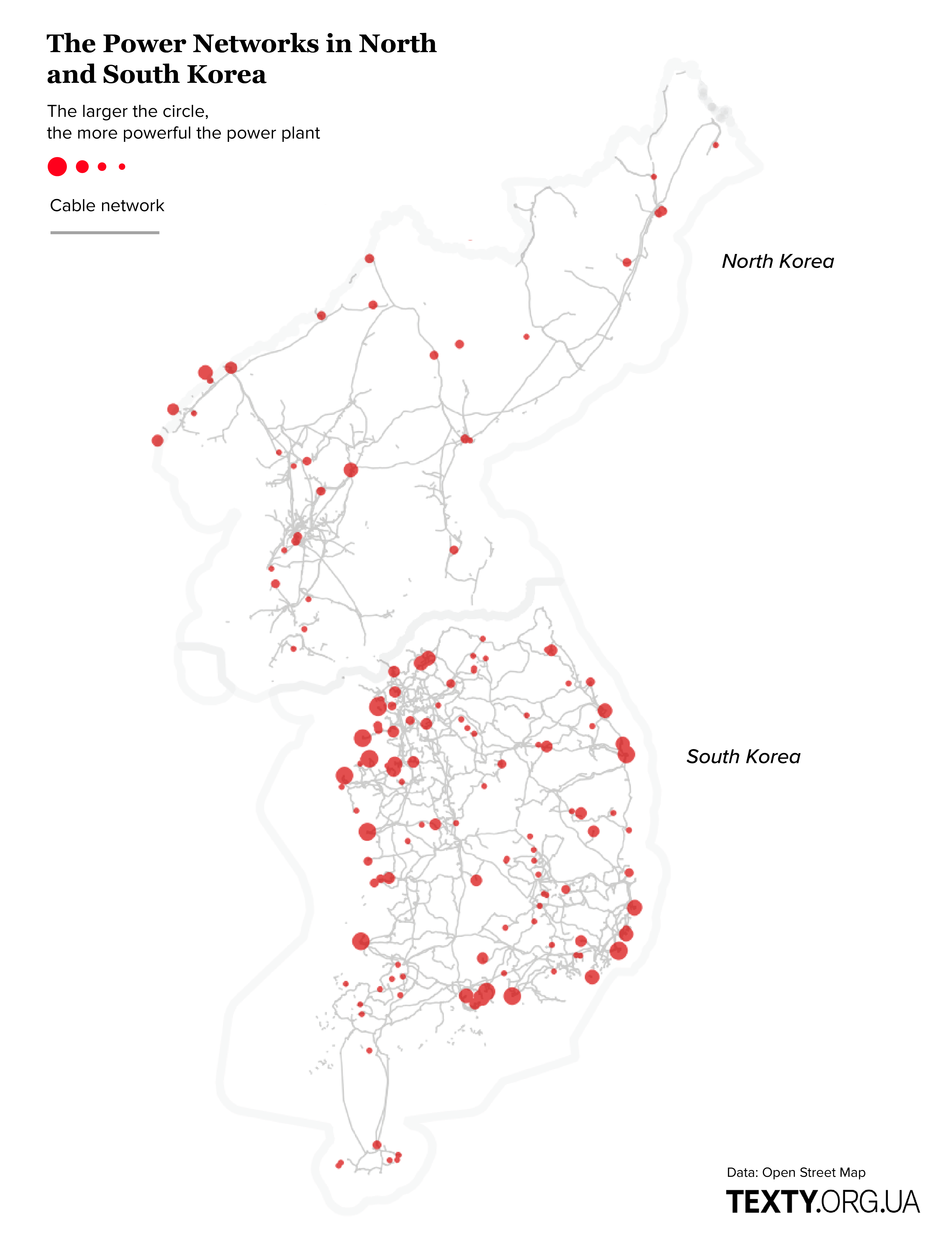
Finally, we will also highlight the fundamental difference between the two approaches—or, more precisely, civilizations. This difference is strikingly evident in the example of the power grids of South and North Korea.
Підпишіться, щоб отримувати найкращі статті на e-mail (раз на два тижні)

Підписатися