

How Russian propaganda covers protests in Iran
On December 28, protests began in Iran in response to rapidly rising prices and the fall of the national currency, which later turned into demonstrations against the theocracy that has ruled the country since the 1979 Iranian Revolution. We analyzed posts by Russian propagandists on Telegram aimed at a Russian audience to track how Russian propaganda responded to these events.
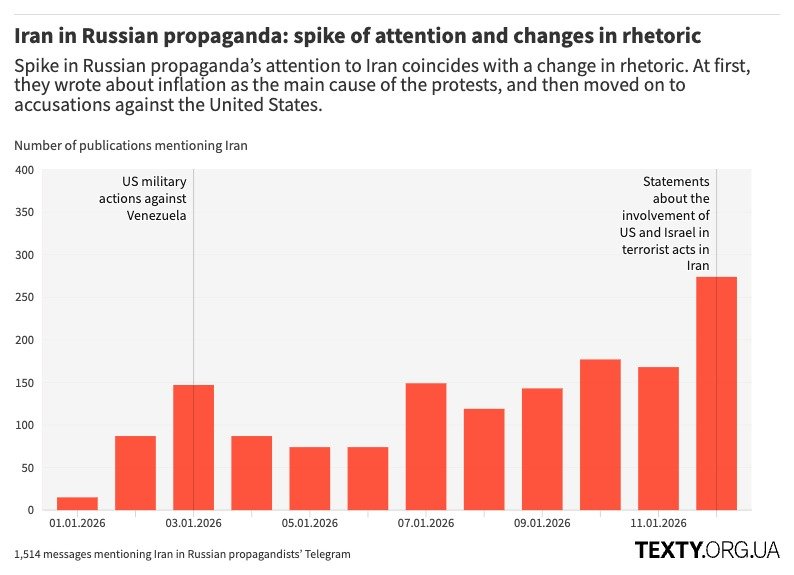
In total, we examined more than 1,500 posts published between January 1 and January 12 that mention Iran. This is about 5% of all posts collected from nearly 120 Telegram channels belonging to the Russian propaganda network.
To sum up, Russian propaganda began with an analysis of economic problems, sometimes expressing sympathy for the protesters, and ended with calls for shooting. In a few days, the protests in Iran were reinterpreted. From an economic crisis, they turned into an "American conspiracy".
At first, there was "sincere" compassion
It all started with simple messages.
"There are mass protests in Iran due to rapid inflation, there are injuries" — these were the main headlines on January 1–2 in the Russian propaganda Telegram channel.
In most of the reports we analyzed, Russian propagandists spoke with ostentatious excitement about the protests in Iran. They cited inflation and the country's economic policy as the leading causes of the unrest: "Mass protests have been taking place in Iran since December 28 following a sharp fall in the national currency... In 2025, consumer goods prices in the country rose by more than 52%".
At this stage, the rhetoric seemed almost neutral. Russian channels were essentially reproducing the logic of socio-economic analysis, which they do not usually resort to when describing events in other countries. The protests were presented as a consequence of Iran's internal problems, without the usual propaganda search for an "external enemy".
Only a few propaganda channels cautiously hinted that "something was wrong here" and suggested that Israel's actions could have caused the unrest. These hints were quickly redirected to the traditional scenario with the US behind the scenes: "Trump welcomed 2026 in Florida in the company of Israeli Prime Minister Benjamin Netanyahu. I believe that Iran should prepare itself this year".
However, initially, Russian Telegram propaganda was in no hurry to shift responsibility for the events onto the collective West. On the contrary, it harshly criticized the Iranian government for inflation, corruption, and economic policy. In particular, statements such as "the reasons for the state of the Iranian economy are the simultaneous pressure of Western sanctions, the dominance of the public sector and semi-public security forces, corruption, and ineffective management" appeared.
At the beginning, propaganda had not yet settled on a single line of explanation. It vacillated between sincere sympathy for the "victims of inflation", criticism of the allied regime, and cautious attempts to fit the protests into a familiar conspiracy narrative. It is from this point that the transformation of messages begins — from neutral economic analysis to the search for an external enemy, which is a classic mechanism of Russian propaganda.
Everything points to US involvement
On January 2–3, the logic of propaganda changes dramatically. A clearly defined "initiator" of the mass unrest emerges, and it is ultimately the US.
The situation was further exacerbated by Donald Trump's statement that the United States was ready to come to the aid of the protesters. This statement instantly angered Russian propagandists and became the perfect excuse to change their rhetoric, "Yeah, right. They organized and paid for the protests themselves. 'Peaceful' protesters are throwing stones at the police, and the police are naturally defending themselves. But how could it be without the damn US. Damn saviors".
From this moment on, one of the key narratives takes shape. The US is not just observing events, but is ready to take advantage of the situation and seize the initiative.
However, even this version of events did not last long. The next day, January 3, the US launched a military invasion of Venezuela and captured President Nicolás Maduro. This event sharply intensified the emotional tone of Russian Telegram propaganda and became universal "proof" of Washington's aggressive intentions.
After that, the United States finally became the main instigator of all unrest in Iran, regardless of its real causes.
Some propagandists are beginning to broaden the scope of their explanations, claiming that the US cannot, in principle, accept the existence of the Iranian regime. Last year's attacks on Iran are presented as a defeat for Washington, as if the US was unable to implement its plans at that time and has now moved on to "retribution" by other means: "1. Israel and the US will not abandon their goal of destroying Iran’s political system. There will be no peaceful coexistence there. 2. Having failed to defeat Iran militarily in the summer of 2025 and receiving a harsh response from Israel, opponents returned to their usual tactics".
Changing narratives
Within a matter of days, propaganda undergoes a complete transformation — from socio-economic explanations and cautious criticism of the allied regime to a harsh conspiracy narrative about the "American interference". The real internal causes of the protests finally disappear from view, giving way to the universal and convenient scheme of an external enemy: "Only a naive person could think that something could radically change in US politics. If the scheme works, why change it?"
Next, the description of the protests themselves changes. Protesters become "rioters", "rebels", and "terrorists". The phrase "peaceful protesters" is deliberately placed in quotation marks and replaced with the narrative of "armed militants", which is well known to Ukrainians.
This is how Russian propaganda media described the participants of the Revolution of Dignity in 2013–2014: "In various cities, the core of the 'protest' consists of small groups of militants armed with cold weapons and firearms who attack security forces and police stations. Ask Lukashenko what to do with such 'protesters'. And ask Yanukovych what not to do, he knows for sure".
Russian propaganda Telegram channels are flooded with direct calls for the harsh suppression of protests, citing the words of the Ayatollah, which are used as a moral justification for violence: "Protesting is a right, but rioting is not. It is useless to talk to rioters. They must be subdued".
Iranian law enforcement agencies, on the contrary, are accused of being too lenient: "In any country in the world, this would be punishable by a bullet to the forehead. In America, a bullet to the forehead is punishable for much less. Iranian security forces are too lenient".
We want to add that, according to the human rights organization HRANA, cited by CNN, at least 2,400 people have already died during the protests in Iran. CBS claims that at least 12,000 people have died, but the number could be as high as 20,000.
At the same time, propagandists appeal to "unity" and complain about world leaders who allegedly do not hear their message. The rhetoric takes on an openly ultimatum tone: "This is a turning point for the international community. Those who express protest and disagreement still have national pride and are ready to defend their sovereignty. Those who remain silent or keep quiet have something to hide or are 'doormats'.
Z-propaganda ("Z"– Russian pro-war symbol), which traditionally sounds more radical than television propaganda and propaganda in the Russian media, goes even further. It already openly states that it is impossible to negotiate with Donald Trump and that any agreements with the US are doomed to betrayal: "Donald Trump recently held telephone negotiations with Nicolás Maduro, and then a treacherous blow, and the Venezuelan president is in an American prison. Incidentally, the same thing happened with Iran: our friend Steve Witkoff convinced Tehran that it had nothing to fear during negotiations with Washington on its nuclear program. And again, there was a sudden attack by Israel, one of the goals of which was to kill the Iranian leadership".
Is Russia a reliable ally?
Venezuela, the seizure of tankers flying the Russian flag, Iran — these are all "bad days" in the propaganda calendar. And the point here is not compassion, but a sense of threat.
For years, Russia has declared its alliance with both Caracas and Tehran, demonstrating mutual support on international platforms, while Iran has also been actively assisting Russia in its war against Ukraine. That is why Russian propaganda perceives the events in Venezuela and Iran not as "other people's problems", but as attacks on its allies.
Now this support is beginning to crumble, and Moscow is unable to help its partners. Military, economic, and diplomatic resources are limited, as is evident even in propaganda rhetoric.
Against this backdrop, the official information machine also joins in with the Z-propaganda. On January 2, major Russian media outlets began massively circulating statements that "Iran has numerous documents proving the involvement of the US and Israel in terrorist acts during the unrest". This is an attempt to return events to the familiar framework of conspiracy and relieve allies of responsibility for the internal crisis.
The propaganda task is changing accordingly. Now it is necessary to prove that "everything is not so bad" and that Russia is allegedly helping Iran as much as it can.
That is why Telegram channels are actively spreading messages with references to Western media reports about "active assistance" to Iran from Russia and China: "They write that China and Russia are helping. Russia is providing equipment, China is providing technology".
The rhetoric then intensifies even further. Propagandists claim that "Russia and China continue to actively supply Iran with weapons: aircraft, helicopters, radar systems, air defense systems, etc," hinting that Iran could use these resources to combat external threats actively. Even if there is no real confirmation of such deliveries, the narrative itself serves to reassure the domestic audience.
However, in the absence of any breakthrough in the situation, propaganda is becoming increasingly less confident. That is why we are seeing the emergence of an information campaign to justify. It consists not only of preparing informational justifications and shifting the blame onto external enemies, but also of gradually diminishing the value of allies themselves.
Thus, following the fall of the Assad regime in Syria and against the backdrop of recent events in Venezuela, one of the reasons cited for the catastrophe is the inefficiency of regimes, corruption, and unprofessionalism. Similar sentiments are emerging regarding Iran: there are growing attempts to portray it as an "imperfect" ally, and Russia may even benefit from any changes.
A revealing example is the sudden shift to utilitarian logic. Some channels report with obvious satisfaction on the rise in energy prices: "Meanwhile, Brent crude oil has risen to $64 per barrel. In our draft budget, the average price of oil is set at $59?...So what does that mean? Is Trump, by attacking Venezuela and Iran, working as an agent of our Ministry of Finance? He enriches himself, of course, the imperialist is relentless, but he also fills Russia's budget".
As a result, propaganda demonstrates two mutually exclusive strategies: on the one hand, there is rhetoric about "loyalty to allies" and stories about assistance, and on the other hand, there is a willingness to distance oneself from them when it becomes advantageous quickly.


