Статті
Why Russian Bulgakov should be cancelled in the West
The Western public just adores Russian writer Mikhail Bulgakov. However, he is part of the spread of Russian imperialism, which could be dangerous in the modern, democratic world. We will explain the problematic of Bulgakov in the case of his Ukrainian "fans".
Drivers have a concept known as the "blind spot". This section of the road cannot be seen for specific reasons. Ukrainian fans of Bulgakov also have their own "blind spot". When they passionately discuss the writer's Ukrainian identity, and rave about his novel "The Master and Margarita", they somehow mostly forget about something. Bulgakov's story "I Killed".
If you ask these fans, whether they know this story, they will most likely say that yes. They have read it, but they don't really remember what it's about. In short, "I Killed" is a complete so-called "blind spot". When you start reading, you immediately understand why.
The writer tells the story from the perspective of a neutral narrator. At first glance, his protagonist is an entirely impartial figure who inspires immediate trust. This narrator, in the company of Moscow doctors, listens to Doctor Yashvin's story about his adventures in Kyiv during the Russo-Ukrainian war in 1917-1918.
The narrator briefly describes Doctor Yashvin, and from his words, it immediately becomes clear that we are dealing with a true professional, an almost perfect person. "He was very clean-shaven, dressed very neatly, loved going to the theater. When he talked about the theater, he did so with great taste and knowledge. <...> and he was a doctor, to give him his due, a very good one."
Bulgakov also mentions the doctor's "white skin", which he obviously likes very much. "Dark-haired, he also had very white skin, which made him handsome and somehow set him apart from the crowd."
Yashvin begins to recount his stay in Kyiv just before the retreat of the Ukrainian army and the occupation of the city by the Bolsheviks (Russian or Soviet army during that period — ed.)
He does not skimp on epithets: "Because what Petliura's troops (the Ukrainian troops of the Ukrainian People's Republic — ed.) did in Kyiv during their last month is beyond comprehension. Pogroms broke out every minute, someone was killed every day, with preference given to Jews, of course."
His "understandable matter" at the end of the accusation of pogroms is also telling. With this phrase, he seems to dismiss anyone who would dare to question the allegations of pogroms. This is one of his favorite tricks, by the way, as it is for modern Russian propagandists who make categorical statements. Such personalities as Olha Skabeeva or Vladimir Solovyov would certainly appreciate it.
Yashvin, as a doctor, is mobilized to one of the Ukrainian units, where he meets his antagonist, Ukrainian Colonel Leshchenko. Remember the description of the beautiful "white-skinned" doctor Yashvin? Here is the description of the Ukrainian Leshchenko's appearance: "His slanted eyes looked unkind, sickly, strange, as if black balls were jumping in them. His face was dotted with freckles, and his black trimmed mustache twitched nervously."
Of course, the colonel turns out to be an anti-Semite, but this comes as no surprise. It seems that Bulgakov clearly adheres to the following paradigm: if you are Ukrainian, you are anti-Semitic. Every single Ukrainian in this story is anti-Semitic, and they begin every conversation with this topic.
What is interesting and what seems to have gone unnoticed so far is that the story, in which Bulgakov very clearly and systematically emphasizes the anti-Semitism of Ukrainians, was published in the "Medical Worker journal in 1926. It was in May of that year that Symon Petliura was shot and killed in Paris by Symon Schwartzbard, whose trial gave Russian Soviet propaganda free rein to label the Ukrainian liberation movement as anti-Semitic. In other words, Bulgakov's story fits perfectly into the context of the Soviet authorities' trend of discrediting Ukrainians.
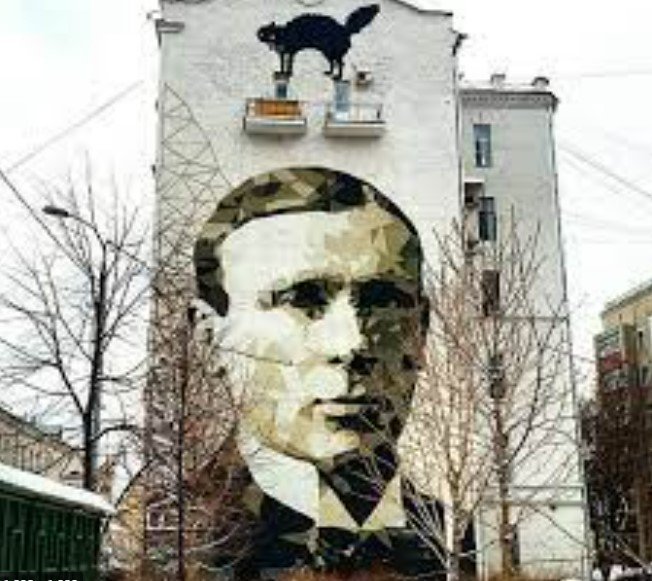
But let's return to the story "I Killed." Doctor Yashvin is forced to treat Ukrainian soldiers suffering from frostbite. But he strongly disapproves of this and constantly contemplates how to escape. At the same time, the author describes how Petliura's troops mock a detainee. Of course, the central figure here is the notorious Colonel Leshchenko. At the same time, all other Ukrainian soldiers are portrayed merely as gray executors of his will, mechanisms for carrying out the criminal orders of the Ukrainian colonel.
Apotheosis comes when the doctor is brought to the wounded Colonel Leshchenko and the wife of one of the executed men, who spits in the colonel's face. She is sentenced to "25 ramrods", after which Yashvin cannot bear it and, instead of treating the colonel's wound, shoots him with a pistol. Bulgakov describes Leshchenko's murder in great detail.
"I must have shot one of the bullets into his mouth, because I remember him rocking on the stool with blood running from his mouth, then immediately there were streaks of blood on his chest and stomach, then his eyes went blank and turned milky from black, then he collapsed to the floor."
Afterwards, the doctor flees and returns to Kyiv, which is under Bolshevik control.
The work ends with a very symbolic dialogue with the Red Army soldiers (the Soviet Union's military force):
"They stopped me and asked for my documents.
I said:
— I am Doctor Yashvin. I am fleeing from Petliura's forces. Where are they?
They told me:
— They left during the night. There is a Revolutionary Committee in Kyiv.
And I see one of the patrolmen looking into my eyes, then waving his hand pityingly and saying:
— Go home, doctor.
And I went."
A very eloquent ending. But to understand Bulgakov's idea, it is worth returning to the beginning of the story. There, doctors argue about whether a doctor has the right to kill a person. This is precisely what the writer answers with his story.
It is indeed possible to kill a person, but only under one condition: if that person is Ukrainian.
Bulgakov very skillfully substitutes concepts here when he equates Ukrainians with criminals. Because all Ukrainians in this work — without exception! — are sadists and criminals, or those who carry out the orders of sadists and criminals.
In "I Killed," there is not a single positive or neutral character who speaks Ukrainian or at least uses the set of words that Bulgakov considered Ukrainian. The doctor himself, the wife of the man who was shot, even some women who threatened the "Petliurivtsi" with punishment from the Bolsheviks — all of them speak Russian.
At the same time, when we hear Ukrainian, it means that someone from Petliura's forces will ask about Jews or threaten some kind of punishment.
In fact, belonging to the Ukrainian nation is a crime that must be punished, almost like in recent articles by Putin and his entourage.
And this punishment exists, because the entire story leads us to a single conclusion: even a doctor — that is, a person who has sworn an oath not to harm — has every right to kill Ukrainians. Because Ukrainians are a disease, a harmful dislocation that must be corrected. And that is why we are presented with the image of a principled "white-skinned" doctor who carries out his justice on the “slanted-eyed”, as he characterizes Colonel Leshchenko, savages.
Just a few years later, a similar situation occurred in one of the European countries — Germany. There, people similar to Yashvin, clean-shaven, with “very white skin,” wearing white coats, killed millions of people in concentration camps, whose only crime was their “wrong” nationality, which was equated with a crime.
Therefore, when Bulgakov is called a Russian chauvinist, one wants to ask: are you sure that he did not evolve in his views a little further than we think? After all, contemporary Russian society has indeed gone down this path: from chauvinism to real fascism. So why couldn't Mikhail Bulgakov, as a talented writer and Russian, have gone down it a little earlier?
Підпишіться, щоб отримувати найкращі статті на e-mail (раз на два тижні)

Підписатися