Статті
Russia highlights its problems by classifying data (INFOGRAPHICS)
Silence can speak volumes. Texty.org.ua and the UAF StratCom have visualized what data Russia classified — and when — leading up to, and then following its full-scale invasion of Ukraine.
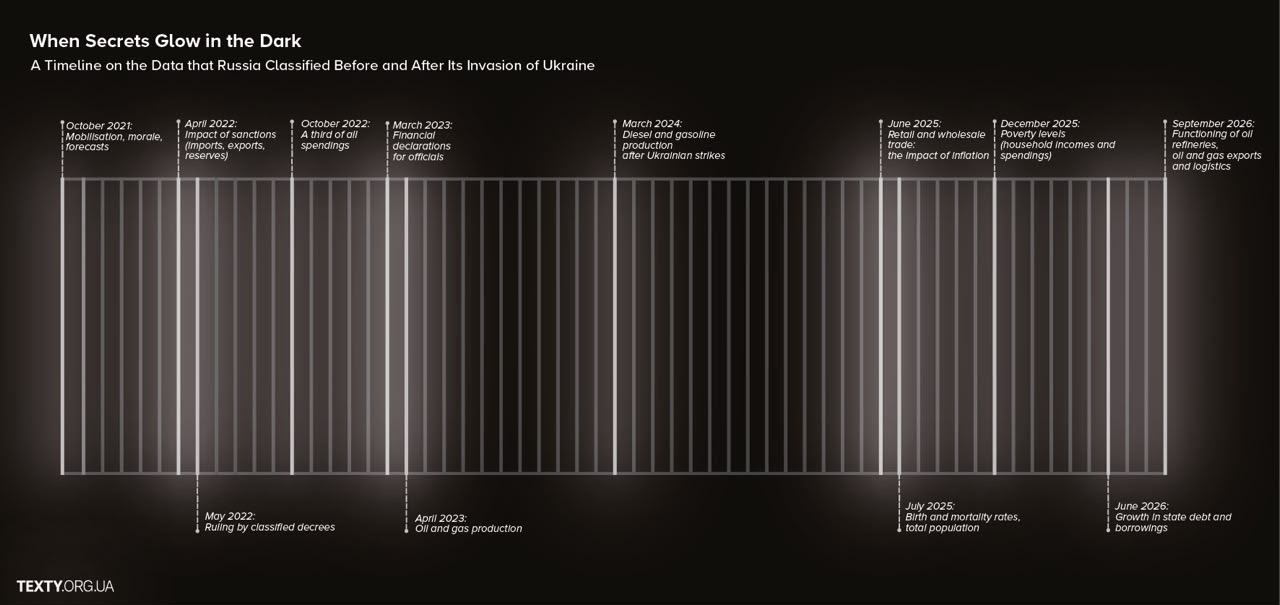
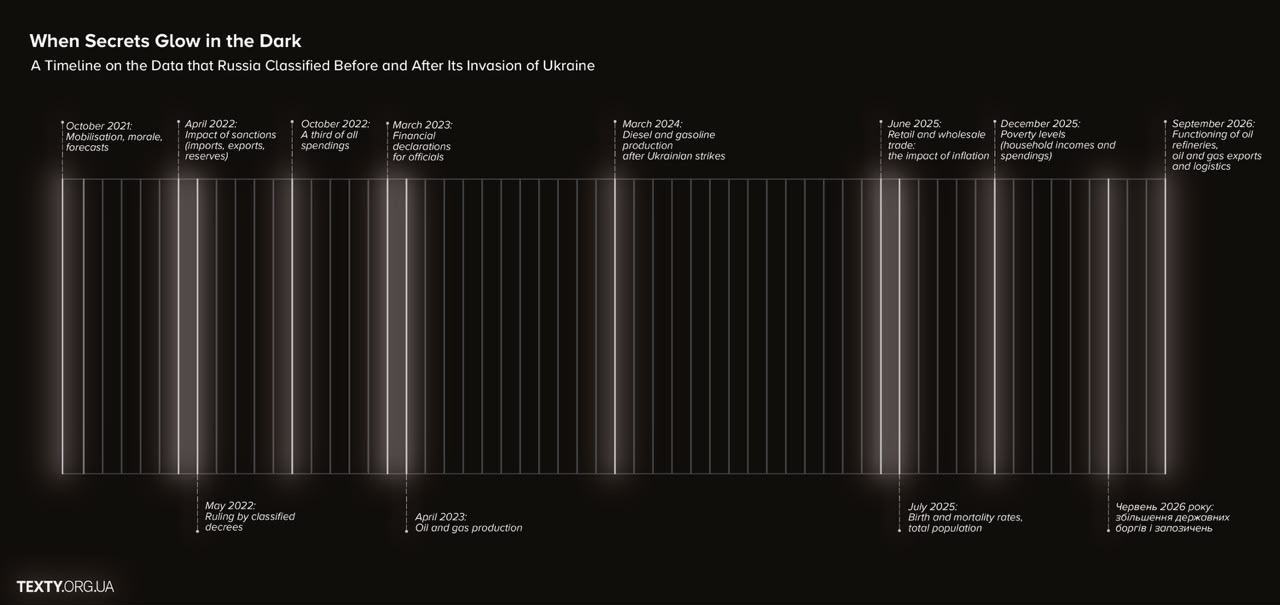
In certain cases, Russia just quietly ceased publishing statistics. In such cases, the date on our timeline marks the month when news outlets noticed and reported the disappearance.
As early as October 2021, FSB Order No. 379 came into effect, effectively classifying key military information, including:
- Mobilization
- Morale of the troops
- Crimes within the Russian army
- Military-political forecasts
This FSB order contains numerous other restrictions.
Immediately following the invasion, in April 2022, the Federal Customs Service and the Central Bank of Russia halted monthly publications of detailed foreign trade statistics (imports and exports), as well as the detailed composition of the country's foreign exchange and precious metal reserves in an effort to conceal the impact of Western sanctions.
Financial reporting was also suspended for numerous individual companies hit by sanctions.
By May 2022, international media were reporting that more than half of all decrees issued by the Russian dictator had been classified. Putin began ruling from the shadows, ensuring nothing remained visible to the public.
In October 2022, reports revealed that over a third of Russia’s state budget spending for the following year had been kept secret. Hidden spending amounted to $31 billion (2.4 trillion rubles) — leading Bloomberg to conclude that "War and Secretive Spending Is Eating Away at Russia’s Budget"
Tellingly, even as war spending escalated, asset declarations for Russian officials and lawmakers stopped being mandatory.
Later, "to prevent a recession", as Liga.Finance reported, Russia classified oil and gas production data starting in 2023, followed by diesel and gasoline production figures in 2024 after Ukrainian strikes began targeting Russian oil refineries.
The trend only intensified from there: Rosstat stopped publishing mortality data broken down by age and region, and eventually withheld causes of death altogether. Media reports have repeatedly highlighted the stark geographic imbalance in invasion casualties, which remain minimal in Moscow but peak in regions populated by ethnic minorities.
Demographic statistics were subsequently shrouded in secrecy, including birth and mortality rates, as well as marriage and divorce figures. Russia has also classified its total population figures. "In place of fresh data, disclosures now carry the label 'temporarily restricted' — a phrase increasingly deployed to disguise uncomfortable facts. Against the backdrop of soaring military expenditures, this looks like an attempt to conceal stagnation and declining incomes in the civilian sector," noted Ukraine's Foreign Intelligence Service.
By late 2025, reports emerged that data on household income and expenditures — effectively obscuring poverty levels alongside the impact of sanctions and inflation — would no longer be published. The report for June and the first half of 2025 omitted:
- Real retail turnover figures (adjusted for inflation)
- Real wholesale turnover metrics — which nominally grew by a mere 0.4% year-over-year, translating to a drop of nearly 10% when accounting for inflation
Starting in mid-2026, growth in state debt and government borrowing was effectively classified, enabling the government to ramp up spending and debt obligations without amending the budget law.
Finally — following, though not explicitly linked to, Ukraine’s "40 Days of Impact" campaign — Russia blacked out data on oil refinery operations, energy exports, and fuel logistics in late September 2026.
Ultimately, one can only encourage Russia to keep piling on the secrecy — because these hidden truths radiate, even in total darkness.
Підпишіться, щоб отримувати найкращі статті на e-mail (раз на два тижні)

Підписатися