

Статті
Four years of full-scale war in five graphs: air raid alerts, Shaheds, missiles, losses
Five graphs show four years of full-scale war: 74,768 air raid alerts, the evolution of drone and missile attacks, the effectiveness of air defense, changes in Russian military equipment losses, the pace of occupation, and estimates of Russian losses as of February 2026.
The data in the graphs covers the period from February 24, 2022, to January 30, 2026.
The sound of air attacks is taken from Fill Feaouill.
Five charts about four years of war: Air raid sirens, Shaheds, missiles, and casualties.
Attention! Sounds of Shahed drones
Drones
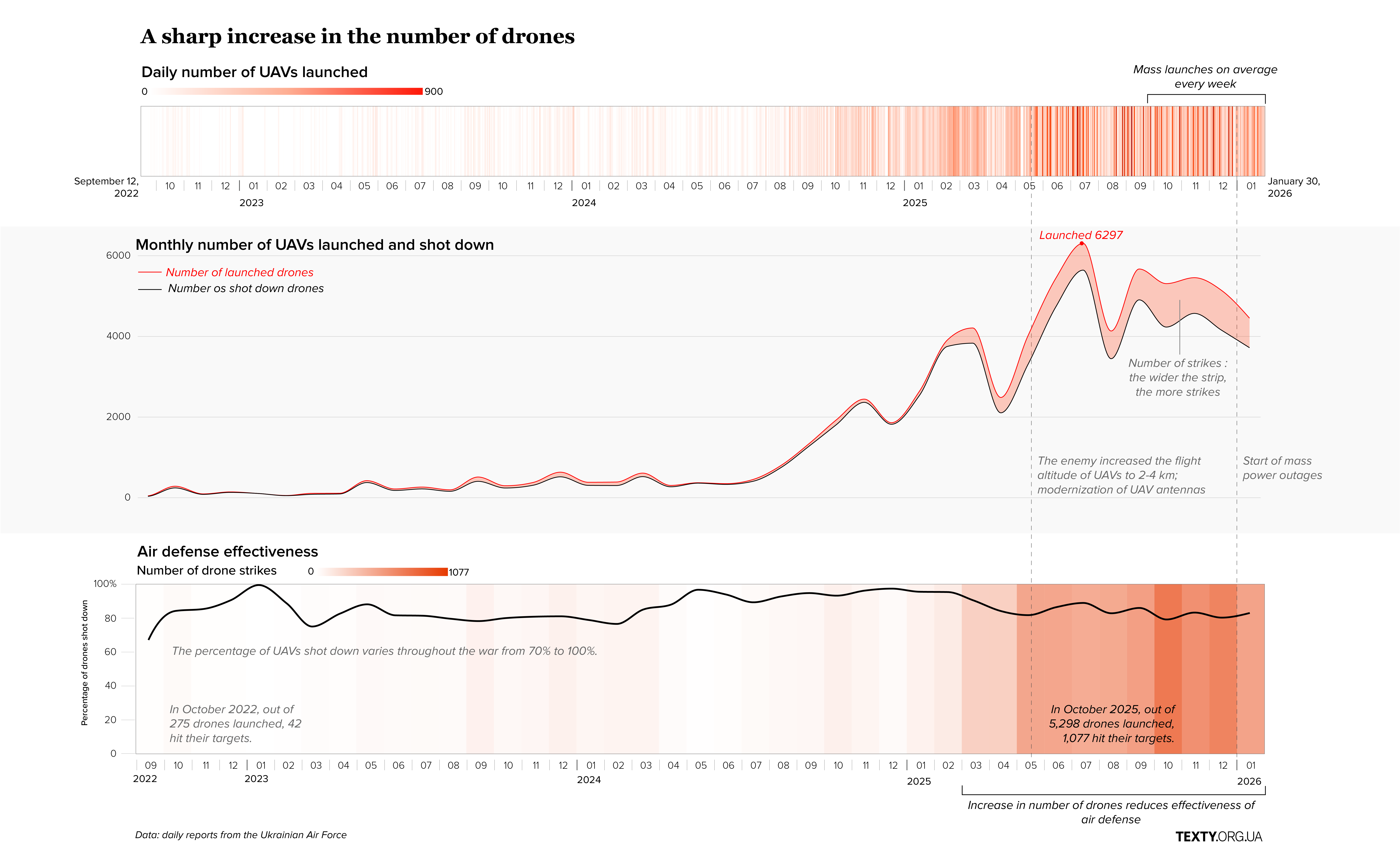
According to summary data from the Ukrainian Air Force, the effectiveness of our air defense is about 80%. But Russia has significantly increased its production. And the 20% that reached their target in the fall of 2022 is significantly less than the same 20% at the beginning of 2026. It was with drones that Russia knocked out our energy system, systematically destroying transformers. Missile strikes on thermal power stations played a supporting role.
Drones are shot down with everything possible — from the ZSU-23-4 self-propelled anti-aircraft gun, better known as the Shilka, and machine guns mounted on pickup trucks to the Gepard anti-aircraft gun tank, helicopters, and sometimes even F-16 fighter jets. Recently, interceptor drones have been deployed. It is worth noting that electronic warfare (EW), in particular, spoofing, that is, the transmission of false GPS signals. There is a constant but hidden and visually ineffective struggle between our EW and drone manufacturers.
The Russians have Kometa — a special antenna that ensures stable drone navigation during jamming and spoofing.
The effectiveness of shooting down depends on the model of antenna installed on the UAV. Therefore, the graph shows significant fluctuations from almost complete interception of all drones to a significant number of missed ones. Today, Russians are massively installing both the latest versions of Russian Kometa and its Chinese counterparts, which greatly complicates the interception of UAVs.
One of the officers of the Ukrainian Air Force recounts:
"The situation changed as follows. Initially, there was a simple 2-channel Kometa. Thanks to our EW, the Shahed drones circled. Some ran out of fuel, some flew to Belarus or elsewhere, and crashed. Accordingly, those Shahed drones that did not hit the target were lost, crashed, and we counted them as shot down in our reports.
Then the 4-channel Kometa appeared, and the Shahed drones began striking the target again. We improved the electronic warfare system, and then the Kometa became six- and eight-channel, twelve- and sixteen-channel.
And each time, the new generation led to a sharp increase in their effectiveness".
Number of missiles launched
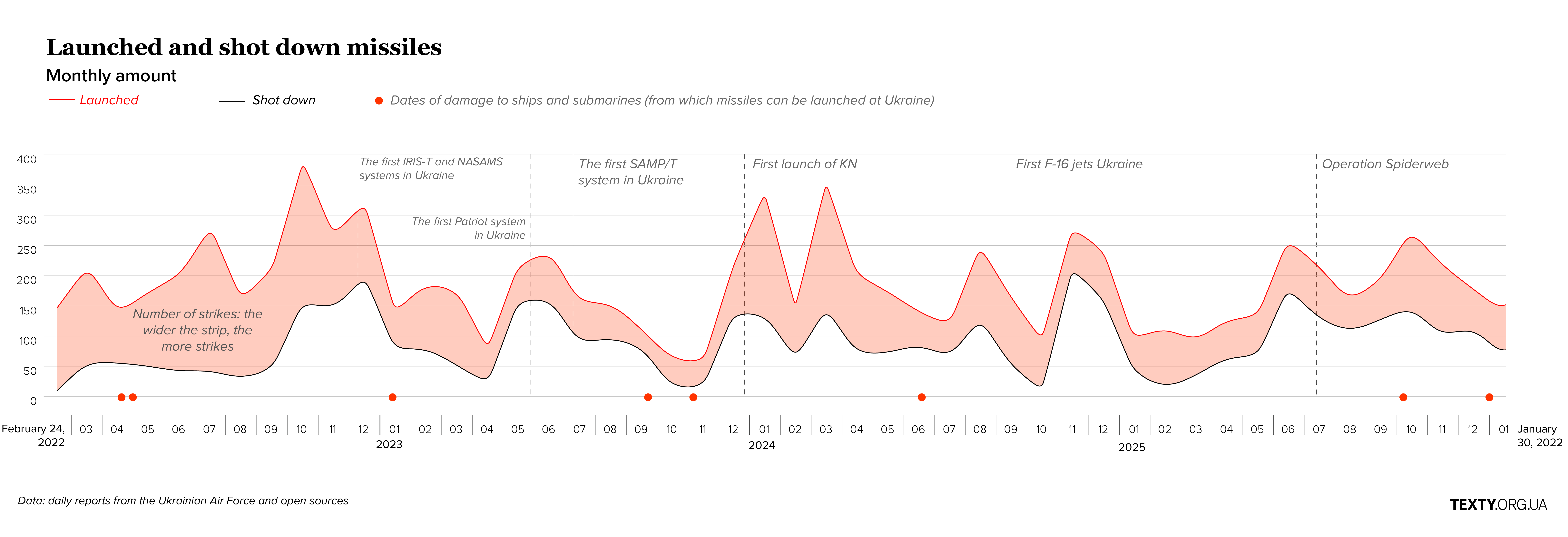
As shown in the graph, the number of missile attacks remains roughly the same. At the beginning of 2026, Russia intensified its massive missile attacks, with the most dangerous ballistic missiles accounting for a significant share.
In January 2026, 91 ballistic missile launches were recorded. This is a sad record for this type of missile during the entire war. Despite all the sanctions, the Russians are developing their production, obtaining hardware from North Korea, China, and Iran. They are also buying a variant of the Iskander ballistic missile, the KN-23, from North Korea.
As for the Oreshnik missiles, which are used to intimidate the entire world and vulnerable civilian populations, experts believe that there are currently three or four of them.
The graph clearly shows that, with the advent of modern Western air defense (primarily Patriot and SAMP/T), the interception rate is increasing. But over time, the Russians are adapting and using modernized missiles that are capable of more nimbly evading even modern air defense.
Sometimes Western military personnel themselves do not expect the results that our calculations show. But the number of missiles shot down depends on whether our air defense batteries have ammunition.
As of February 19, 2026, according to the General Staff of the Armed Forces of Ukraine, the total number of Russian cruise missiles shot down since the start of the full-scale invasion is 4,314.
The graphs show a certain cyclical pattern: accumulation of missiles, attack, accumulation again. Thus, the forecasts are rather disappointing: even though each missile calthoughssians do not take this into account.
Air raid alerts
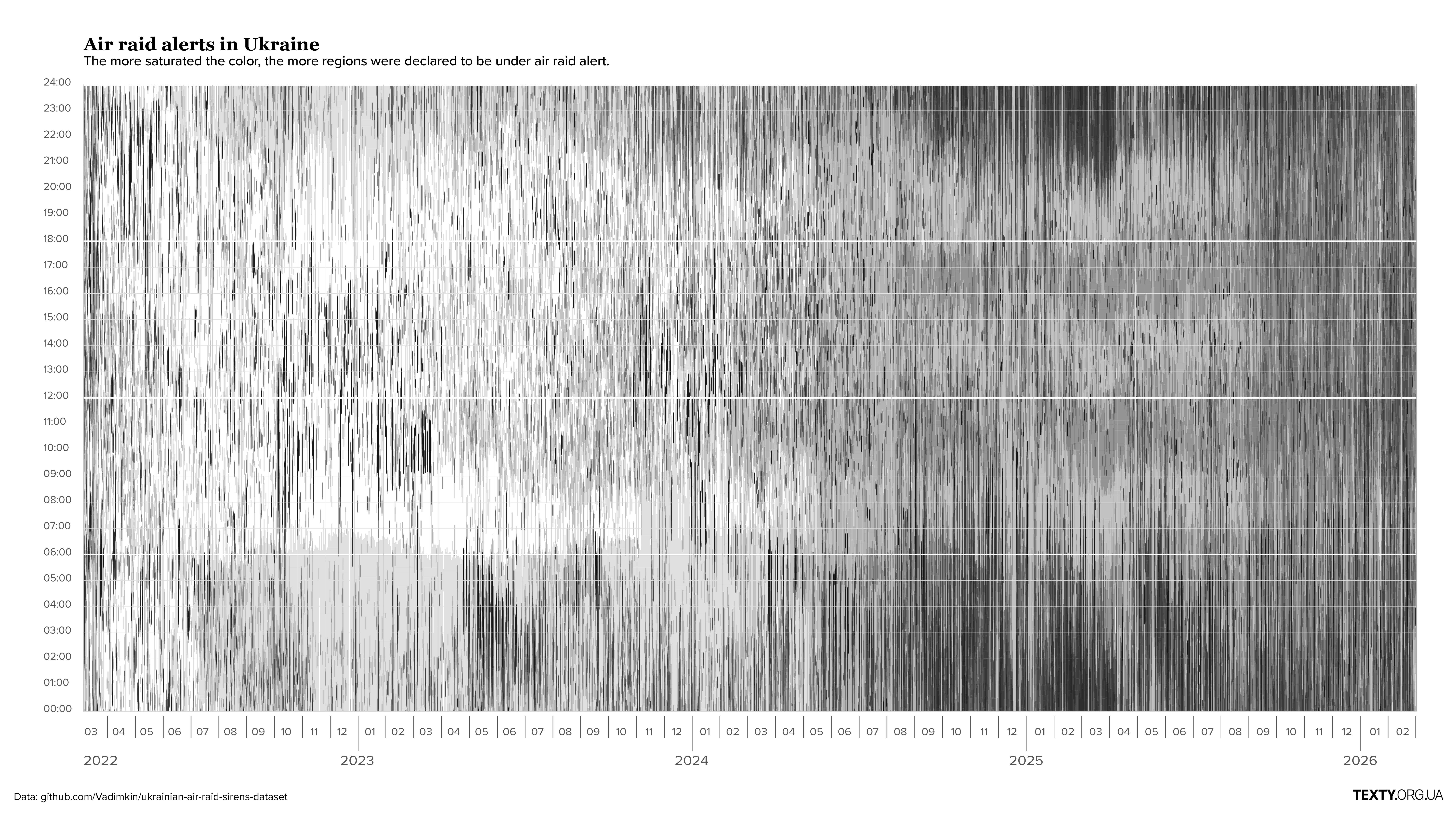
Air raid alerts sound daily in Ukrainian cities, sometimes multiple times a day. People are forced to spend long hours in bomb shelters, hiding from the threat. According to the website air-alarms.in.ua, a total of 74,768 air raid sirens have sounded since February 24, 2022.
The highest number of air raid alerts is recorded in the eastern and southern regions (Kharkiv, Zaporizhzhia, Donetsk), and the longest alerts (over 50 hours) were recorded in the Donetsk and Kharkiv regions.
The grounds for declaring an air raid alert are:
— attacks by UAVs and cruise missiles, when Shahed-type drones or Kalibr-type cruise missiles, X-101, are detected in Ukrainian airspace or approaching our borders;
— ballistic missile threats, when reports are received about the launch of missiles such as Iskander and Kinzhal, requiring immediate bomb shelter for people;
— takeoff of a MiG-31K fighter jet, as this aircraft carries Kh-47M2 Kinzhal aeroballistic missiles capable of striking targets at a distance of up to 2,000 km; due to their high speed and range, an air raid alert is declared throughout the country;
— strategic aviation activity: for example, the takeoff of Tu-95 or Tu-160 bomber, which can carry a large number of high-tech missiles;
— a threat from the Black Sea water area, when missile carriers are brought out of their shelters, and Kalibr missiles are launched or may be launched.
Losses of military equipment
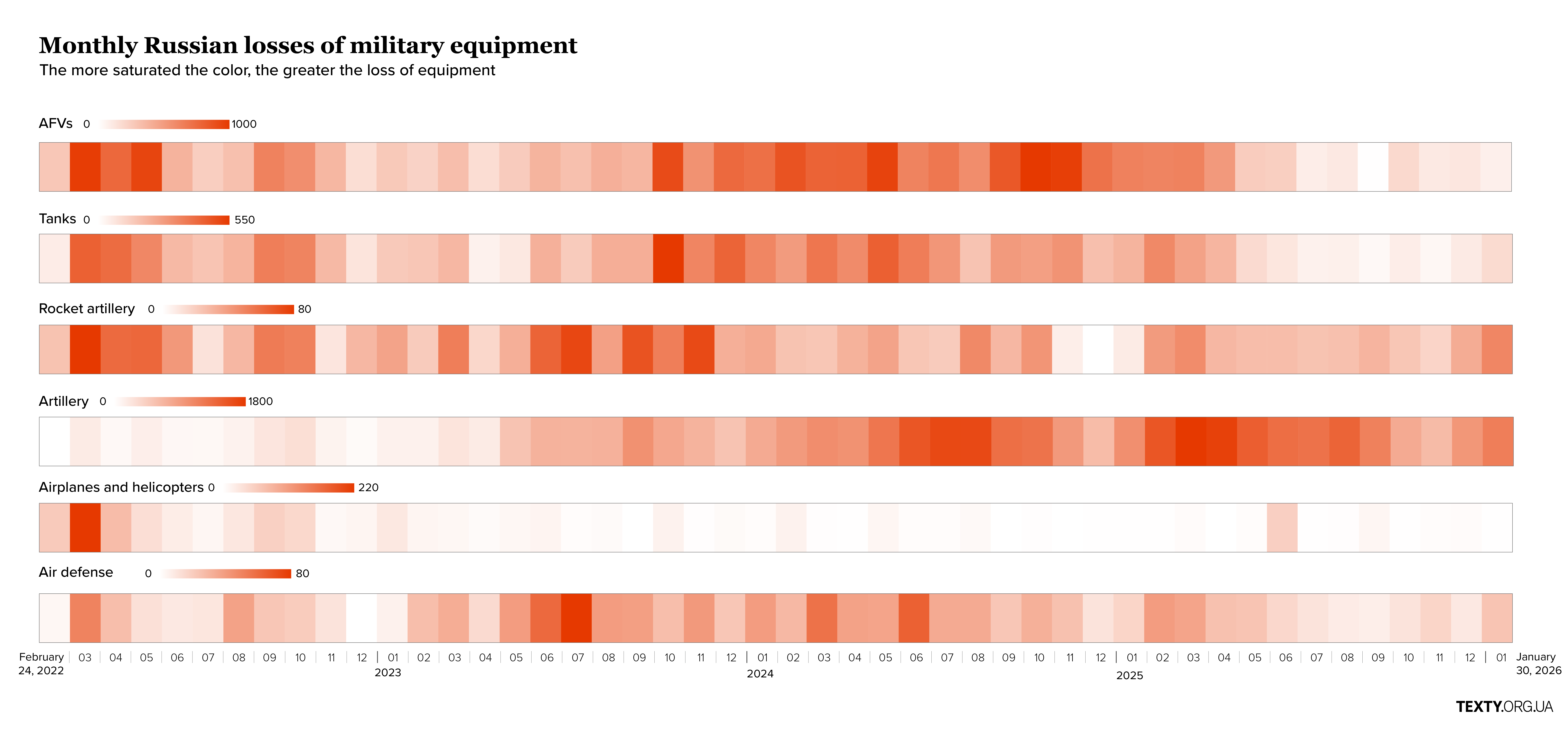
As can be seen, at the end of 2025 and the beginning of 2026, the Russians lost much less military equipment than they did at the beginning of the full-scale invasion.
In the summer of 2025, the Russian army's equipment losses decreased significantly.
This primarily concerns tanks and armored fighting vehicles (AFVs), including armored personnel carriers, infantry fighting vehicles, and airborne combat vehicles. According to data from the OSINT project Oryx, between June and August 2025, the Russians lost 83 tanks and 189 other armored vehicles. In the previous three years of the war, losses in the summer months were as follows: in 2022 — 252 tanks and 411 AFVs, in 2023 — 274 tanks and 468 AFVs, and in 2024 — 268 tanks and 619 AFVs.
What is the reason for the reduction in losses?
Fundamental changes in the conduct of warfare.
According to UAV operators and artillerymen, there is much less equipment on the battlefield and near the line of contact (LOC). The last mass destruction of equipment during the Russian offensive was recorded at the end of 2023, when they stormed the Avdiivka defense node of the Armed Forces of Ukraine, disregarding losses. At that time, the enemy lost hundreds of armored vehicles. After such losses and the massive use of drones, the Russian army switched to infantry assault tactics.
According to the General Staff of the Armed Forces of Ukraine, as of February 19, 2026, the Russians had lost 11,682 tanks, 24,054 AFVs, 4,072 pieces of special equipment, and 79,036 vehicles. Today, their "endless supply of Soviet military equipment" is effectively running out.
What remains in warehouses and storage yards is often in terrible condition. All of this is usually dismantled for spare parts.
But there is no reason to rejoice. Uralvagonzavod (Russia's largest tank manufacturer) produces about 20 new T-90 tanks of various modifications every month, as well as refurbishes about 130 T-72 tanks. Other repair factories are also involved in refurbishing old tanks. The fact that the Russians are not using these tanks right now indicates that they are stockpiling them for future offensive operations.
Enemy advance and losses
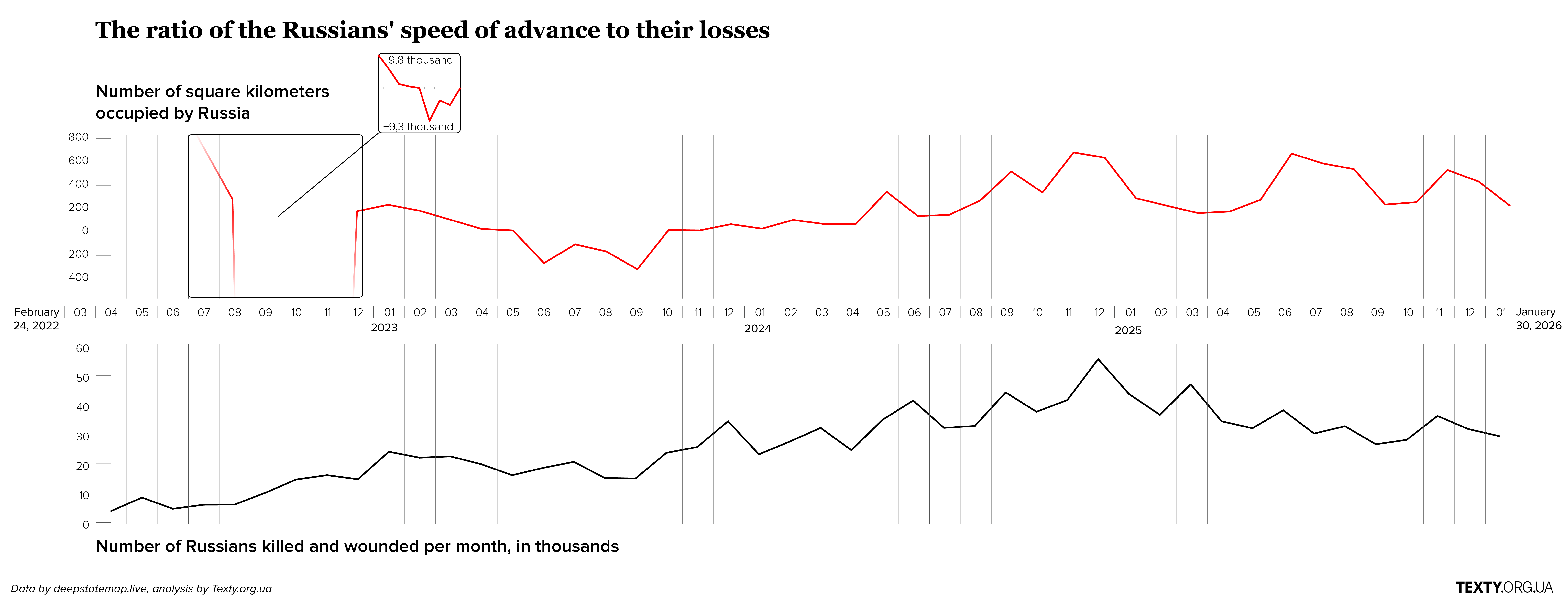
There are two curves on the graph. The upper one shows the pace of the Russians' advance, and the lower one shows their losses. The ideal graph, given the enemy's numerical superiority, would look like this: the upper line would be flat, and the lower line would rise sharply. The situation could be considered "difficult but controllable" if the advance led to greater enemy losses, i.e., if the two lines were synchronized. This was the case in 2024. But since January 2025, the situation has been deteriorating, with the Russians advancing faster and suffering fewer casualties. And last year was very bad, with the death toll rising slightly only in September-October.
Occupied kilometers of Ukraine
According to DeepState, as of February 2026, 116,165 square kilometers of Ukrainian land have been occupied. This is 19.25% of the entire territory of the state as of 1991, or every fifth square kilometer.
In January of this year, the enemy occupied 245 square kilometers of Ukrainian territory, which is almost half as much as in December or November 2025. There has also been a slight decrease in assault activity — 4% less than in December. And the military says that January 2026 was less tense than December 2025.
If we recall the dynamics of the occupation, since February 27, 2014, when the annexation of Crimea began, followed by the war in Donbas, Russia has occupied about 16,000 square kilometers. In 2015–2021, during the "frozen" conflict, the occupation remained at about 7% of the territory with constant shelling along the front line.
After the start of the full-scale invasion and capture of Kherson, Mariupol, and part of the Kharkiv region, more than 25% of Ukrainian territory fell under occupation. Still, the Ukrainian Armed Forces' autumn counter-attack in 2022 returned part of the land.
According to DeepState, between 2023 and 2025, losses amounted to several thousand square kilometers in Donetsk, Zaporizhzhia, Sumy, and Kharkiv regions. However, counter-attacks by the Armed Forces of Ukraine in certain areas of the front line are pushing back the Russians, and the area of occupied territories is changing, but not significantly so far.
Number of Russians killed and wounded
As of February 2026, it is difficult to give an exact figure for the occupiers' losses, as different sources give different estimates. However, it is possible to determine an approximate range based on figures provided by the General Staff of the Armed Forces of Ukraine, the CSIS (Center for Strategic and International Studies), and the Russians themselves.
Russia's total losses as of 2026:
≈1,257,000 people in total — this is the official estimate of the General Staff of the Armed Forces of Ukraine (killed, wounded, missing, and captured together). CSIS and Western intelligence analysts give a slightly different figure — ≈1,200,000 casualties.
This means that Russia's total losses amount to 1.0–1.3 million people. According to various estimates, between 300,000 and 400,000 Russians have been killed.
Why is there such a big difference? First, Russia conceals its losses and officially publishes almost no figures on "casualties in the special military operation." In addition, the lightly wounded are often not counted, and a significant number of wounded and exchanged prisoners return to the front.
Furthermore, according to our military, many bodies from both sides remain on the battlefield, especially during large battles (near Bakhmut, Avdiivka).
The dynamics of losses fluctuate depending on escalations on the front line and, accordingly, the large number of occupiers disposed of.

Підпишіться, щоб отримувати найкращі статті на e-mail (раз на два тижні)

Підписатися